Law explainer · NSW Tint Law
NSW window tint laws: the legal limit for every window, explained
How dark you can go on each window in NSW, how the limit is measured, and what happens at a pink slip if your tint is too dark.
Written and reviewed by Mohammad Habboushi, Founder of Tinting Xperts
· 11 min read

Key takeaways
- On a NSW passenger car, the front side windows must let through at least 35% of light, measured through the glass and film together.
- With an exterior mirror on each side, the rear side windows and rear windscreen can go down to 20%.
- The windscreen can only carry a tinted band across the top, and every tint must reflect no more than 10% of light.
- Tint is checked at the yearly pink slip inspection, and a car that fails can be issued a Defect Notice.
- Factory privacy glass counts: film on top of it must still leave the combined reading inside the limit.
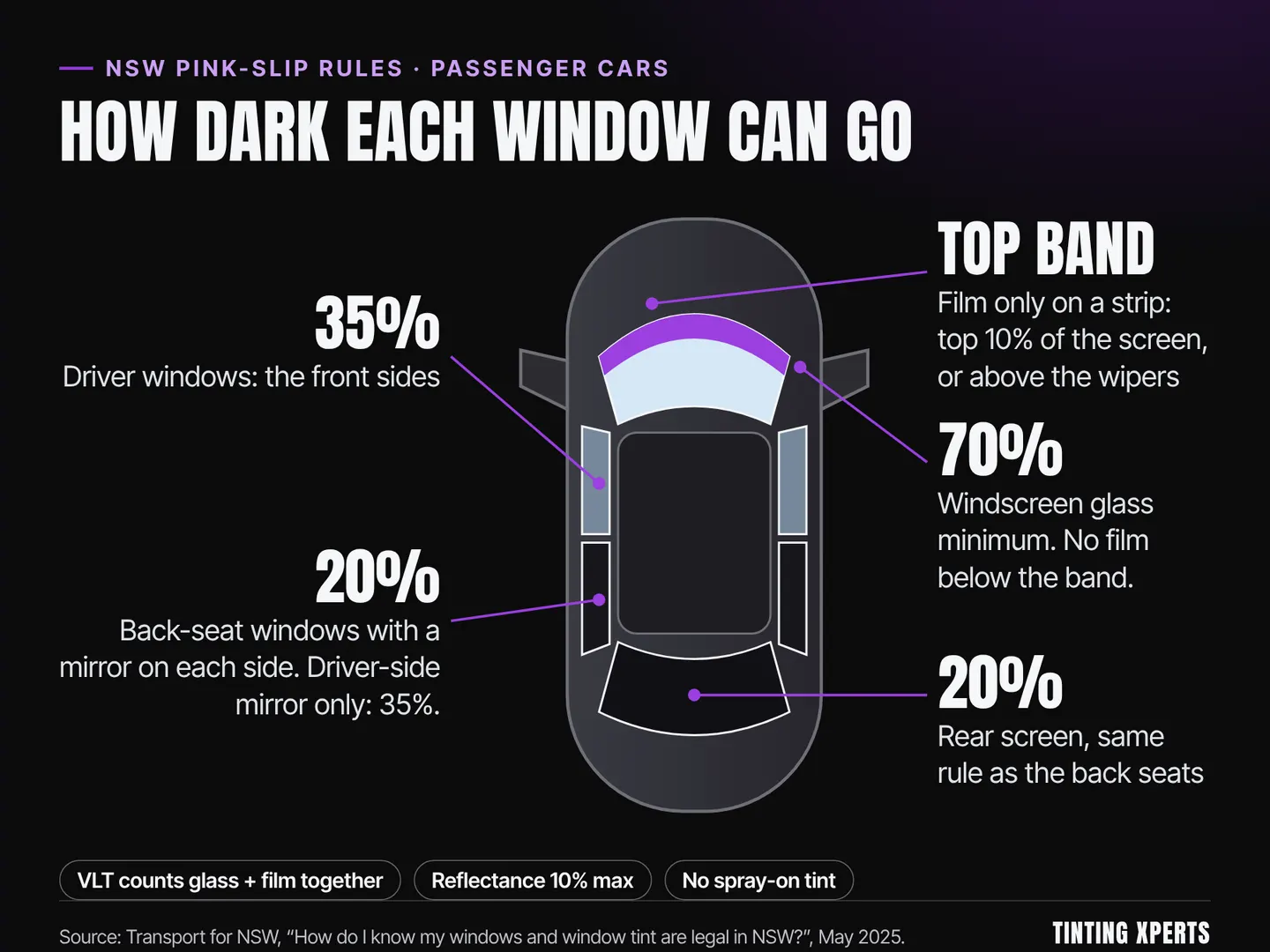
NSW window tint laws set a minimum amount of light each window must let through. On a passenger car, the front side windows need at least 35%, and the rear side and rear windows at least 20% if you have a mirror on each side.[1] The windscreen can only have a strip across the top.
Those limits are measured through the glass and the film together, not the film on its own. That one detail is behind most failed pink slips. This guide covers every window, the exceptions, what happens if your tint is too dark, and how to check a car before you buy it.
NSW window tint laws at a glance
Transport for NSW splits a car's glass into three groups. The driver windows are the side windows in line with the driver, on both sides of the car. The rear windows are everything behind the driver: the back-seat side windows, the rear windscreen and any quarter glass.[1] The windscreen is its own group.
| Window | Minimum VLT | Notes |
|---|---|---|
| Windscreen | 70% | No film, except a tinted or opaque band across the top[1] |
| Front side (driver) windows | 35% | Applies to both front doors |
| Rear side windows and rear windscreen | 20% | Only if the car has a rear-vision mirror on each side |
| Rear windows, driver-side mirror only | 35% | The rear must match the front |
| Any window, reflectance | No more than 10% reflected | Mirror-like film is not allowed |
35%
The least light a NSW front side window may let through, measured through the glass and film together[1]
If you only remember one rule, make it the front windows. They are the ones an inspector or police officer looks through first, and they are where a too-dark film shows up straight away.
What VLT means, and why the film's number isn't the final number
VLT stands for visible light transmittance. It is the percentage of visible light a window lets through. A window at 0% lets no light through, and the lower the number, the darker the glass.[1] So a 20% tint is darker than a 35% tint.[1]
The legal limit applies to the finished window. Western Australia's transport department puts it neatly: a 35% reading means 35% of the light passes through both the window and the tint together.[2] NSW measures it the same way.
All windows to the side and ahead of the driver in the normal driving position, other than the windscreen, may have a film fitted provided that the resulting VLT is 35% or more.[3]
That matters because most car glass is not perfectly clear. VicRoads notes that the glass in many new vehicles is made with a slight tint, so film should be chosen so the window does not fall below the limit.[3] The darkness of the glass and the film multiply. For example, film that passes 35% of light, fitted to glass that passes 80%, leaves roughly 28%. That is under the front limit.[2]
Factory privacy glass
Many SUVs and wagons leave the factory with dark rear glass. Transport for NSW calls this privacy glass. It is allowed because it is part of the manufacturer's approval to sell the car in Australia, even when it is darker than the film limits.[1] The catch comes when you add film over it.
The rule for adding film over privacy glass is the same as for clear glass: the glass and the film together must stay within the limit. Transport for NSW adds that if the privacy glass is already darker than the limit, no film can be applied to it at all.[1] A good installer will tell you that before cutting any film, rather than after.
Window by window: what NSW allows
Front side windows
The driver and front passenger windows must let through at least 35% of light.[1] This is the darkest legal tint for the front of a NSW car.
Rear side windows and rear windscreen
Behind the driver, a passenger car with a rear-vision mirror on each side can go down to 20%.[1] That covers the back-seat side windows, the rear windscreen and any small quarter windows. A darker rear shade adds privacy and keeps sun off passengers in the back.
The windscreen
Windscreen glass must let through at least 70% of light and cannot be covered in film.[1] The only exception is a tinted or opaque band across the top. The band can cover no more than 10% of the windscreen's height, or the area above the wiper sweep, whichever is greater.[1] Full windscreen tint is not legal in NSW.
Cars with only a driver-side mirror
If your car has an exterior mirror on the driver's side only, the rear windows must let through at least 35%, the same as the front.[1] The darker rear limit depends on side mirrors, which let you see behind you when the rear glass is dark.
Utes, vans, trucks and buses
Commercial vehicles, trucks and heavy buses follow the same windscreen rule. Their driver windows need at least 35% light.[1] For windows behind the driver, Transport for NSW specifies no minimum, so a van's rear glass can be very dark.[1]
Light buses are different. A bus with 10 or more seats and a gross vehicle mass of 4500 kg or less follows the car limits: 20% at the rear with two mirrors, or 35% with only a driver-side mirror.[1] Emergency exit windows on public passenger buses must not be coated without approval from an Approved Vehicle Examiner.[1]
Cars first registered before 1 August 1994
Older cars get some leeway. On a car first registered on or before 1 August 1994, the rear and driver windows may be darker than the current limits, as long as the tint was fitted before that date.[1] The windscreen rule still applies in full. New tint on an older car must meet today's limits.
Reflective, mirror and spray-on tint
Darkness is not the only test. Transport for NSW lists these as not allowed on your windows:[1]
Mirror-like film that is too reflective. Film on glass must not reflect more than 10% of light.[1]
Spray-on tinting or finishes.
Window film that is darker than the limit for that window.
Damaged tint that impairs the driver's visibility, such as bubbling, peeling or scratched film.
The reflectance rule exists because a mirror finish can dazzle other drivers with reflected sun or headlights.[2] The ceramic film we fit isn't mirror-like, so the rule mostly catches metallic films and novelty finishes. Damaged tint is worth fixing for the same reason: it is a pink slip item even when the shade is legal.
What happens if your tint is too dark
It fails the pink slip
Transport for NSW says window tint is checked at your yearly pink slip inspection.[1] If a window reads under its limit, the car fails until the film is removed or replaced. That means paying for removal and new film, then going back for the inspection.
You can be issued a Defect Notice
Your car must be roadworthy and meet the standards required by law to be registered in NSW. Service NSW says that if your vehicle is not safe to drive, you could be issued a Defect Notice, and you must repair it by the due date on the notice.[4] Once the repair is done and inspected, the notice is cleared through Service NSW.[4]
Illegal tint can also lead to a fine. We don't quote amounts in this guide because they change. Transport for NSW or NSW Police can tell you the current position.
Your insurance can be affected
Tint is a modification, and insurers expect to hear about modifications. One specialist insurer lists window tint darker than your state allows as an example of an illegal modification.[5] It warns that illegal or undeclared modifications can void a policy, reduce payouts or lead to declined claims.[5]
The practical steps are simple. Keep the tint legal, tell your insurer about it, and keep the invoice that shows the film and shade. Read your own policy wording, because insurers handle this differently.
Can you get a medical exemption for darker tint in NSW?
Some people with light-sensitive conditions ask whether a doctor's letter allows darker film. Transport for NSW's tint fact sheet does not describe a medical exemption, and we couldn't confirm a published NSW process.[1] Other states differ: Western Australia says exemptions may be granted on medical grounds with evidence from a medical specialist.[2]
If this applies to you, ask Transport for NSW before you tint. Its fact sheet lists Technical Enquiries at technical.enquiries@transport.nsw.gov.au or 1300 137 302.[1] Get any approval in writing and keep it in the car. Don't rely on a tint shop's word, including ours.
How a tint shop measures VLT
A tint meter shines light from one side of the glass to a sensor on the other. Instrument Choice, which sells them, says its meters use a beam at 550 nanometres and give the reading as VLT.[6] Horseshoe meters slide over a side window. Two-piece meters with magnetic probes can also read windscreens and rear glass.[6]
The same tools are used by police to check tint and by workshops to make sure custom tint is legal.[6] At Tinting Xperts we check the shade against NSW limits before fitting, and we show you the film on your own glass first. If a shade won't pass on your car, you hear it from us before any film is cut.
Buying a car with tint already on it
Second-hand cars often come with tint fitted by an earlier owner, and nobody knows what shade was used. You become responsible for it the day you register the car. A few checks before you hand over money will save you a failed pink slip.
Look at the front windows in daylight
Stand outside and look in through the front side windows. If you can't see the driver's seat clearly, the tint may be under the 35% front limit.[1] Compare the front and rear glass: they shouldn't look the same if the rear is at a legal 20%.[1]
Check the film's condition
Look for bubbling, peeling edges, purple discolouration and scratches. Damaged tint that affects the driver's view is not allowed, whatever its shade.[1]
Ask for a meter reading
Ask the seller for a recent pink slip or ask a tint shop to read the windows with a meter. A reading takes moments and tells you the combined light through glass and film.[6]
Price in the fix
If the tint is too dark or damaged, allow for removal and new film before you agree on a price. Ask the tint shop to quote removal and refit together.
Window tint laws in other states
The headline numbers are close to national. Victoria, Queensland and Western Australia publish the same front and rear limits as NSW, and they also cap reflectance at 10%.[3][7][2] The details around them differ, so check the rules where the car is registered.
| State | Front side windows | Rear side and rear windows | Where it comes from |
|---|---|---|---|
| NSW | 35% | 20% | Transport for NSW fact sheet[1] |
| Victoria | 35% | 20% | VicRoads VSI 2[3] |
| Queensland | Greater than 35% | Greater than 20% | RACQ summary of Queensland rules[7] |
| Western Australia | 35% forward of the B-pillar | 20% behind the B-pillar | Department of Transport bulletin IB-119D[2] |
We could only open official or motoring-body pages for the states above, so the table stops there. If your car is registered elsewhere, ask that state's transport authority. Rules on exemptions also vary: Western Australia, for example, lets vans with factory metal panels behind the B-pillar go down to 0% on the rear glass.[2]
How we keep your tint legal
Every car window tinting job at our Revesby workshop and our Condell Park workshop starts with the law. We show you film on your own glass, explain the limits for each window, and check the shade before fitting. The film is plotter-cut to your car and fitted in-house, with a lifetime tint warranty.
If you want the most heat rejection from a legal shade, look at ceramic window tinting. Ceramic film rejects heat with its material, not its darkness, so a legal front shade still keeps the cabin cooler. Our guide to window tint percentages shows what each shade looks like, and ceramic vs carbon tint compares the film types.
Our service
We tint cars at two workshops in south-west Sydney. You choose from three ceramic film grades, we check every shade against the NSW limits on your glass, and most cars are done in two to four hours with a lifetime warranty on the tint.
Frequently asked questions
What is the darkest legal tint in NSW?
On a passenger car with a mirror on each side, 35% on the front side windows and 20% on the rear side windows and rear windscreen.[1] Both figures are measured through the glass and film together. The windscreen can only have a strip across the top.
Is 20% tint legal in NSW?
Yes on the rear side windows and rear windscreen, if the car has an exterior mirror on each side. No on the front side windows, which must let through at least 35%.[1] A 20% film on the front doors will fail a pink slip.[1]
Can I tint my windscreen in NSW?
Only with a band across the top. The band can cover no more than 10% of the windscreen's height, or the area above the wiper sweep, whichever is greater.[1] The rest of the windscreen must let through at least 70% of light, with no film on it.[1]
Does factory tinted glass count towards the limit?
Yes. Transport for NSW says the combined VLT of privacy glass plus any film must be within the limits.[1] If the factory glass is already darker than the limit, no film can be added to it.
Will illegal tint fail a pink slip in NSW?
Yes. Transport for NSW says window tint is checked at the yearly pink slip inspection.[1] Tint that is too dark, too reflective or damaged enough to affect the driver's view will fail until it is fixed.
Are the rules different for utes and vans?
For commercial vehicles, the windscreen rule and the 35% driver-window limit still apply.[1] Transport for NSW sets no minimum for windows behind the driver on commercial vehicles, trucks and heavy buses.
Can I get a medical exemption for darker tint in NSW?
We couldn't find a published NSW medical exemption process, and Transport for NSW's tint fact sheet doesn't describe one.[1] Ask Transport for NSW Technical Enquiries before tinting, and get any approval in writing.
Not sure what your car can take? Send us the make and model and we'll tell you the legal shades for each window before you book. For what to expect after fitting, read how long window tint takes to cure.
Sources
- [1]Transport for NSW. How do I know my windows and window tint are legal in NSW?, 2025-05. ↑
- [2]Department of Transport and Major Infrastructure, Western Australia. IB-119D Vehicle Safety and Standards Bulletin: Window Tinting, 2025-10. ↑
- [3]VicRoads. Vehicle Standards Information 2: Window tinting and films, 2021-10. ↑
- [4]Service NSW. Get help with a vehicle Defect Notice, 2025-05. ↑
- [5]National Cover. Car Modifications and Insurance: What To Know In Australia, 2025-10. ↑
- [6]Instrument Choice. How do tint meters work and where are they used?, 2026. ↑
- [7]RACQ. How dark can your car window tint be?, 2022-05. ↑
About the author
Founder, Tinting Xperts
Mohammad Habboushi founded Tinting Xperts in 2016 with one bay, one squeegee and a rule the team still works to: if it isn't right, it doesn't leave. The business has grown to two workshops, at Revesby and Condell Park, and a team of more than 30 fitters, and Mohammad still fits cars on the floor most days.


