Comparison · Window Tinting
Ceramic vs carbon tint: which window film keeps your car cooler?
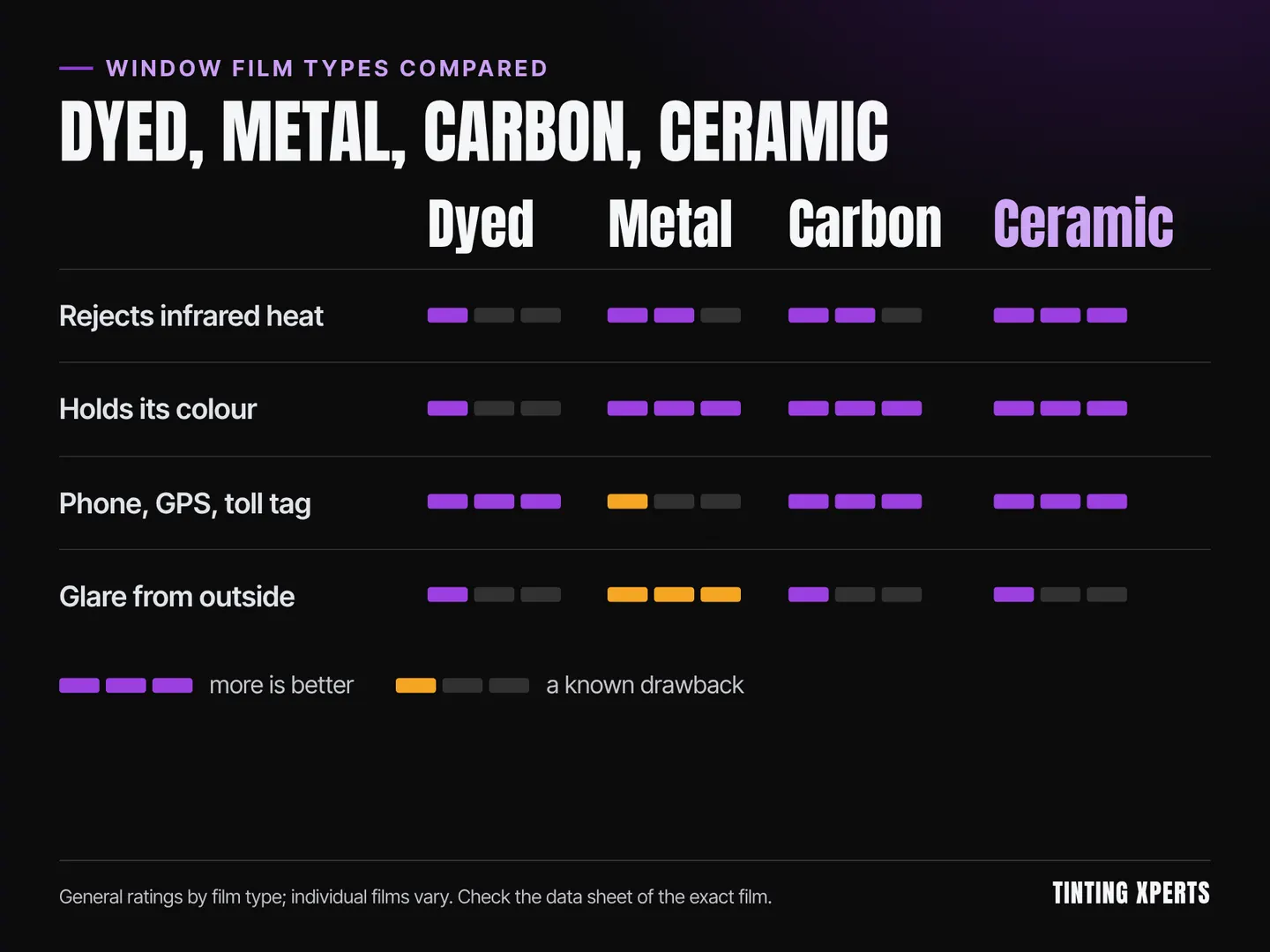
Both films block UV, hold their colour and leave your phone signal alone, so the real difference is how much heat each one stops at a legal shade.
Written and reviewed by Mohammad Habboushi, Founder of Tinting Xperts
· 12 min read

Key takeaways
- Carbon and ceramic films both block over 99% of UV and neither contains metal, so neither interferes with phones or GPS.
- Ceramic film rejects far more infrared heat: on one maker's sheet, its ceramic 35 shade rejects 57% of solar energy against 38% for its carbon 35.
- Carbon's heat rejection mostly rises with darkness, while a ceramic film's infrared rejection stays high even at light shades.
- Both are colour-stable and won't turn purple like old dyed film.
- Choose ceramic if heat is the reason you're tinting; choose carbon or carbon ceramic for a deep matte look on a tighter budget.
Ceramic vs carbon tint comes down to heat. Both films block UV, hold their colour and contain no metal, so neither upsets your phone or GPS. Ceramic film rejects much more of the sun's infrared heat at the same shade, and looks clearer. Carbon gives a deep matte look for less. For a hot cabin, ceramic does more.
This guide puts the two side by side using the makers' own published figures, not sales talk. It covers heat, UV, clarity, signal, fading and looks, then tells you which film suits which driver. If you already know you want the cooler option, our ceramic window tinting page explains how we fit it.
Ceramic vs carbon tint: the side-by-side comparison
Here is the short version. The figures in the heat row come from one manufacturer's specification sheet, so both films were measured the same way on the same glass.
| Criterion | Carbon tint | Ceramic tint |
|---|---|---|
| What's in the film | Carbon particles instead of dyes | Non-metallic, non-conductive ceramic particles |
| Total solar energy rejected at about 35% VLT | 38% (SunTek Carbon 35) | 57% (SunTek Evolve 35) |
| Heat rejection at light shades | Drops as the shade gets lighter | Infrared rejection stays high at every shade |
| UV blocked | Over 99% | Over 99% |
| Phone, GPS and radio signal | No interference: no metal | No interference: no metal |
| Colour over time | Colour-stable; won't turn purple | Colour-stable; won't turn purple |
| Clarity | Good; larger particles can add slight haze | Very clear, especially nano-ceramic |
| Look | Deep, matte, non-reflective black | Neutral, clear-looking tint |
| Relative cost | Usually lower | Usually higher |
The heat and UV figures are from SunTek's automotive specification sheet, measured on 6 mm clear glass.[1] The descriptions of each film's make-up come from SunTek, 3M and the RACQ, and are covered in detail below.[2][3]
What carbon tint is
Carbon tint is a polyester window film coloured with fine carbon particles. SunTek says its carbon films are made with carbon particles rather than simple dyes, and describes them as non-reflective with an attractive appearance.[2] 3M calls its version nano-carbon and says the carbon is dispersed throughout the thickness of the film.[4]
That construction is what makes carbon film last. Old dyed films faded and went purple in the sun. The RACQ says carbon films are similar to dye films but offer the colour stability that old dye technologies are missing.[3] The film maker puts it more bluntly:
Since the nano-carbon is dispersed throughout the thickness of the film, it ensures years of performance with no chance of the film turning purple.
Where carbon falls short
Carbon's weak point is heat. Most of its heat control comes from how dark it is. On SunTek's sheet, its Carbon 70 shade rejects 27% of total solar energy and its darkest Carbon 5 rejects 46%.[1] So to get more heat rejection from carbon, you mostly have to go darker, and the law limits how dark you can go.
There's also a small clarity cost. The RACQ notes potential haziness due to the size of the carbon particles used to make the film.[3] Most people never notice it on side windows, but it can show when you look through the glass at an angle.
What ceramic tint is
Ceramic tint uses ceramic particles to block infrared light, the part of sunlight you feel as heat. The RACQ says ceramic films are made from particles that are non-conductive and non-metallic.[3] SunTek describes its ceramic range as a nano-ceramic construction with no metal content.[5]
Why does infrared matter so much? Because you can't see it, a film can block a lot of it without looking dark. The RACQ says ceramic films block a large share of infrared radiation, which makes up about half of the heat you feel from the sun.[3] 3M describes infrared rays as primarily responsible for the heat you feel when driving.[4]
Ceramic and nano-ceramic: what the names mean
"Nano-ceramic" describes how fine and even the particles are. The RACQ says the best ceramic films are nano-ceramic films with the smallest and most uniform particle size.[3] Smaller particles mean less scattered light, so the glass looks clearer. 3M markets its Ceramic IR range as nano-ceramic technology with up to 95% infrared rejection.[6] If heat is your main reason for tinting, see our nano-ceramic window tinting page.
Carbon ceramic: the hybrid in between
Some films combine both. Carbon ceramic film pairs a carbon layer for a deep, even, matte look with ceramic technology for extra heat rejection. SunTek's version of the idea is its CXP range, which it calls non-metal, nano-hybrid carbon technology.[2] On SunTek's sheet, CXP 35 rejects 53% of total solar energy, much closer to its ceramic films than to plain carbon.[1]
It suits drivers who like the carbon look but want more heat control than plain carbon gives. We fit it too: see carbon ceramic window tinting.
Heat rejection: the numbers that matter
Tint spec sheets are full of acronyms. Three of them tell you most of what you need to know about heat:
VLT (visible light transmitted) is how much light gets through. The lower the number, the darker the window.[4]
TSER (total solar energy rejected) is the share of all the sun's energy the filmed glass keeps out. 3M explains it simply: the higher this value, the less solar heat is transmitted.[4]
IRER (infrared energy rejection) measures infrared across a wide band, counting the heat the film absorbs and re-radiates into the car.[4] SunTek calls it a more complete measurement of the heat you feel from solar infrared.[1]
Be wary of a single "IR rejection" figure on its own. Some brands measure it at one narrow band of wavelengths, which gives a big number that doesn't match what you feel. 3M, for example, measures its IRR figure over 900–1,000 nm only.[4] TSER and IRER give the fairer picture.
| Film | Type | Visible light through | Total solar energy rejected | Infrared energy rejected (IRER) |
|---|---|---|---|---|
| Carbon 35 Black | Carbon | 36% | 38% | Not published[1] |
| CXP 35 Black | Nano-hybrid carbon | 33% | 53% | 55% |
| CIR 30 Black | Ceramic | 33% | 55% | 59% |
| Evolve 35 | Nano-ceramic | 38% | 57% | 64% |
All four films let through a similar amount of light, yet the ceramic films keep out roughly half as much heat again as plain carbon.[1] That gap is the whole argument for ceramic.
50% vs 46%
Total solar energy rejected by SunTek's near-clear Evolve 70 ceramic film (65% VLT) and its darkest Carbon 5 film (5% VLT)[1]
Why ceramic works at light shades
Look across a whole range and the pattern is clear. SunTek's Evolve nano-ceramic films hold their infrared energy rejection at 64–65% from the darkest shade to the lightest.[1] 3M's Ceramic IR range does the same, at 66–67% across every shade from IR 5 to IR 70.[6] The film's ceramic layer does the heat work, so you choose the shade for looks, privacy and the law.
Carbon behaves differently. 3M's nano-carbon Color Stable film rejects 70% of infrared in its narrow-band measure at its darkest shade, but only 27% at its lightest.[4] With carbon, light shades give up most of the heat benefit.
What the spec sheet can't tell you
Spec figures are measured on a flat test panel, not your car. SunTek notes that actual performance will vary with factors including glass type and properties.[1] Factory-tinted glass, the angle of the sun and the colour of your interior all change what you feel. The ranking holds, though: at the same shade, ceramic keeps more heat out than carbon.
UV protection: a tie
On UV, there's nothing between them. SunTek's Carbon 35 and Evolve 35 nano-ceramic both block over 99% of UV.[1] 3M lists its nano-carbon film at 98–99% and its ceramic film at 99.6–99.9%, depending on shade.[4][6]
That matters more than most people think. Cancer Council Australia says the tempered glass used in car side and rear windows can let through as much as 79% of UVA.[7] It says films can cut UV through tempered glass by over 99%, but only while the windows are closed.[7] So for UV alone, any quality carbon or ceramic film does the job.
Clarity, glare and night driving
Glare depends on the shade, not the film type. SunTek's Carbon 35 cuts glare by 59% and its Evolve 35 nano-ceramic by 57%.[1] At the same darkness, both make bright days equally comfortable.
Night driving is where the film type matters indirectly. Because ceramic rejects heat without needing to be dark, you can pick a lighter shade and still get a cool cabin. A lighter shade is easier to see through on unlit roads and when reversing. SunTek also says its ceramic tint can help reduce the distractions of headlights and streetlight glare.[5] Our guide to window tint percentages shows how each shade looks after dark.
Clarity is the other point. The RACQ credits ceramic films with higher optical clarity, while noting that carbon's larger particles can add slight haze.[3] On a windscreen strip or a car you look through at an angle every day, that difference is worth having.
Phone, GPS and radio signal
Neither film should affect your signal. The old problem was metallised film: the RACQ notes that metals are known to interfere with radio and cellular signals.[3] Carbon and ceramic films leave the metal out.
3M says its nano-carbon Color Stable film is non-metallised and won't interfere with mobile devices, GPS or satellite radio.[4] It says its Ceramic IR technology is compatible with 5G devices.[6] SunTek calls both its carbon and ceramic ranges signal-friendly.[2][5] If signal is your worry, either film is fine. Just avoid cheap metallised film.
Fading, colour and how long they last
Both films hold their colour. The purple, bubbled tint you see on old cars is usually dyed film. The RACQ says previous dye technologies fade or turn purple over time, while carbon films offer the colour stability those dyes lacked.[3]
The makers back this with warranties. SunTek covers its carbon films with a lifetime limited warranty that includes protection against colour change.[2] 3M gives both its Color Stable and Ceramic IR ranges a limited lifetime warranty, and sells them through its authorised dealer installers.[4][6] Whichever film you choose, every tint job we fit comes with a lifetime tint warranty.
The look: matte carbon or neutral ceramic
This is the one area where carbon has a real edge for some owners. SunTek describes carbon as non-reflective with an attractive appearance, and 3M says its nano-carbon film rivals tinted factory glass in its rich appearance.[2][4] It gives a deep, even black that suits dark cars and sporty builds.
Ceramic films tend to look more neutral. 3M describes its Ceramic IR as an attractive neutral colour.[6] Neither looks like a mirror. SunTek's Carbon 35 and Evolve 35 both reflect 6% of visible light.[1] That's well inside the NSW limit, which says film must not reflect more than 10% of light.[8]
Which should you choose?
If a hot cabin is the reason you're tinting
Choose ceramic. The spec sheets show it keeps far more heat out at the same shade.[1] Cars parked outside all day, cars with big rear glass, and anyone with kids or a dog in the back will notice it most. If you want the most heat rejection from a light, legal shade, go for nano-ceramic.
If you want a dark, matte look on a tighter budget
Carbon is a solid film. It blocks UV as well as ceramic, won't fade or turn purple, and leaves your signal alone.[1][2] Carbon ceramic sits between the two if you like the carbon look but want more heat control.
If your car already has privacy glass
Many SUVs come with dark rear glass from the factory. Transport for NSW says the combined VLT of the privacy glass plus any film must stay within the legal limit.[8] That rules out adding much darkness, so you want heat rejection without extra shade. The RACQ calls ceramic film the best option for privacy glass.[3] Our guide to NSW window tint laws explains how privacy glass is measured.
If you mostly drive at night
Pick a lighter shade and let ceramic do the heat work. On a NSW passenger car, the front side windows can't go below 35% anyway.[8] A ceramic film at a lighter shade keeps the view out clear after dark.
Our service
Our ceramic window film (IR70) stops around 70% of the infrared heat that comes through your glass, blocks almost all UV and has no metal to upset your phone or GPS. We fit it to NSW-legal shades at Revesby and Condell Park, usually in a single visit.
Our service
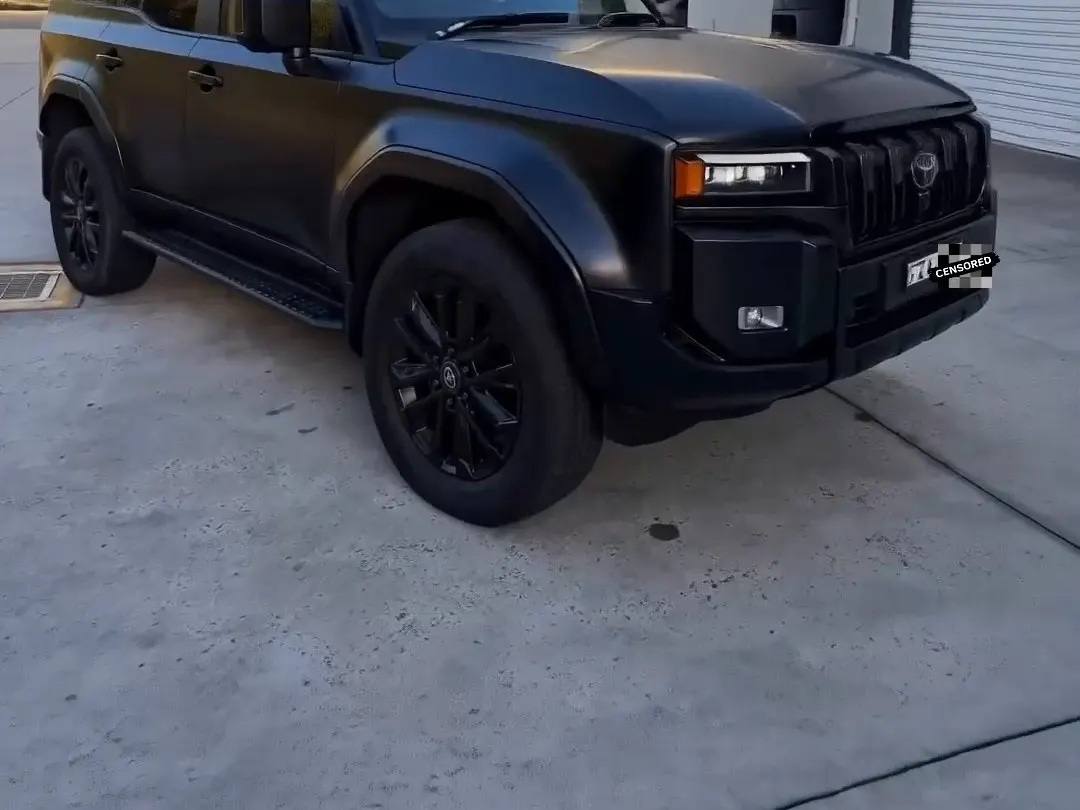
Carbon ceramic window tint is our IR50 film: a deep, matte, non-reflective black that holds its colour, with a ceramic layer that rejects around 50% of infrared heat. It's the best-value way to get a dark, even, legal look on any car, fitted in-house with a lifetime tint warranty.
How we fit ceramic and carbon tint
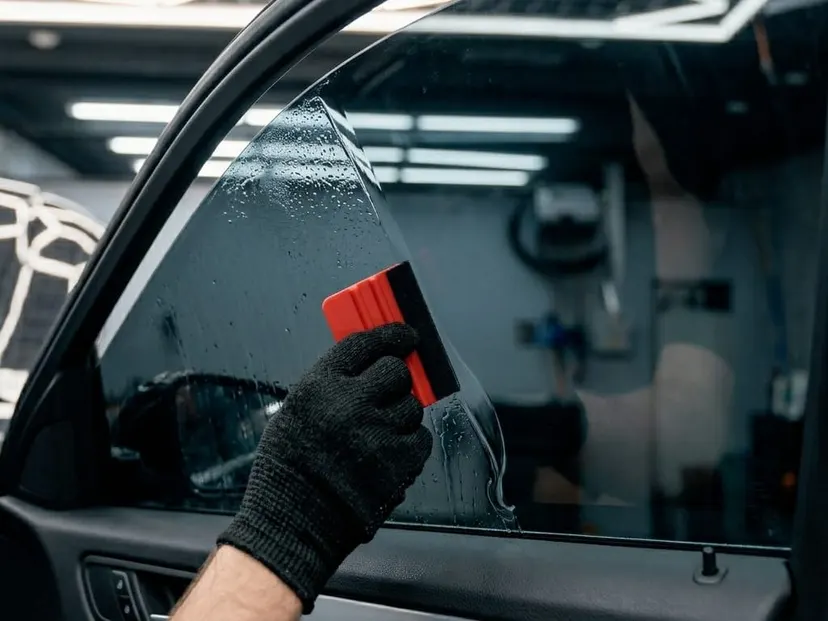
The job runs the same way whichever film you pick. Most cars take two to four hours.
Tell us the car
Send the make, model and year, and which windows you want done. Factory privacy glass and curved rear screens change the plan, so we ask up front.
Pick your shade and film
We show you film on your own glass and explain the legal limit for each window. Then you choose between carbon, carbon ceramic, ceramic and nano-ceramic with the trade-offs in front of you.
Fitting in a dust-controlled bay
The film is plotter-cut to your car by computer and fitted in-house by our own team, with no subcontractors. We check the shade against NSW limits before it goes on.
Cure and go
Leave the windows up for two days while the film cures. Our guide on how long window tint takes to cure explains what's normal in the first few weeks.
Typical for the ceramic film we fit at 35% VLT: 99% of UV blocked, 58% of infrared heat rejected, 52% of glare cut, and no signal interference. Exact performance varies with glass type and vehicle, a caveat SunTek prints on its own specification sheet too.[1]
What decides the cost
We don't publish prices, because every car is different. These are the things that set the quote:
The film. Carbon, carbon ceramic, ceramic and nano-ceramic each sit at a different level.
How many windows. Just the rear, the sides and rear, or a windscreen strip as well.
The shape of the glass. Big, curved rear windscreens and small quarter windows take longer to fit well.
Old film. Removing worn or illegal tint, and the glue under it, adds time before new film goes on.
Send us the make and model through our quote request page and tell us whether carbon or ceramic interests you. We'll come back with a written quote for each, so you can compare them properly.
Ceramic and carbon tint questions
Is ceramic tint better than carbon tint?
For heat, yes. On SunTek's specification sheet, its Evolve 35 ceramic film rejects 57% of total solar energy against 38% for its Carbon 35 film.[1] For UV, signal and colour stability, the two are equal.
Is ceramic tint worth the extra over carbon?
It's worth it if heat is your main reason for tinting, or if you want a lighter shade without a hot cabin. If you mainly want privacy and a dark look, and the car is often parked in shade, carbon gives you most of what you need.
Does carbon tint fade or turn purple?
No. Purple, faded tint is a problem of old dyed films. The RACQ says carbon films offer the colour stability older dye technologies lacked, and SunTek's carbon warranty covers colour change.[3][2]
Does ceramic or carbon tint interfere with phone or GPS signal?
Neither should. Both are made without metal, which is what causes signal problems in metallised films.[3] 3M says its carbon film won't interfere with mobile devices or GPS, and its ceramic film is compatible with 5G devices.[4][6]
Is ceramic tint darker than carbon tint?
Not necessarily. Darkness is set by the shade you choose, and both types come in a full range of shades. What differs is heat: a light ceramic film can keep out more heat than a very dark carbon one.[1]
Can you see out of ceramic tint at night?
Yes, at a sensible shade. Because ceramic film rejects heat without needing to be dark, you can choose a lighter shade that's easier to see through after dark. On a NSW car, the front side windows must let through at least 35% of light anyway.[8]
What is carbon ceramic tint?
It's a hybrid film that combines a carbon layer, for a deep matte look, with ceramic technology for better heat rejection than plain carbon. It sits between the two on heat. SunTek's similar CXP film rejects 53% of total solar energy at a 35 shade.[1]
Want to see the difference on your own glass? Bring the car to our Revesby workshop or our Condell Park workshop and we'll hold carbon and ceramic film up to your windows side by side.
Sources
- [1]SunTek (Eastman Performance Films). Automotive Window Film Specifications, 2024-04. ↑
- [2]SunTek. Carbon Tint, 2026. ↑
- [3]RACQ. Car window tints explained, 2022-03. ↑
- [4]3M. 3M Automotive Window Film Color Stable Series, 2021. ↑
- [5]SunTek. Ceramic Tint, 2026. ↑
- [6]3M Australia. 3M Automotive Window Film Ceramic IR Series, 2025-12. ↑
- [7]Cancer Council Australia. UV radiation: Tinted windows fact sheet, 2017-11. ↑
- [8]Transport for NSW. How do I know my windows and window tint are legal in NSW?, 2025-05. ↑
About the author
Founder, Tinting Xperts
Mohammad Habboushi founded Tinting Xperts in 2016 with one bay, one squeegee and a rule the team still works to: if it isn't right, it doesn't leave. The business has grown to two workshops, at Revesby and Condell Park, and a team of more than 30 fitters, and Mohammad still fits cars on the floor most days.


