
Paint Protection & Care
Graphene Coating in Sydney for Cars That Live Outside
A graphene coating is a ceramic-type paint coating with graphene added to the formula. It cures into a hard, slick, glossy layer that sheds water, and it's anti-static, so dust clings less. We correct your paint first, then apply it by hand indoors at Revesby or Condell Park.

What it is
What graphene coating gets you
A graphene coating is a liquid paint coating, built on the same glass-forming chemistry as a ceramic coating, with graphene added. For a graphene coating in Sydney, we correct the paint, then apply the coating by hand in a clean indoor bay at our Revesby and Condell Park workshops.
It cures into a hard, glossy layer bonded to your clear coat. Water beads and runs off, dirt struggles to grip, and the surface is anti-static, so less dust settles on it between washes. Those are the reasons owners ask for it, especially if the car sleeps on the street or in an open carport.
This page explains what graphene coatings are, what their makers claim against what you can rely on, who should choose one, how we prepare and coat the car, how to look after it and what affects the quote.
- Hand wash, iron fallout and tar removal, and a clay treatment
- Machine paint correction before the coating goes on
- Panel prep so the coating bonds straight to the clear coat
- Graphene coating applied and levelled by hand, panel by panel
- Wheel, glass and trim coating if you want them done too
- The coating maker's warranty and written aftercare for outdoor cars
What a graphene coating is
Graphene is a form of carbon: a sheet one atom thick, arranged in a honeycomb pattern. It's known for strength and for conducting heat well. Coating makers add it to a glass-forming coating to borrow some of those properties.
What you get on your car is still a coating, not a layer of pure graphene. It goes on as a liquid, bonds to the clear coat and hardens as it cures, the same way a ceramic coating does. The graphene changes how the cured layer behaves on the surface.
Why the label alone tells you little
The word graphene appears on everything from spray waxes to professional coatings. A product can carry it without saying how much it contains or in what form. Judge a coating by what its maker publishes, how it's applied and who stands behind the warranty, not by the word on the bottle.
Graphene coating claims vs what you can count on
Makers make a lot of claims for graphene. Some are well supported; others are plausible but hard to see in everyday driving. Here's how we explain them to customers who ask.
| Criterion | What makers claim | What you can count on |
|---|---|---|
| Water spotting | Fewer spots, because water beads tightly and runs off before it dries | Fewer spots than bare paint, but any coating spots if hard water dries on a hot panel; drying the car still matters |
| Dust | Anti-static surface, so dust doesn't cling | Dust wipes and rinses off more easily; it still settles on a car parked outside |
| Heat | Spreads heat across the panel, so droppings and spots bake on less | A possible bonus on dark cars in the sun; hard to measure on a real car |
| Hardness | Harder and more flexible than ceramic, so it resists fine marring | Resists light wash marring; it's still not scratch-proof and won't stop a chip |
| Life | Lasts longer than plain ceramic | Depends on prep, washing and parking more than on the graphene itself |
So treat graphene as a refinement, not a different category. If you want the full side-by-side, our guide to graphene vs ceramic coating works through it, and our ceramic coating page explains the coating it builds on.
The graphene coating we apply
These are the published figures for our graphene coating. We quote them because they're what the maker stands behind, not because a number on its own decides how your car will look in a few years.
| Property | Rating | In plain terms |
|---|---|---|
| Hardness | 10H, rated above our ceramic coating | Tough against light marring; washing technique still decides whether swirls come back. |
| Make-up | 85%+ active composition with graphene, inorganic glass formula | Most of the liquid is the coating itself rather than solvent that evaporates. |
| Solvents | VOC-free | No strong solvent fumes in the bay while it's applied. |
| Chemical resistance | Acid and alkali resistant from pH 1 to pH 14 | Copes with acidic droppings and strong cleaners, though nothing should be left on it to bake. |
| Water beading | Contact angle over 110°: ultra-hydrophobic | Water stands up in tall beads and leaves a tilted panel quickly. |
| Static | Anti-static | Fine dust has less charge to hold it to the paint. |
Who a graphene coating suits
Graphene earns its place where a car faces the weather every day. If yours lives in a garage and comes out on a Sunday, a ceramic coating gives you nearly everything you need.
Cars parked on the street or in a carport
Outdoor cars collect dust, pollen, overnight dew and sprinkler spray. A slick, anti-static surface means a lot of that comes off with a rinse instead of a scrub.
Black and dark-coloured paint
Dark paint shows every spot and speck of dust, and it gets very hot in the sun. That's where tight beading and an anti-static finish show most.
Cars under trees or near the water
Sap, bat droppings and salt air are hard on clear coat. The coating won't make them harmless, but it gives you longer to clean them off before they mark the paint.
Cars with paint protection film
A graphene coating over paint protection film keeps the film slick and stops grime building up along its edges. If you're weighing film against a coating rather than combining them, our guide to PPF vs ceramic coating applies just as well to graphene.
Getting the paint ready for graphene
A graphene coating is clear and glossy, so it shows off whatever is underneath it. Most of the result comes from the prep. A premium coating on swirled paint looks worse than a basic one on corrected paint.
Before coating, every car is washed and chemically decontaminated, then clayed until the paint is smooth. Then we polish out the swirls, holograms and light scratches that sit in the clear coat. Our paint correction page explains how far polishing can go, and the guide to what paint correction is covers the terms you'll hear.
Last comes the panel wipe. Polishing oils fill fine marks and can block the bond, so every panel is wiped back to bare clear coat. Skip that step and the coating may sit on the oil and fail early.
How we apply a graphene coating
Everything happens indoors, in a bay where we control the dust, light and panel temperature. The coating is applied panel by panel, never across the whole car at once.
Look at the car and quote
We check the paint with you in good light, point out chips, resprays and heavy swirling, and agree the coating, the surfaces and the correction in a written quote.
Wash, decontaminate and clay
A foam pre-wash and a careful hand wash first. Then iron and tar removers and a clay treatment take out the bonded particles a wash leaves behind.
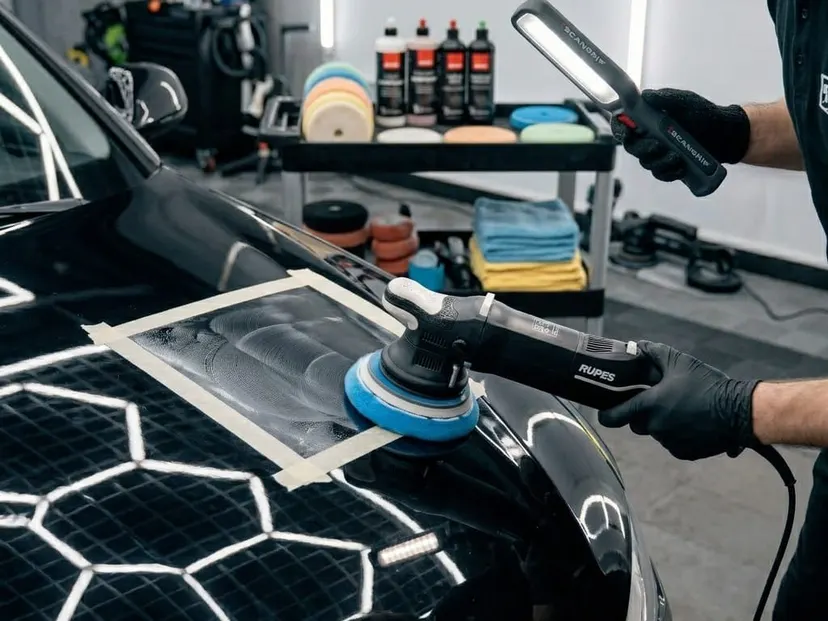
Polish out the swirls
Panels are taped off and machine polished, with an inspection light held close so fine marks can't hide. The aim is a clear coat that reflects evenly before it's sealed.
Wipe every panel back
A panel prep wipe takes off polishing oils and fingerprints, so the graphene coating meets clean clear coat.
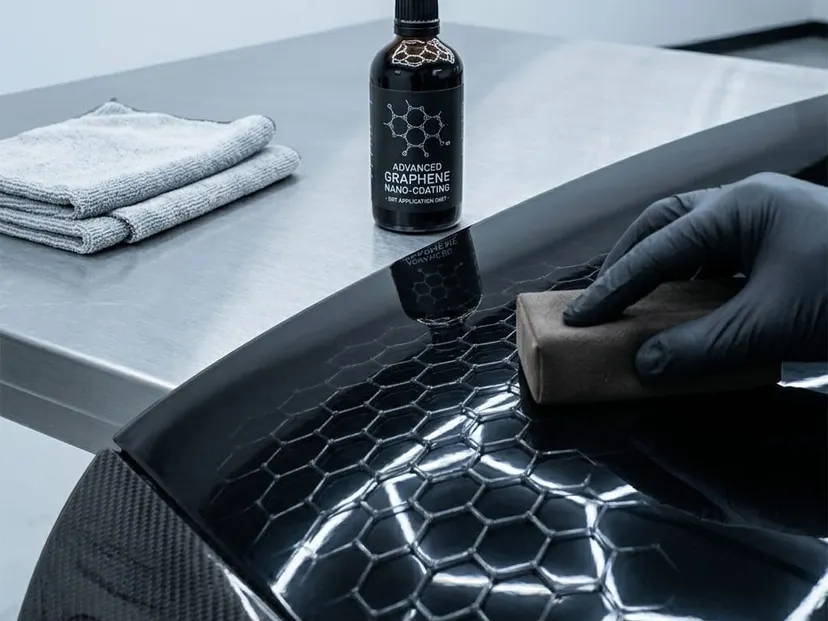
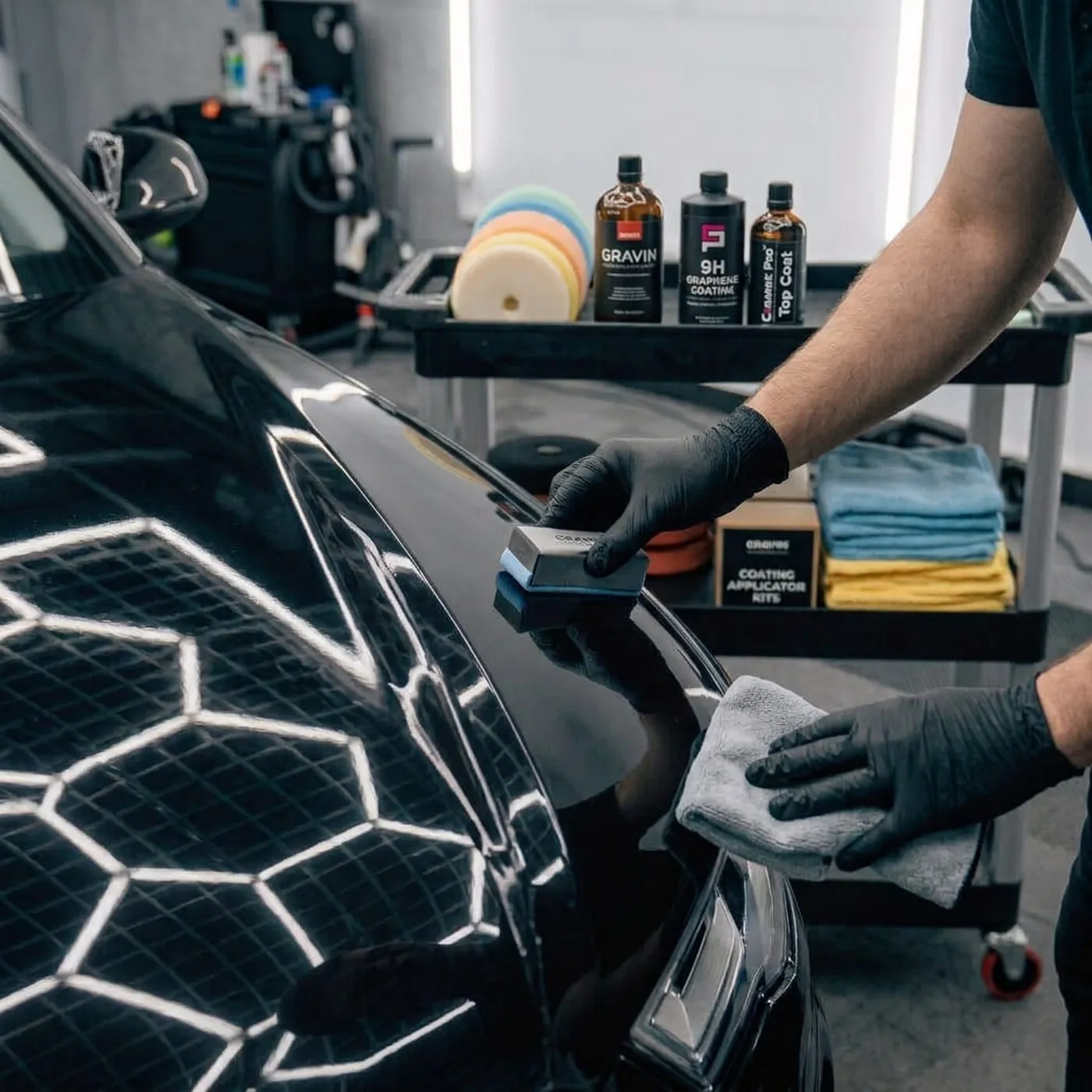
Coat, panel by panel
The coating is spread by hand in small, overlapping sections. Once it flashes, each section is buffed level with a fresh microfibre so no high spots dry in.
Inspect and let it cure
Each panel is checked from several angles under lights while any streak can still be corrected. The car then stays inside and dry while the coating sets.
Collect the car
You leave with the maker's warranty in writing and an aftercare sheet, including the first-wash date for the coating we've used.
Looking after your graphene-coated car
The coating makes washing easier, but it can't protect against bad washing. These habits keep it working, and they matter most on a car that's parked outside.
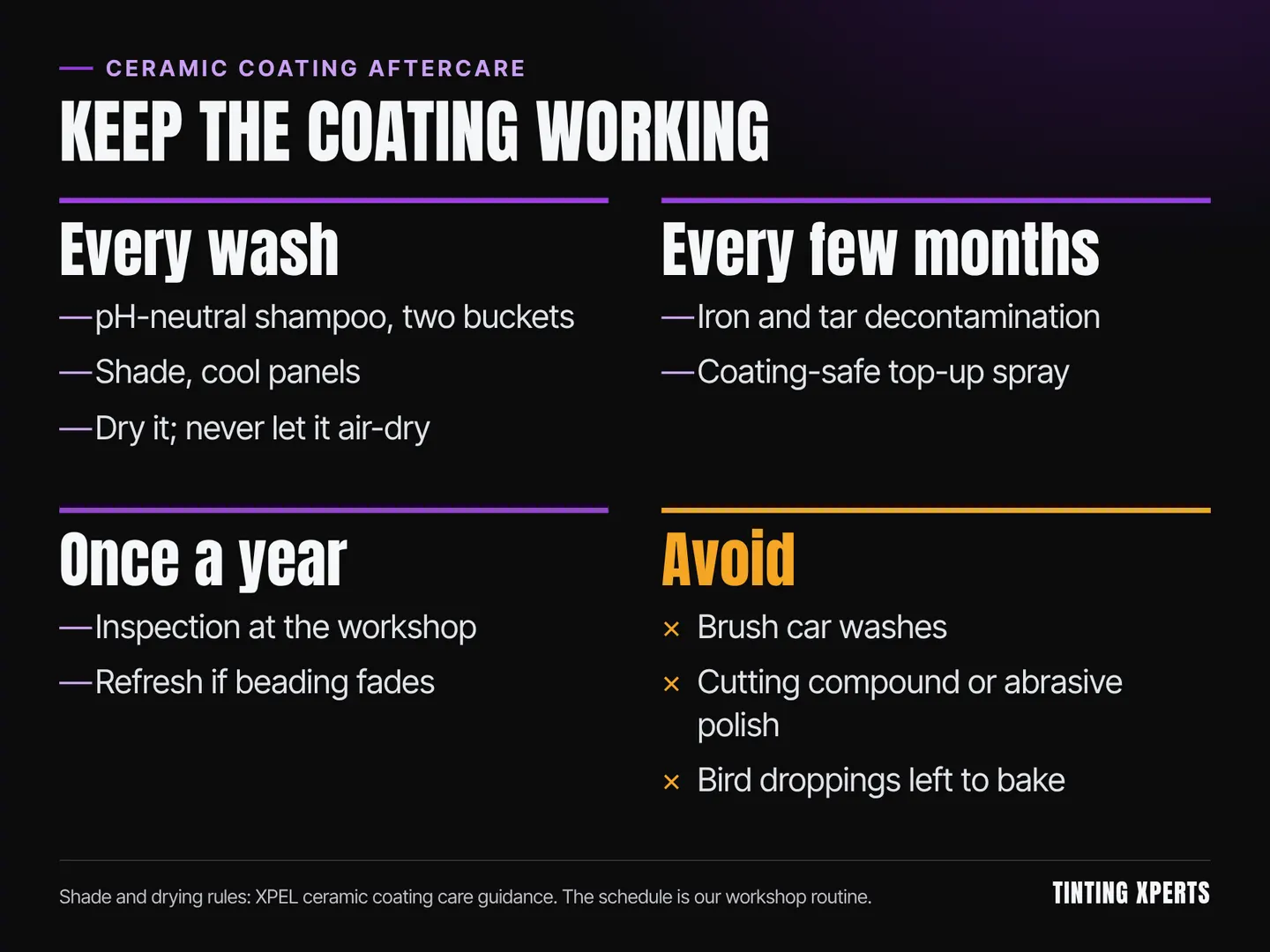
Respect the first-wash date on your aftercare sheet, and keep the car dry for the first few days where you can.
Wash out of direct sun with a pH-neutral shampoo, a soft mitt and two buckets.
Dry it every time. Even soft Sydney mains water leaves marks when it dries on a hot dark panel.
Rinse dust off before it builds up. On an anti-static finish, a rinse between washes often brings the gloss straight back.
Clean off droppings and sap the same day with water and a soft cloth.
Use an iron remover every few months, and a coating-safe top-up spray when the beading slows.
Stay out of brush car washes, and keep polishes and cutting compounds off the coating.
How long any coating keeps performing depends mostly on that routine. Our guide on how long ceramic coating lasts covers the signs of wear and the habits that shorten a coating's life, and it applies to graphene too.
Graphene on wheels, glass and trim
Paint gets the most attention, but outdoor cars have other surfaces that suffer. We can coat them at the same visit, each with a product suited to it.
Wheel faces and barrels, so hot brake dust rinses off instead of baking on. Wheels are best done off the car.
Exterior glass, so rain beads and clears at speed and dried water marks wipe off.
Black plastic trim, to bring back its colour and slow the greying from UV.
Tint goes on the inside of the glass and a glass coating on the outside, so car window tinting can be done in the same booking.
Our service
A ceramic coating is a liquid layer that bonds to your clear coat and cures hard, slick and glossy. Water beads off, grime lets go and washing gets quicker. We decontaminate and correct the paint first, then coat it by hand in a clean indoor bay at Revesby or Condell Park.
What decides the cost of a graphene coating
We quote after looking at the paint, never from the model name alone. These are the things that move the quote:
Correction needed. Heavily swirled or neglected paint takes more polishing stages, and polishing usually takes longer than the coating.
Size. A four-wheel drive or people mover has far more paint to prepare and coat than a small hatch.
Extra surfaces. Wheels off, glass, trim and calipers each add time and product.
Film on the car. Coating over film is quoted with a prep and coating that suit film.
Combined work. Tint, film or a detail booked at the same visit can be quoted together.
Send us the make, model and colour, and tell us where the car is parked. You'll get a written quote, and the price on it is the price you pay. You can pay by cash, credit or debit card, Afterpay or AMEX.
Why choose Tinting Xperts for your graphene coating
We started in 2016 and now have more than 30 fitters across two workshops in south-west Sydney. Coatings are applied by the same team that corrects the paint, so nothing is rushed between hand-offs.
Indoor bays only, so the coating cures without dust, wind or sun on it.
Correction on every job before a drop of coating touches the paint.
VOC-free coatings with published specifications, not just a label.
The maker's warranty on the coating, written down and given to you with the invoice.
One team for the whole car: coatings, film, tint, wraps and car detailing.
Bring the car to our Revesby workshop or our Condell Park workshop for a look at the paint, or request a graphene coating quote and we'll book it in at the workshop closer to you.
See some of our work: photos of a few cars we’ve finished
Areas we serve
Graphene Coating near you
Customers come to whichever of our two workshops is closer. Pick your suburb for the nearest one and local work.
- Graphene Coating in Revesby2212
- Graphene Coating in Bankstown2200
- Graphene Coating in Padstow2211
- Graphene Coating in Panania2213
- Graphene Coating in Milperra2214
- Graphene Coating in East Hills2213
- Graphene Coating in Georges Hall2198
- Graphene Coating in Condell Park2200
- Graphene Coating in Chester Hill2162
- Graphene Coating in Bass Hill2197
- Graphene Coating in Greenacre2190
- Graphene Coating in Liverpool2170
Questions
Graphene Coating: common questions
Is graphene coating just ceramic coating with a new name?
Not quite. It's a ceramic-type coating with graphene added, so it works the same way but behaves a little differently on the surface. The main differences you'll notice are tighter beading and less dust clinging between washes.
Does graphene coating stop water spots completely?
No coating does. A graphene coating sheds water quickly, so fewer drops are left to dry on the paint. Drying the car after every wash is still the best way to avoid spots.
Is a graphene coating worth it for a garaged car?
Usually it's not needed. A garaged car avoids most of the dust, dew and droppings that graphene helps with, so a ceramic coating does the job. Graphene makes more sense on a car that's parked outside every day.
Can a graphene coating go on a brand-new car?
Yes, and new is a good time to do it. New paint often still has light swirls from dealer washes, so we inspect it and polish it before coating. Many owners book film on the front at the same visit.
Can you put a graphene coating over a ceramic coating?
Not over one that's still on the paint. A new coating needs to bond to bare clear coat, so the old coating is polished off during correction first. If your existing coating is in good condition, a top-up may be all it needs.
Does graphene coating make my car run cooler?
Makers say graphene spreads heat across the surface, which may help stop droppings and spots baking on. It won't make the cabin cooler. For heat inside the car, ceramic window tint is the product that helps.
Can I use a pressure washer on a graphene-coated car?
Yes, once the coating has cured. Keep the nozzle a sensible distance from the paint and well back from film edges and badges. Rinsing with a pressure washer is a good way to take dust off before you touch the paint.
How long will you need my car for a graphene coating?
It depends on the size of the car and how much correction the paint needs. Adding wheels, glass or trim also adds time. We give you drop-off and pick-up times with the written quote.
What warranty comes with a graphene coating?
The coating carries its maker's warranty, which we give you in writing with your invoice. It usually asks for correct washing and any inspections the maker requires. Your aftercare sheet spells those out.
Guides
Read before you book
Plain-English guides on graphene coating, from the people who fit it.
Comparison · Ceramic & Graphene Coatings
Graphene vs ceramic coating: what's really different, and which suits your car
A graphene coating is a ceramic coating with carbon added; here's what that changes, what it doesn't, and how to choose for a Sydney car.
· 11 min read
Guide · Ceramic & Graphene Coatings
How long does ceramic coating last? Real lifespans, and how to make yours go the distance
What the coating makers actually promise, what wears a coating out on a Sydney car, and the simple routine that keeps it working for years.
· 12 min read

Visit us
Two workshops, one team
Tinting Xperts Revesby
Unit 28/172 Milperra Road, Revesby NSW 2212
Mon – Sat · 9:00am – 5:00pm
Tinting Xperts Condell Park
141 Eldridge Road, Condell Park NSW 2200
Mon – Sat · 9:00am – 5:00pm
Reviewed by Mohammad Habboushi, Founder.