
Paint Protection & Care
Paint Protection Film in Sydney, Fitted In-House
Paint protection film is a clear, self-healing urethane layer fitted over your paint. It takes the stone chips, grit and scuffs that would mark the panels. We correct the paint, then fit gloss, matte or colour film, from partial front to full body, at Revesby and Condell Park.

What it is
What paint protection film gets you
Paint protection film (PPF) is a thick, clear urethane film fitted over your car's paint so it takes the hits instead. If you're after paint protection film in Sydney, we fit it in-house at Revesby and Condell Park, from a strip across the bumper to every painted panel.
The film soaks up stone chips flicked up on the M5 and the M4, grit thrown off the back of trucks, bug splatter and the odd car-park scuff. Its top coat is self-healing, so fine scratches fade with warmth from the sun or warm water. Underneath, the paint stays as it was on the day the film went on.
This page covers what film stops and what it can't, the coverage packages, gloss, matte and colour film, how we fit it, how to look after it and what decides the cost. If you're still deciding whether to fit film at all, our guide is paint protection film worth it? works through that question car by car.
- Paint washed, decontaminated and corrected before any film goes on
- Coverage to suit: partial front, full front, full front plus or full body
- Clear gloss, clear matte or colour film
- Film plotter-cut from a pattern for your make and model
- Fitted in a clean indoor bay and inspected under lights before handover
- The film maker's warranty and written care instructions
What paint protection film stops
Stone chips are the reason most people fit film. At motorway speed, a small stone hits the front of a car hard enough to punch through the clear coat and colour to the primer. Once that happens, the only proper fixes are touch-up paint or a respray. Film spreads the force of the impact and takes the mark instead.
The damage film takes for your paint
Stone chips and road rash on the bumper, the leading edge of the bonnet, the mirrors and the front of the guards.
Sandblasting on the lower panels and behind the front wheels, where grit is thrown up on wet roads and gravel.
Fine scratches and swirls in the film's top coat, which level out again with warmth.
Bird droppings, bat droppings, sap and bugs, which sit on the film instead of etching the clear coat on a hot day.
Light scuffs from bags, keys, pets and fingernails on the panels covered, such as the rear bumper loading lip and door handle cups.
UV fading of the colour underneath, because quality film is UV-stable.
Where film reaches its limits
Film isn't armour. A large rock at speed can still chip through it, although the film usually absorbs most of the damage. A deep gouge, a dent or a scrape along a bollard cuts the film, and the panel under it may need repair. Film also can't fix damage that's already there. It goes over chips and scratches; it doesn't fill them.
Paint protection film coverage packages
Most cars don't need film on every panel. The real question is which panels take the hits the way you drive, and where you're happy for a film edge to sit. These are the four packages we fit most often. We can also film single areas, such as a rear bumper loading lip, door edges or a roof leading edge.
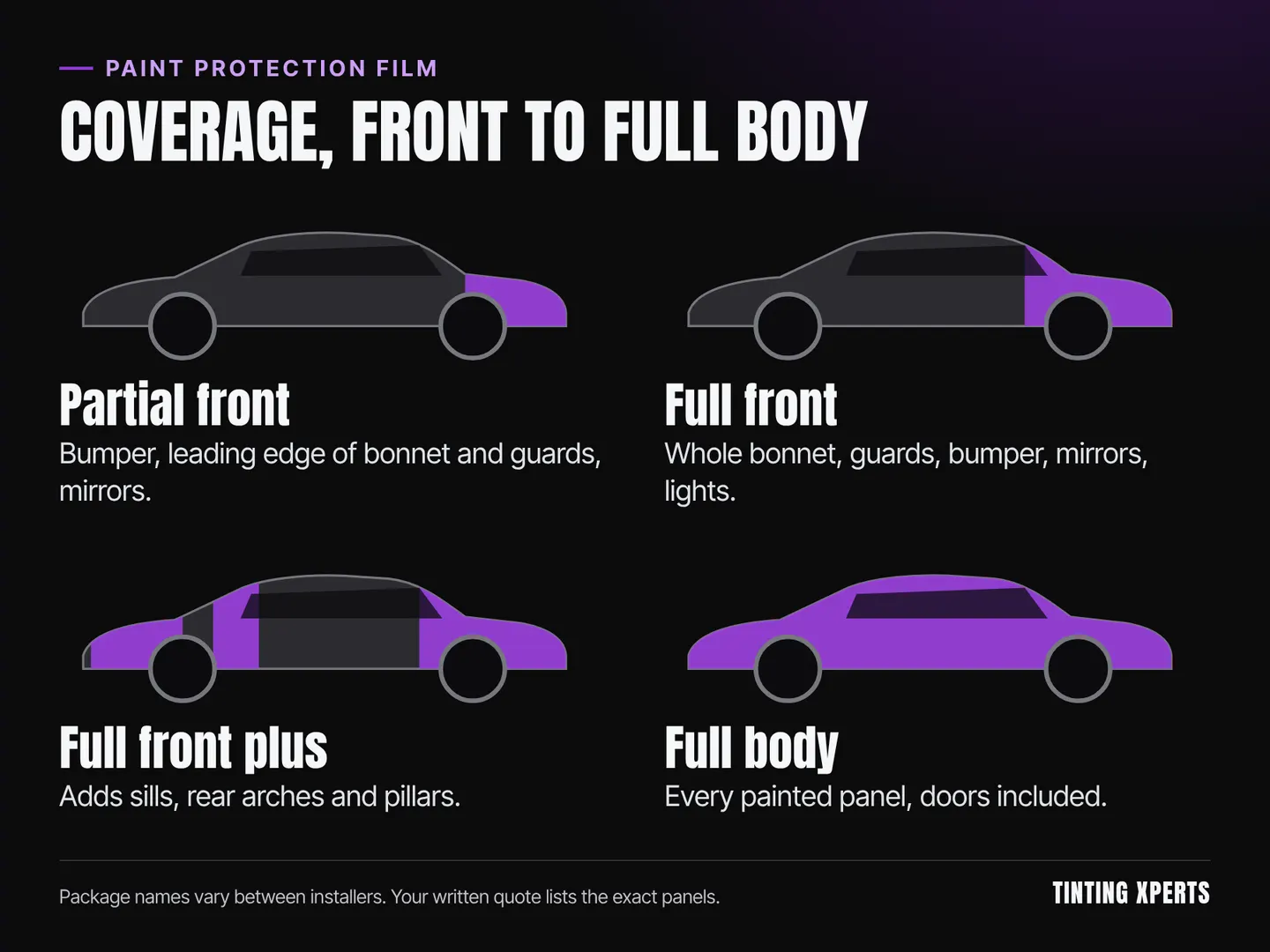
| Package | Panels covered | Suits | Keep in mind |
|---|---|---|---|
| Partial front | Front bumper, the leading part of the bonnet and front guards, mirror caps | Mostly suburban driving, lighter paint colours, a tighter budget | A film edge runs across the bonnet and guards; it's faint, but you can find it up close |
| Full front | The whole bonnet, both front guards, the front bumper, mirrors and headlights | Most cars, especially if you're on the M5, M7 or Hume regularly | No edge across the middle of the bonnet, which is why it's the usual choice |
| Full front plus | Full front, plus the side sills, A-pillars, roof leading edge and the front of the rear guards | Lowered cars, wide-body cars, SUVs, and anyone doing regular highway or country trips | Covers the lower panels that get sandblasted behind the front wheels |
| Full body | Every painted panel, with edges wrapped wherever the car allows | New and high-value cars, matte paint, colour change with film | The biggest job; every panel is protected and the whole car can be coated over |
How to choose your package
Think about where you drive and how long you'll keep the car. If you're on the motorway every day, the front is under constant fire, and full front is the sensible minimum. If you take the car up the Hume or out west on country roads, add the sills and the front of the rear guards. If the car is new, dark or matte and you'll keep it for years, full body means no panel ever needs touching up.
When you bring the car in, we'll walk around it with you and point out where it's already picking up chips. That usually tells you more about the right package than any package name does.
Gloss, matte or colour paint protection film
Film comes in different finishes, all with the same self-healing urethane and the same impact protection. The right one depends on the paint you have now and the look you want.
Clear gloss film
The most common choice. It keeps the factory finish and adds a deep, glossy top layer. On well-corrected paint, you have to look along a panel's edge to find it.
Clear matte film
Matte film turns gloss paint satin, a popular way to get a stealth look without a full wrap. On factory matte or frozen paint it does a bigger job. Matte paint can't be polished, so a chip, a scratch or a stain on it is very hard to fix. Film over it protects the finish and keeps the sheen even.
Colour PPF
Colour film changes the car's colour the way a vinyl wrap does, but it's thicker and it self-heals. It costs more than vinyl, so it suits owners who want a new colour and chip protection in one layer. If the change is mainly about looks, compare it with car wrapping, and our guide to car wrap vs paint explains how a wrap stacks up against a respray.
How we fit paint protection film
Most of a film job is preparation. Film is clear and sits tight on the paint, so anything trapped under it, from a speck of dust to a swirl mark, stays visible for the life of the film. This is what happens to your car, in order.
Look at the paint and quote
We go over the car with you in good light, note existing chips and any resprayed panels, and confirm the coverage and film in a written quote.
Wash and decontaminate
A full hand wash, then iron, tar and sap removers and a clay treatment, so nothing bonded to the paint ends up sealed under the film.
Correct the paint
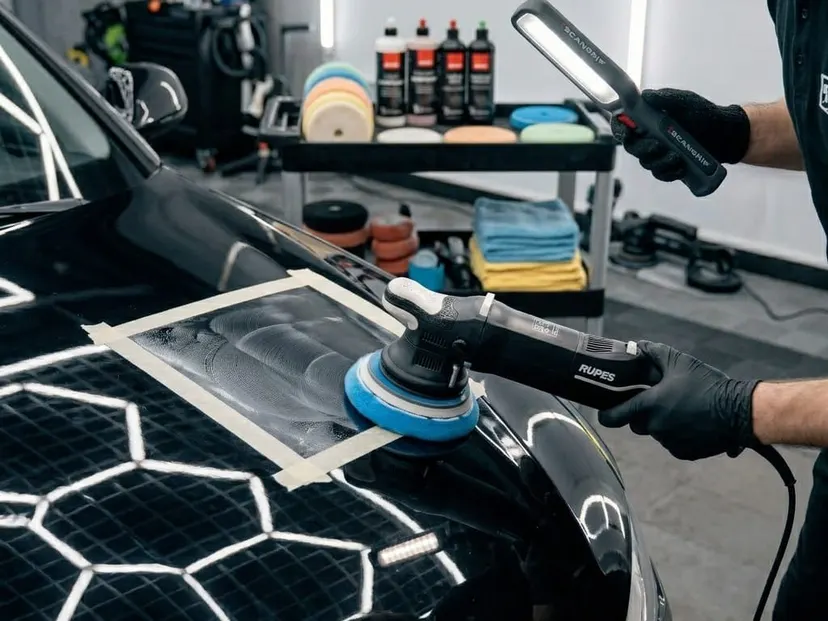
Swirls and light scratches are machine-polished out of the clear coat on the panels being filmed. Film protects paint; it doesn't hide what's wrong with it.
Cut the film for your car
The film is plotter-cut from a pattern for your make and model, so each piece is already shaped before it reaches the car instead of being trimmed to size on your paint.
Lay, position and squeegee
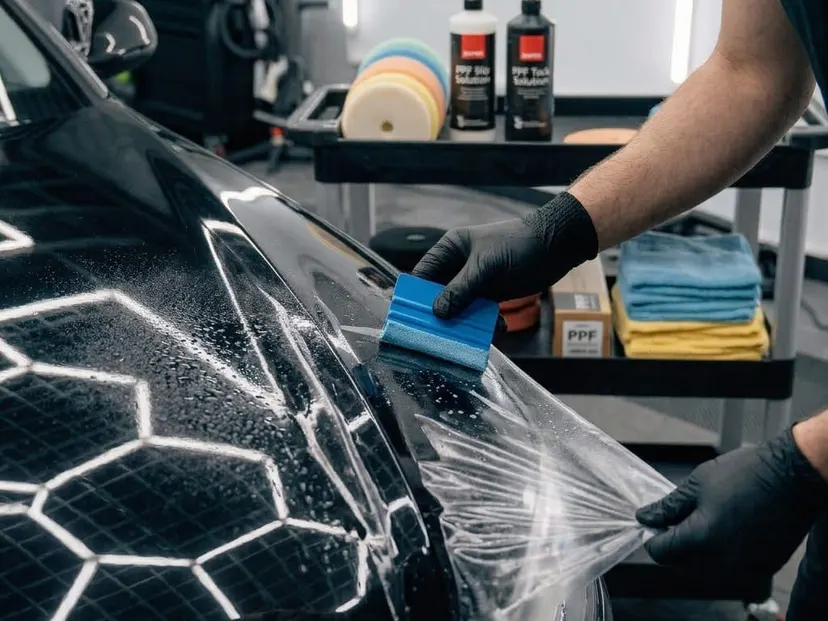
Each piece is laid onto a slip solution, slid into position, then squeegeed to push the solution out from underneath. Edges are wrapped around the ends of panels wherever the car allows.
Heat, stretch and seal the edges
Curves, vents and sharp corners are worked with gentle heat so the film lies flat without tension that could lift it later. Edges are pressed down and checked again.
Inspect and hand over
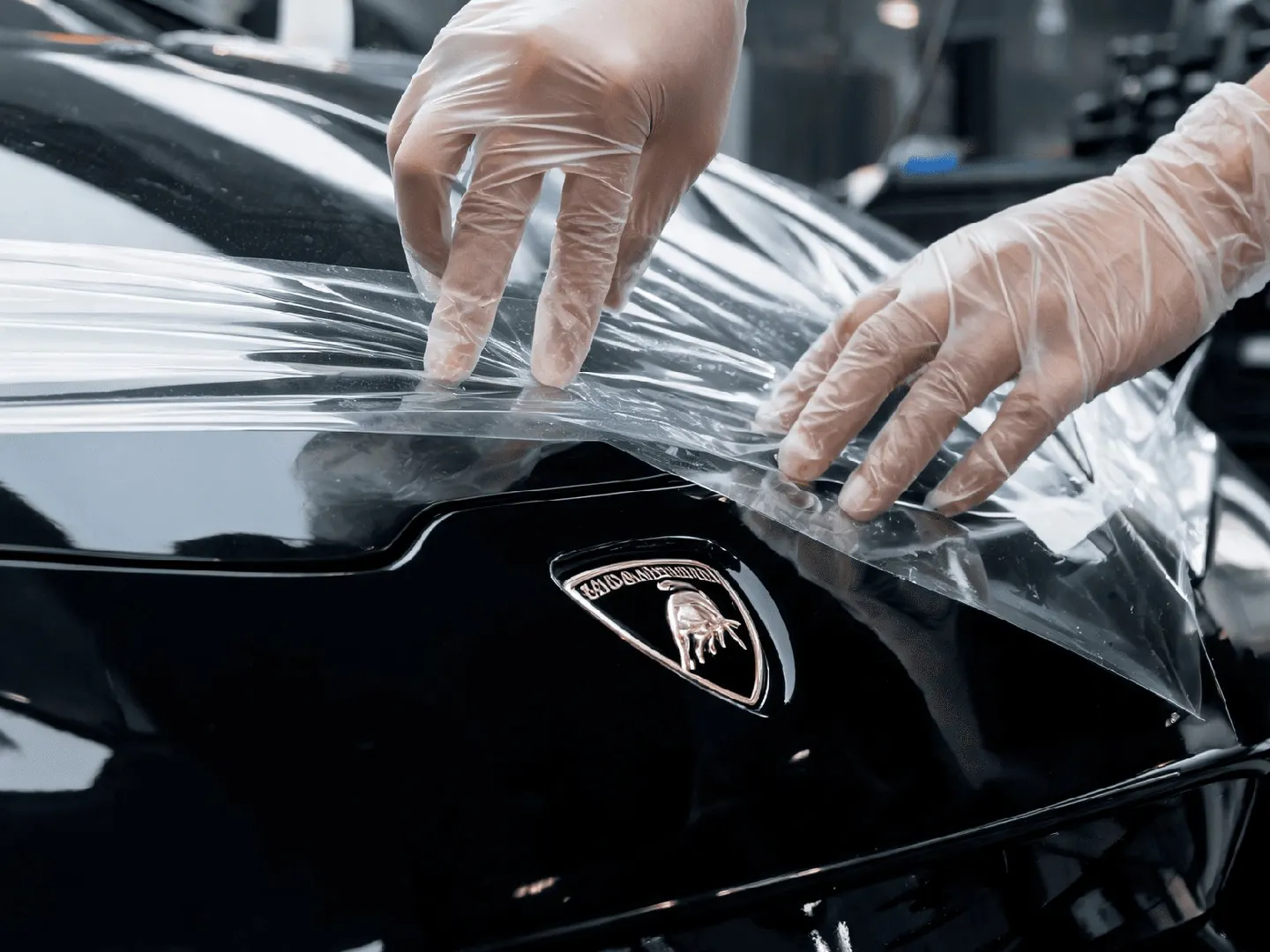
The whole car is checked under inspection lights before you collect it. You leave with written care instructions and the maker's warranty details, and we send a check-in message a week later.
Paint protection film on a new car
The best time to fit film is before a new car has done many motorway kilometres. Every trip adds chips, and film can't undo them. Many owners book the film for the week they collect the car, so the paint is covered before its first long drive.
New doesn't always mean perfect paint, though. Cars are washed at the port and again before delivery, often in a hurry, and they can arrive with light swirls, holograms or water spots. We inspect new paint as closely as old, and a light polish is often all it needs before the film goes on.
If the dealer offers a paint protection package, ask exactly what it is before you pay for it. It's often a sealant or coating wiped on before delivery, which is a different product from film and won't stop a chip. You can decline it and book film with us instead.
New-car owners often have everything done at one visit: film on the front, a ceramic coating over the whole car and ceramic window tinting on the glass. That's one booking and one invoice, and the car is protected inside and out from the start.
Pairing PPF with a ceramic coating
Film and a coating do different jobs, which is why they work so well together. Film absorbs impacts on the panels that face the road. A coating is a thin, hard, glassy layer that makes the surface slick, so dirt, droppings and water let go. Coat over the film and the filmed panels wash as easily as the rest of the car, and the film's top coat stays cleaner for longer.
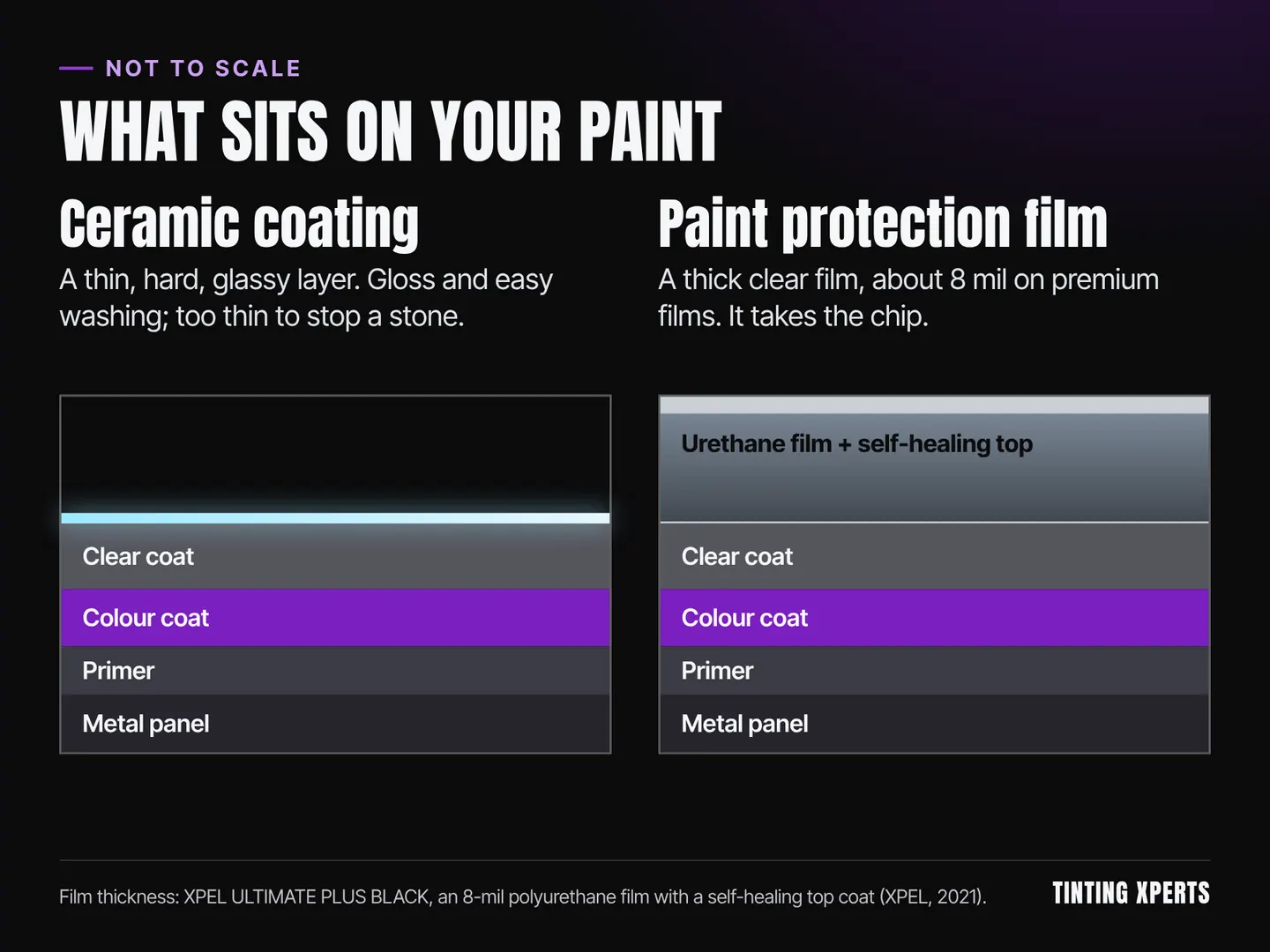
If you're choosing between the two rather than combining them, our guide to PPF vs ceramic coating compares them side by side.
Our service
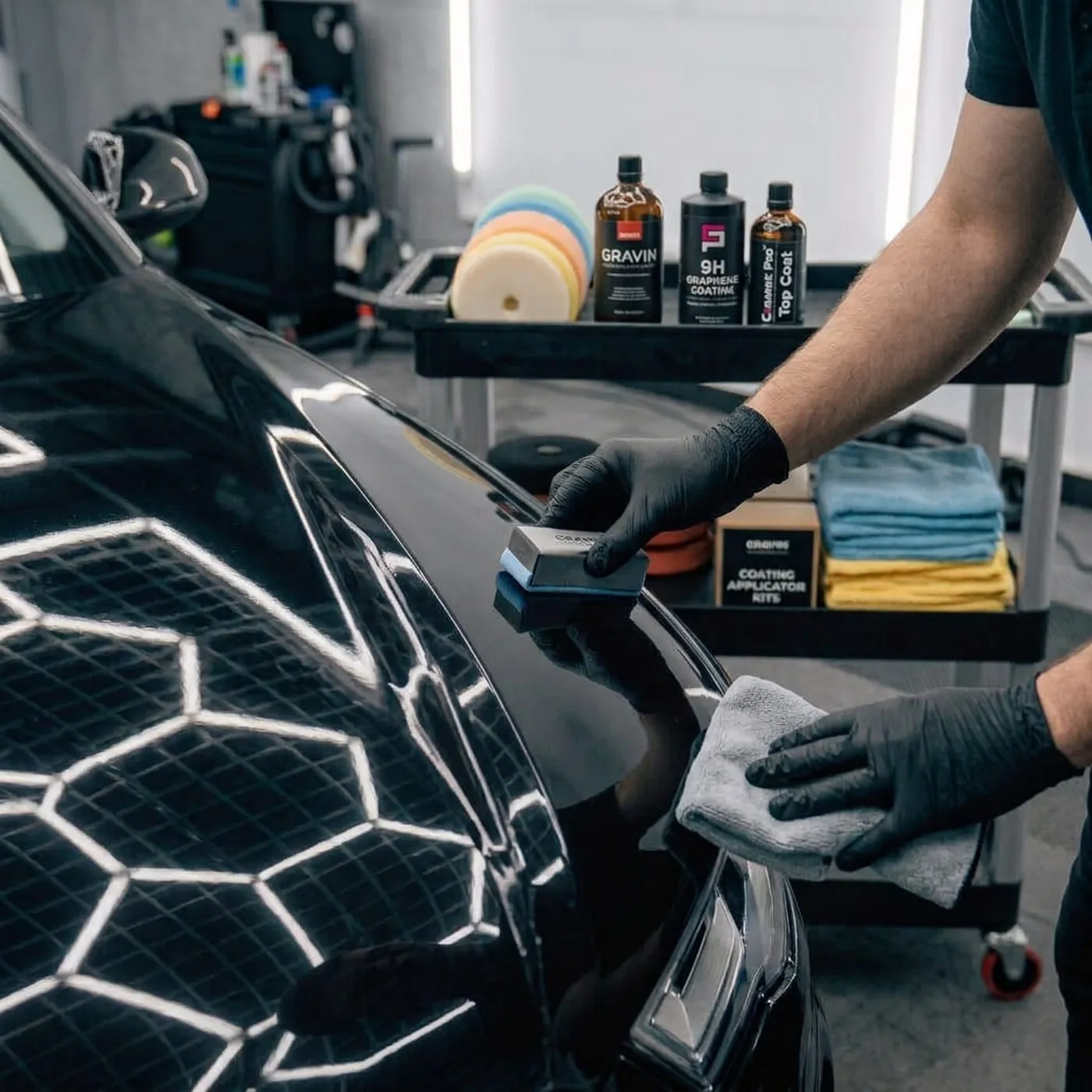
A ceramic coating is a liquid layer that bonds to your clear coat and cures hard, slick and glossy. Water beads off, grime lets go and washing gets quicker. We decontaminate and correct the paint first, then coat it by hand in a clean indoor bay at Revesby or Condell Park.
Caring for paint protection film
Film is easy to live with. Treat it like good paint, and it keeps looking like good paint.
Let it settle first. Wait for the time on your care sheet before the first wash, and leave the edges alone while the adhesive sets.
Hand wash with a pH-neutral shampoo and the two-bucket method, using a soft mitt and a clean drying towel.
Keep a pressure washer back from the edges. A close jet aimed into an edge can lift it, so rinse across the film, not into it.
Skip brush car washes. The brushes scuff the top coat and drag grit across every panel.
Clean off droppings, sap and bugs promptly. Film resists them far better than paint, but anything baked on for weeks is harder to shift.
Use film-safe products. Keep cutting compounds and solvent cleaners off the film; a coating or spray sealant made for film keeps it slick.
Looking after matte film
Matte film needs a little more care, because anything that adds gloss leaves shiny patches. Use a shampoo with no wax or gloss enhancers, never polish or wax it, and blot it dry instead of rubbing hard. A coating made for matte finishes is the easiest way to keep it clean.
Using heat to heal light marks
Fine swirls and light scratches in the top coat fade on their own on a warm day. To speed things up, pour warm water over the mark or leave the car in the sun for a while. A cut right through the film won't heal, but that piece can be replaced on its own.
What decides the cost of paint protection film
Every film job is quoted for the car in front of us, because no two cars take the same amount of film or time. These are the main factors:
Coverage: a partial front uses a fraction of the film and fitting time of a full body.
The car's size and shape: big bonnets, deep vents, aggressive bumpers and sharp body lines take longer to fit cleanly.
The film: clear gloss, clear matte and colour film are different products.
Paint correction: paint that needs a lot of polishing before film adds time to the job.
Edge work and parts removal: wrapping edges, or removing badges, mirror caps or trim for a hidden edge, takes extra time.
A coating over the film at the same visit.
Send us the make, model and the coverage you have in mind, or bring the car to our Revesby workshop or our Condell Park workshop, and you'll get a written quote. The quote is free and fixed, with no extras added on the day. We take cash, credit, debit, Afterpay and AMEX.
Why have your PPF fitted by Tinting Xperts
We've been fitting film to cars in south-west Sydney since 2016, and a team of 30+ fitters now works across our two workshops. Paint protection film is fitted by the same people who correct the paint underneath it.
Indoor fitting only. Film goes on in clean indoor bays, never in a driveway or a car park, because dust under film is there to stay.
Paint corrected first on every job, so the film seals in a clean, glossy finish.
Patterns cut for your model on the plotter.
The maker's warranty on the film, in writing with your invoice.
Everything under one roof: film, coatings, paint correction, tint and wraps in one booking.
Ready to protect the paint? Ask for a written PPF quote and we'll book the car in at whichever workshop is closer to you.
In their words
What some of our customers say
“Gave good advice in a kind way, kept car secure and got the job done in 6 days for my red Tesla Model YL all body PPF with matt finish and window tinting. No complaints and reasonable pricing.”
abhishek chakraborty · Full-Body Matte PPF & Tint · on Google “Very good experience with this company, full ppf our new bmw , very clear communication & pricing the work speaks for itself, Will definitely recommend to friends & family ,”
Dan H · Full PPF · on Google “Highly Recommend Mo for the work he done! full car PPF and he also went above and beyond wrapping external parts that wasn’t listed. Also ensures great service for warranty if anything just bring it back to the shop!”
Nav Singh · Full PPF · on Google “The team were amazing! Best priced for the work they do, which is top quality. Mo was very patient and explained everything clearly, including completing the PPF on my new car in a short period. The finish was an perfect finish with high gloss. Thanks again!”
Jason Bui · PPF · on Google “Got my Car fully wrapped with PPF, great service, good quality and finish, affordable prices. Highly recommended!!”
Ahmad Raad · Full PPF · on Google “I have done full body PPF, Window Tint & Interior Protection.I am very impressed with the service and result. It was a pleasure to deal with Mo. He was attentive, accomodating & replied promptly.”
Rusho Realm · Full PPF, Tint & Interior Protection · on Google
See some of our work: photos of a few cars we’ve finished
Areas we serve
Paint Protection Film near you
Customers come to whichever of our two workshops is closer. Pick your suburb for the nearest one and local work.
- Paint Protection Film in Revesby2212
- Paint Protection Film in Bankstown2200
- Paint Protection Film in Padstow2211
- Paint Protection Film in Panania2213
- Paint Protection Film in Milperra2214
- Paint Protection Film in East Hills2213
- Paint Protection Film in Georges Hall2198
- Paint Protection Film in Condell Park2200
- Paint Protection Film in Chester Hill2162
- Paint Protection Film in Bass Hill2197
- Paint Protection Film in Greenacre2190
- Paint Protection Film in Liverpool2170
Questions
Paint Protection Film: common questions
How soon can I wash my car after paint protection film is fitted?
Give the film a few days to settle before its first wash, and follow the exact wait on your care sheet. Until then, rinse off bird droppings gently if you need to, but don't scrub or pressure wash. After that, wash it as you would good paint.
Can you see paint protection film on the car?
Clear gloss film is very hard to spot once it's on. You can find an edge if you look closely along a panel, which is why bigger packages wrap edges where they can. On well-corrected paint, most people can't tell which panels are filmed.
Does PPF turn yellow over time?
Quality modern film is made to resist yellowing and staining, and it carries its maker's warranty. Cheap film, and film left caked in grime in the sun, are the ones most likely to discolour. Regular washing keeps clear film clear.
Will paint protection film damage my paint when it comes off?
Not on healthy factory paint. Quality film is designed to peel away cleanly with gentle heat, leaving the paint as it was. Resprayed panels and failing clear coat are the exception, so we check for both before fitting.
Can PPF go over stone chips that are already there?
It can, but the chips will still show under the film. Deep chips are best touched up first so the film lies flat over them. We'll point out existing chips when we inspect the car and tell you which are worth fixing.
Can I take a car with PPF through an automatic car wash?
A hand wash is best for film. Brush washes scuff the top coat and drag grit over every panel, and strong jets close to an edge can lift it. If you have to use a car wash, choose a touchless one.
Can you fit paint protection film to an older car?
Yes, as long as the paint is sound. Older paint usually needs more correction first, and existing chips stay visible under the film. On an older car, film is about stopping further damage, so it makes most sense if you plan to keep it.
How long will you need my car for PPF?
It depends on the coverage and how much paint correction the car needs. A partial front is a much shorter job than a full body. We confirm drop-off and pick-up times when we quote.
What warranty comes with paint protection film?
Film carries its maker's warranty, which covers defects in the film itself. We give you the terms in writing with your invoice. Film warranties cover the film, not impact damage such as a large stone cutting through it.
Can a damaged piece of PPF be replaced?
Yes. Film is fitted panel by panel, so a damaged piece can be peeled off and a new one fitted without redoing the whole car. The paint underneath is usually untouched, which is the whole point of the film.
Guides
Read before you book
Plain-English guides on paint protection film, from the people who fit it.
Comparison · Paint Protection
PPF vs ceramic coating: which protects your paint better?
Film stops stone chips, a coating makes paint glossy and easy to clean, and the right choice depends on how and where you drive.
· 11 min read
Guide · Paint Protection
Is paint protection film worth it? An honest guide for Sydney drivers
What clear film really stops, what it doesn't, how long it lasts and which cars and drivers get the most out of it.
· 13 min read

Visit us
Two workshops, one team
Tinting Xperts Revesby
Unit 28/172 Milperra Road, Revesby NSW 2212
Mon – Sat · 9:00am – 5:00pm
Tinting Xperts Condell Park
141 Eldridge Road, Condell Park NSW 2200
Mon – Sat · 9:00am – 5:00pm
Reviewed by Mohammad Habboushi, Founder.