
Comparison · Ceramic & Graphene Coatings
Graphene vs ceramic coating: what's really different, and which suits your car
A graphene coating is a ceramic coating with carbon added; here's what that changes, what it doesn't, and how to choose for a Sydney car.
Written and reviewed by Mohammad Habboushi, Founder of Tinting Xperts
· 11 min read

Key takeaways
- Most graphene coatings are silicon dioxide (SiO2) ceramic coatings with graphene oxide or graphene platelets added, not a different kind of product.
- Graphene coatings are marketed for fewer water spots, better heat dispersion and more flexibility; ceramic has the longer track record and slightly deeper gloss.
- Professional coatings of both types are rated by their makers for years, but prep, washing and parking decide how long yours really lasts.
- Neither coating stops stone chips; only paint protection film does that.
- For most Sydney cars the gap between a good graphene and a good ceramic coating is small; choose on the product, the installer and your care routine.
Graphene vs ceramic coating is a smaller gap than the marketing suggests. Most graphene coatings are ceramic (SiO2) coatings with a little graphene-type carbon added. Makers claim fewer water spots, better heat dispersion and more flexibility. Ceramic has the longer track record and slightly deeper gloss. For most cars, prep and care matter more.
This guide compares them point by point: what each one is made of, what graphene really adds, how long each lasts, what neither can do and how to choose for a car that lives in Sydney. If you're already leaning one way, our graphene coating service and ceramic coating service pages explain how we apply each.
Graphene vs ceramic coating: the short answer
Choose a ceramic coating if you want the deepest gloss and the most proven chemistry. Choose a graphene coating if water spotting and heat are what you fight most, and you're happy to pay for the newer formula. Either way, the product grade and the installer's prep decide more than the label.
| Criterion | Ceramic coating | Graphene coating |
|---|---|---|
| What it's made of | Silicon dioxide (SiO2) that cures into a thin, glass-like layer | Usually an SiO2 ceramic base with graphene oxide or graphene platelets added |
| Water beading | Strong beading and sheeting | Claimed tighter beading; the difference is small in daily use |
| Water spotting | Good, but hard water left to dry can still spot | Marketed as more resistant to water spots |
| Surface heat | Good heat and UV resistance | Marketed as dispersing surface heat better |
| Light marring | Resists light swirls from washing | Claimed slightly more flexible and resistant to micro-marring |
| Gloss | Deep, wet-look gloss; the benchmark | Comparable gloss; ceramic edges ahead on depth |
| Track record | Long, with plenty of real-world use | Newer, with less independent long-term data |
| Rated life | Depends on the product; many professional coatings are rated up to five years | Depends on the product; rated similarly to ceramic |
| Application | More forgiving, in many formats from sprays to professional coatings | Needs tighter application discipline |
| Stone chips | No meaningful protection | No meaningful protection |
These ratings summarise what Chemical Guys, which makes both types, and The Rag Company say in their side-by-side comparisons.[1][2] The stone chip row comes from Gtechniq, a coating maker, which says coatings can't offer meaningful protection against chipping.[3]
What a ceramic coating is
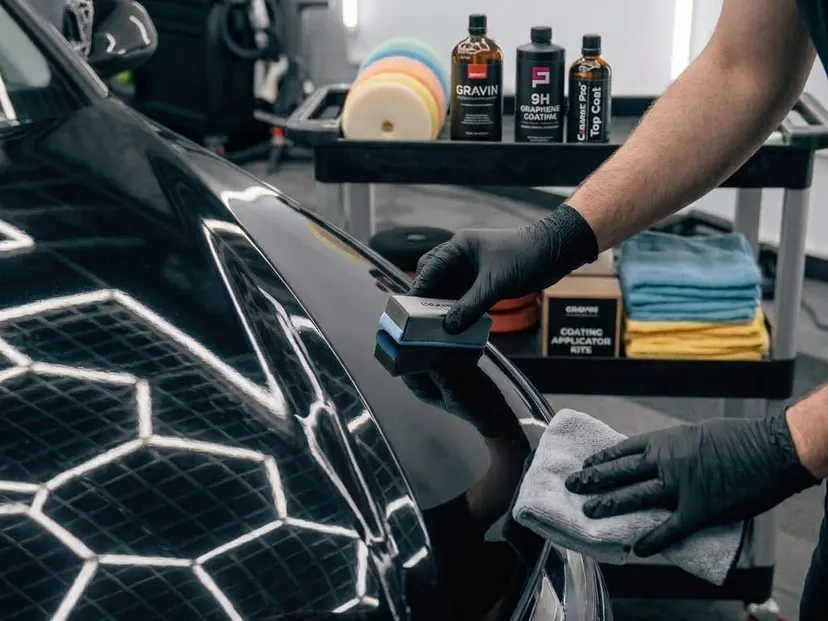
A ceramic coating is a liquid wiped onto clean, corrected paint. It cures into a hard, slick layer bonded to the clear coat. XPEL says ceramic coating is primarily made from a liquid polymer containing silicon dioxide (SiO2), which forms a glass-like layer.[4]
The layer is very thin. Gtechniq says its coatings are about 1 micron thick, compared with roughly 150 microns for paint protection film.[3] That's thin enough to keep the paint looking like paint, but too thin to absorb an impact.
What the coating does well is make the surface harder for dirt and water to grip. Chemical Guys says SiO2 coatings fill microscopic pores and create a smooth hydrophobic surface, so water beads and rolls off.[1] In practice, grime lets go with a gentle wash, so you scrub less and put fewer swirls in the paint.
What a graphene coating is
Graphene itself
Graphene is a real material with genuinely unusual properties. The University of Manchester, where it was first isolated, describes it like this:
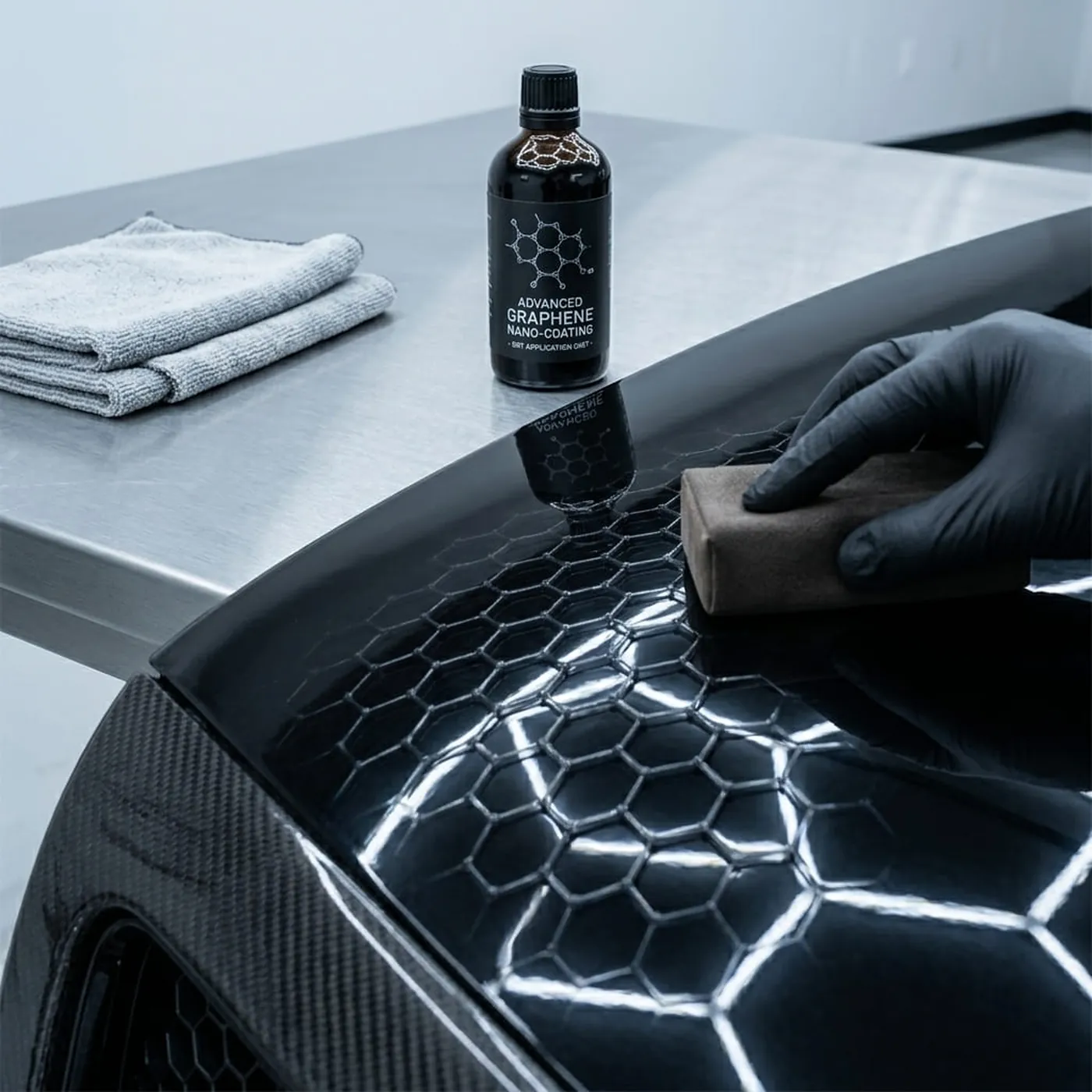
Graphene is the name given to a single layer of carbon atoms arranged in a honeycomb lattice.
The university says graphene is the strongest known material, yet also flexible, and conducts heat exceptionally well despite being one atom thick.[5] Those are the properties coating makers want to borrow. A bottle of coating doesn't turn your paint into a sheet of graphene, though.
How graphene gets into a coating
In car care, "graphene coating" usually means a ceramic coating with graphene added. The Rag Company describes it as a variant of ceramic coating that adds graphene oxide, a form of carbon, to an SiO2-based formula.[2] Chemical Guys says some products blend SiO2 ceramic with graphene in a single formula, sold as a graphene ceramic coating.[1]
Professional products describe it in their own ways. IGL Coatings says its Ecocoat Kenzo is reinforced with graphene nano-platelets.[6] The point is the same: the base is still a coating that cures on your paint, with carbon added to change how it behaves.
Reading the label
Because graphene sounds advanced, the word gets used loosely. A product can mention graphene without saying how much it contains or what form it's in. Judge a coating on what its maker publishes: rated life, the conditions behind that rating, whether only trained installers can buy it, and the warranty.
Where graphene coatings claim an edge
Fewer water spots
Water spots are minerals left behind when water dries on paint. IGL says its graphene-reinforced Kenzo offers significantly greater resistance to water spots.[6] Chemical Guys says graphene lowers surface energy, so water beads into tighter droplets that carry minerals away more effectively.[1]
Context matters here. Chemical Guys points to hard-water areas as where this pays off most.[1] Sydney Water says Greater Sydney's drinking water has a CaCO3 level of about 57 mg/L, which it classes as soft.[7] So mains water in Sydney is less likely to spot than in hard-water regions. Gtechniq still warns never to let tap water dry on your car.[3]
Heat dispersion
Graphene conducts heat well, and makers say that carries into the coating. Chemical Guys says graphene gives a measurable advantage in dispersing surface heat compared with pure SiO2 ceramic.[1] It argues this matters most in hot climates, where heat speeds up coating wear.[1]
Sydney summers bring hot, sunny days, and dark paint left in the sun gets very hot to the touch. Cancer Council Australia also notes Australia has some of the highest UV levels in the world.[8] The Rag Company, though, lists graphene's heat benefit as a marketing claim with less independent data behind it.[2] Treat it as a possible bonus, not a guarantee.
Flexibility and light marring
Chemical Guys says graphene makes a coating harder, more flexible and more resistant to micro-marring than pure ceramic.[1] Micro-marring is the faint web of fine marks that builds up from washing and wiping. Any coating still needs gentle washing to stay clear of swirls.
Slickness and beading
Both types bead water strongly. Chemical Guys says the difference in water repulsion is measurable in lab testing but negligible for most drivers in daily use.[1] If beading is all you care about, either type will impress you when it's new.
Where ceramic coating still leads
Ceramic coatings have been around longer, and that shows in three ways.
Track record. Chemical Guys says ceramic has the longest real-world track record, while graphene has fewer years of independent data.[1] The Rag Company makes the same point.[2]
Gloss. Chemical Guys says graphene gives comparable shine, but ceramic edges ahead on pure gloss depth.[1] On a black or dark metallic car, depth of gloss is what you notice.
Forgiving application. Chemical Guys says graphene needs tighter application discipline and leaves less room for error.[1] That matters for DIY kits; a trained installer working in a controlled bay closes most of the gap.
Ceramic also comes in the widest range of products, from spray toppers to multi-layer professional systems. That makes it easier to match a product to your car and budget, and to top it up between services.
How long graphene and ceramic coatings last
Up to 5 years
The protection IGL Coatings states for its graphene-reinforced Ecocoat Kenzo, a professional-only coating[6]
Lifespan depends far more on the product tier than on whether it says graphene. Here's what makers publish for a range of coatings, from entry level to professional.
| Product | Type | Maker's stated life |
|---|---|---|
| GYEON Q² One EVO | Entry-level SiO2 ceramic | Up to 24 months[9] |
| Gtechniq EXO | Hydrophobic top coat | Up to 18 months with correct washing[3] |
| Chemical Guys Carbon Force | Ceramic coating for home use | Up to five years[1] |
| IGL Ecocoat Kenzo | Graphene-reinforced, professional only | Up to 5 years[6] |
| Gtechniq Crystal Serum Ultra | Professional ceramic | 9-year guarantee with proper care[3] |
Chemical Guys says professional ceramic coatings last up to five years with proper care, and that graphene coatings are rated similarly.[1] So don't pick graphene expecting it to double the life of a coating. Pick the grade you need, then look after it.
These are best-case figures that assume correct prep and washing. Our guide on how long ceramic coating lasts covers what wears a coating out on a Sydney car and how to spot when it's fading.
What neither coating can do
No coating, graphene or ceramic, stops a stone chip. Gtechniq says coatings can't offer any meaningful protection against stone chipping.[3] Chemical Guys agrees that neither type protects against rock chips or deep scratches.[1] The layer is simply too thin to absorb an impact.
The good news is that the two work together. Fit film to the front first, then coat the whole car. Gtechniq warns that film and vinyl won't stick to paint that's already coated, so the order matters.[3]
Graphene vs ceramic coating for Sydney cars: which to choose
A daily driver parked outside
Sun, sprinklers, bird droppings and dust are your enemies. A graphene coating's claimed water-spot and heat benefits suit this car best, if you'll pay for them. A good professional ceramic coating with regular, gentle washing will also do the job well.
A garaged weekend car or show car
Gloss is the priority, and the car rarely sits in harsh sun. Ceramic's slightly deeper gloss and long track record make it the natural pick. Many owners add a ceramic top coat for extra slickness.
A black or dark-coloured car
Dark paint shows every swirl, water spot and hint of dullness. Both types help, but the prep matters most: dark paint needs careful correction before any coating goes on. Choose the product with the gloss you like, then wash it gently.
Matte or satin paint
Matte paint needs a coating made for it. Chemical Guys says standard coatings designed for gloss paint are not suitable for matte finishes.[1] IGL lists its Kenzo as safe on matte and gloss paintwork.[6] Check the product is matte-safe before anything touches the paint.
A car with paint protection film
Coating the film adds slickness and keeps it cleaner. IGL lists Kenzo as safe on PPF and vinyl.[6] Check the film maker's warranty first: XPEL's excludes damage from non-XPEL branded ceramic coatings.[10]
Our service
A graphene coating is a ceramic-type paint coating with graphene added to the formula. It cures into a hard, slick, glossy layer that sheds water, and it's anti-static, so dust clings less. We correct your paint first, then apply it by hand indoors at Revesby or Condell Park.
Our service
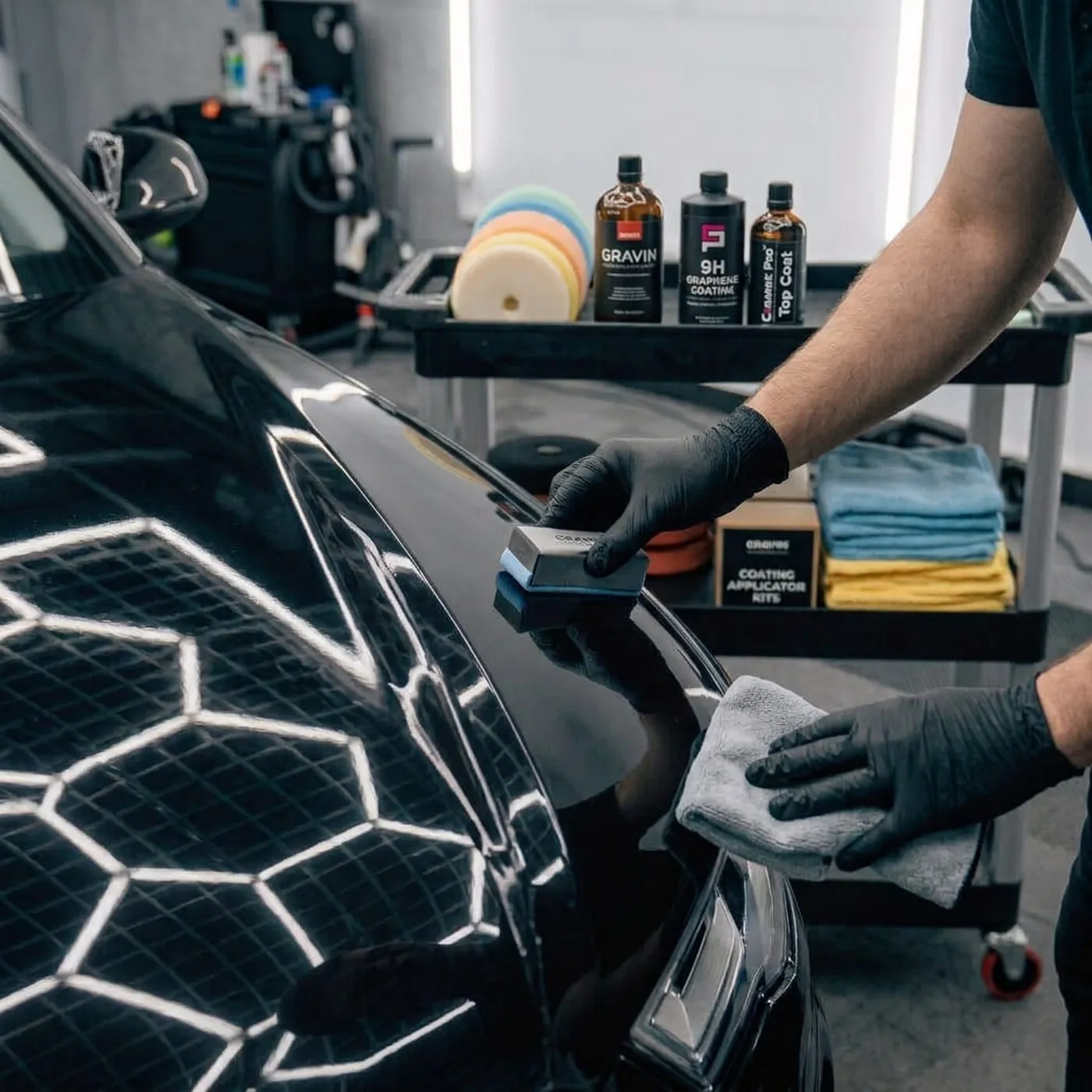
A ceramic coating is a liquid layer that bonds to your clear coat and cures hard, slick and glossy. Water beads off, grime lets go and washing gets quicker. We decontaminate and correct the paint first, then coat it by hand in a clean indoor bay at Revesby or Condell Park.
Prep decides more than the chemistry
A coating bonds to whatever is on the paint when it goes on. If that's swirls and old wax, that's what gets sealed in. The steps below are the same for graphene and ceramic, and they're where a good result is won or lost.
Wash and decontaminate
The car is washed, then iron fallout and tar are removed and the paint is clayed until it's smooth to the touch.
Correct the paint
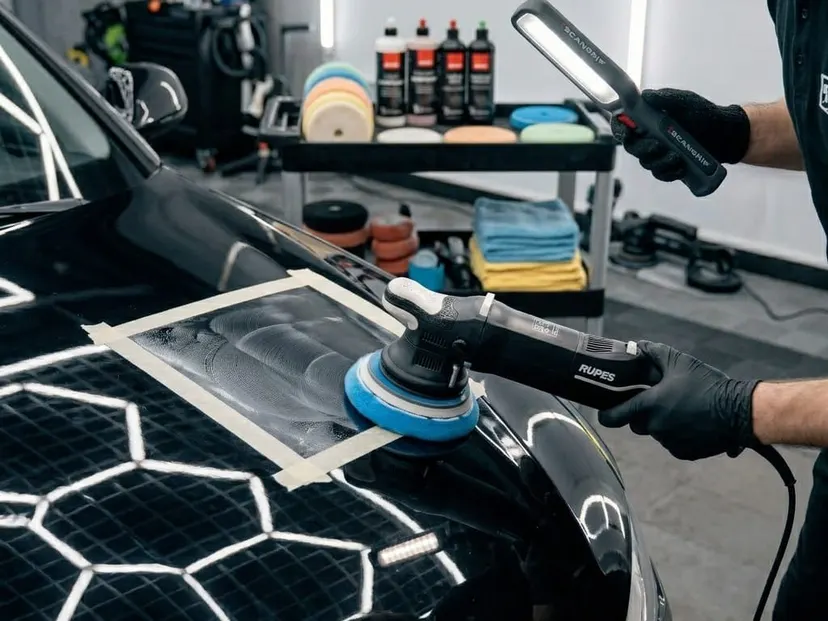
Swirls and light scratches are machine-polished out, so the coating seals in clear, glossy paint. Our guide to what paint correction is explains the stages.
Strip oils with a panel wipe
Polishing oils are wiped off so the coating bonds to bare clear coat. GYEON, for example, specifies an oil-free, fully dry surface and a prep product before its coating.[9]
Apply panel by panel
The coating is spread in small sections and levelled off before it flashes. GYEON says to wipe its One EVO off within 10 to 30 seconds of applying.[9]
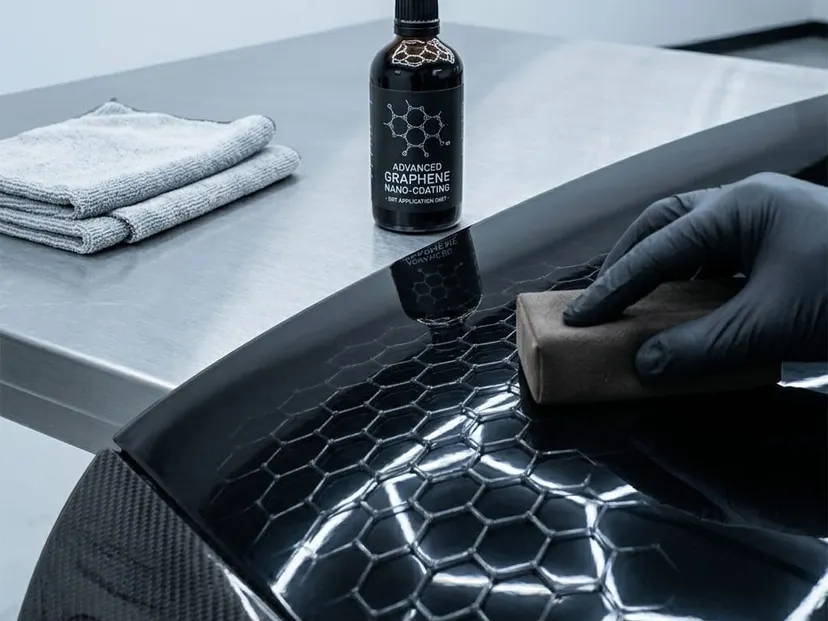
Let it cure
Keep the car dry and out of the sun while the coating cures. GYEON says to keep its One EVO away from direct sun and water for the first 12 hours.[9]
Looking after either coating
The care routine is the same for both types, and it's what keeps a coating working for its rated life.
Wash with a pH-neutral shampoo and a mitt. Gtechniq bases its coating life on washing this way.[3]
Avoid brush car washes. Gtechniq notes a thin ceramic layer has limits against automatic car washes and hedges.[3]
Dry the car after rinsing. Gtechniq says never to let tap water dry out on your vehicle.[3]
Top it up. Chemical Guys recommends a coating booster or ceramic detail spray to refresh the water beading between full reapplications.[1]
Remove droppings and sap quickly. A coating buys you time, but it's still best to lift them the same day.
What decides the cost of a coating
We don't publish prices, because the work behind a coating varies so much from car to car. These are the things that set the quote:
The product. Entry-level, professional or graphene-reinforced, and how many layers go on.
Paint correction. A new car may need a light polish; an older car may need a full correction first.
The size of the car. More panels mean more prep and more coating.
Extras. Wheels, glass, trim and any filmed panels can be coated too.
Send us the make, model and year, and a few photos of the paint, through our quote request page. We'll come back with a written quote.
Graphene and ceramic coating questions
Is graphene coating better than ceramic coating?
Not across the board. Graphene coatings are marketed for fewer water spots and better heat dispersion, while ceramic has the longer track record and slightly deeper gloss.[1] For most daily drivers the difference is small next to prep and care.
Is a graphene coating just a ceramic coating?
Mostly, yes. The Rag Company describes graphene coating as a variant of ceramic coating with graphene oxide added to an SiO2 formula.[2] The graphene changes how the coating behaves, but it still cures as a thin coating on the paint.
Is graphene coating worth it in Australia?
It can be if your car lives outdoors in strong sun and you fight water spots, because those are graphene's claimed strengths. Sydney's mains water is classed as soft, which reduces the water-spot advantage here.[7] A good ceramic coating is still a strong choice.
How long does graphene coating last?
It depends on the product, as with ceramic. IGL rates its graphene-reinforced Kenzo at up to five years of protection.[6] Chemical Guys says graphene coatings are rated similarly to professional ceramic coatings.[1]
Can you put a graphene coating over a ceramic coating?
Some systems allow it. Chemical Guys says that in some systems a ceramic base coat can be topped with a graphene layer, but to always follow the product's instructions.[1] Ask your installer whether the two products are designed to work together.
Does graphene coating stop rock chips?
No. Like ceramic, it's far too thin to absorb an impact, and Chemical Guys says neither type protects against rock chips.[1] Paint protection film is the product for chips.
Can graphene coating go on paint protection film or matte paint?
Some can. IGL lists its Kenzo as safe on PPF, vinyl and matte paint.[6] Always check the product is approved for your surface, and check the film maker's warranty rules on coatings.
Not sure which suits your car? Visit our Revesby workshop or our Condell Park workshop and we'll look at the paint with you. We'll tell you how much correction it needs and which coating fits the way you drive and park.
Sources
- [1]Chemical Guys. Ceramic Coating vs. Graphene: A Side-by-Side Comparison, 2026-06. ↑
- [2]The Rag Company. Graphene vs. Ceramic Coating: Full Comparison (2026), 2026. ↑
- [3]Gtechniq Australia. Gtechniq Australia FAQs, 2026. ↑
- [4]XPEL. Frequently Asked Questions (FAQs), 2026. ↑
- [5]The University of Manchester, Graphene at Manchester. History, 2026. ↑
- [6]IGL Coatings. Ecocoat Kenzo Graphene Reinforced, 2026-09. ↑
- [7]Sydney Water. Water analysis, 2026. ↑
- [8]Cancer Council Australia. UV Index, 2026. ↑
- [9]GYEON. Q² One EVO, 2026. ↑
- [10]XPEL Australia. Warranty Information, 2026. ↑
About the author
Founder, Tinting Xperts
Mohammad Habboushi founded Tinting Xperts in 2016 with one bay, one squeegee and a rule the team still works to: if it isn't right, it doesn't leave. The business has grown to two workshops, at Revesby and Condell Park, and a team of more than 30 fitters, and Mohammad still fits cars on the floor most days.


