
Comparison · Paint Protection
PPF vs ceramic coating: which protects your paint better?
Film stops stone chips, a coating makes paint glossy and easy to clean, and the right choice depends on how and where you drive.
Written and reviewed by Mohammad Habboushi, Founder of Tinting Xperts
· 11 min read

Key takeaways
- PPF is a thick, clear urethane film that absorbs stone chips; a ceramic coating is a thin glass-like layer that does not.
- A ceramic coating adds gloss, water beading and stain resistance, and makes washing faster.
- Premium films carry manufacturer warranties of up to ten years against yellowing, cracking and peeling.
- You can put a ceramic coating over PPF, but check the film maker's warranty rules on which coating to use.
- For a new car driven daily on Sydney motorways, film on the front plus a coating over the whole car covers both risks.
PPF vs ceramic coating comes down to what you need protecting from. Paint protection film is a thick, clear urethane layer that soaks up stone chips and scratches. A ceramic coating is a thin, hard, glossy layer that repels water and grime. Film stops impact damage. A coating doesn't. Many owners use both.
This guide compares them point by point: what each one is, what it stops, how long it lasts, how you look after it and what decides the cost. Then it tells you which to choose for a new car, a daily driver on Sydney motorways and a track car. If you already know you want film, our paint protection film service page explains how we fit it.
PPF vs ceramic coating: the short answer
If stone chips are your worry, choose film. If you want a glossy car that's quicker to wash and harder to stain, choose a coating. If you want both, put film on the panels that face the road and a coating over everything.
| Criterion | Paint protection film (PPF) | Ceramic coating |
|---|---|---|
| What it is | A clear, flexible urethane film with an adhesive back | A liquid with silicon dioxide (SiO2) that cures into a thin, glass-like layer |
| Thickness | About 150 microns | About 1 micron |
| Stone chips | Absorbs the impact of small stones and grit | No meaningful protection |
| Fine scratches and swirls | Top coat self-heals light marks with heat | Resists light wash marring, but scratches can still go through |
| Bird droppings, sap and bugs | Film takes the etching instead of the paint | Slows etching and makes them easier to wipe off |
| UV and chemicals | Shields paint under the film | Resists UV and wash chemicals on the surface |
| Gloss and water beading | Gloss or satin finish; beading depends on the top coat | Strong gloss boost and water beading |
| Manufacturer warranty | Up to 10 years on premium films | Depends on the product; one professional coating carries a 9-year guarantee |
| Coverage | Usually high-impact panels, or the whole car | Usually the whole car, plus wheels and glass |
| Removal | Peels off with heat when fitted to factory paint | Wears away or is machine-polished off |
The thickness figures come from Gtechniq, a coating maker, comparing its own coatings with film.[1] The warranty figures come from the film and coating makers' own published terms, covered in detail below.[2][3]
What paint protection film is
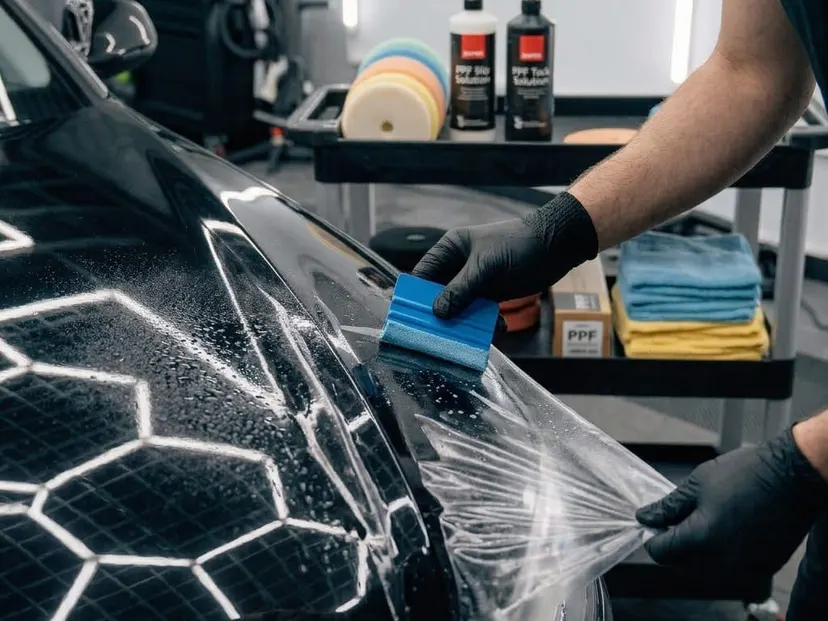
Paint protection film, or PPF, is a clear urethane film laid over painted panels. It's cut to the shape of each panel and stretched on with a slip solution, then the edges are tucked or trimmed. XPEL describes its film as a transparent, durable polyurethane film that guards paint from scratches, chips and stains.[4]
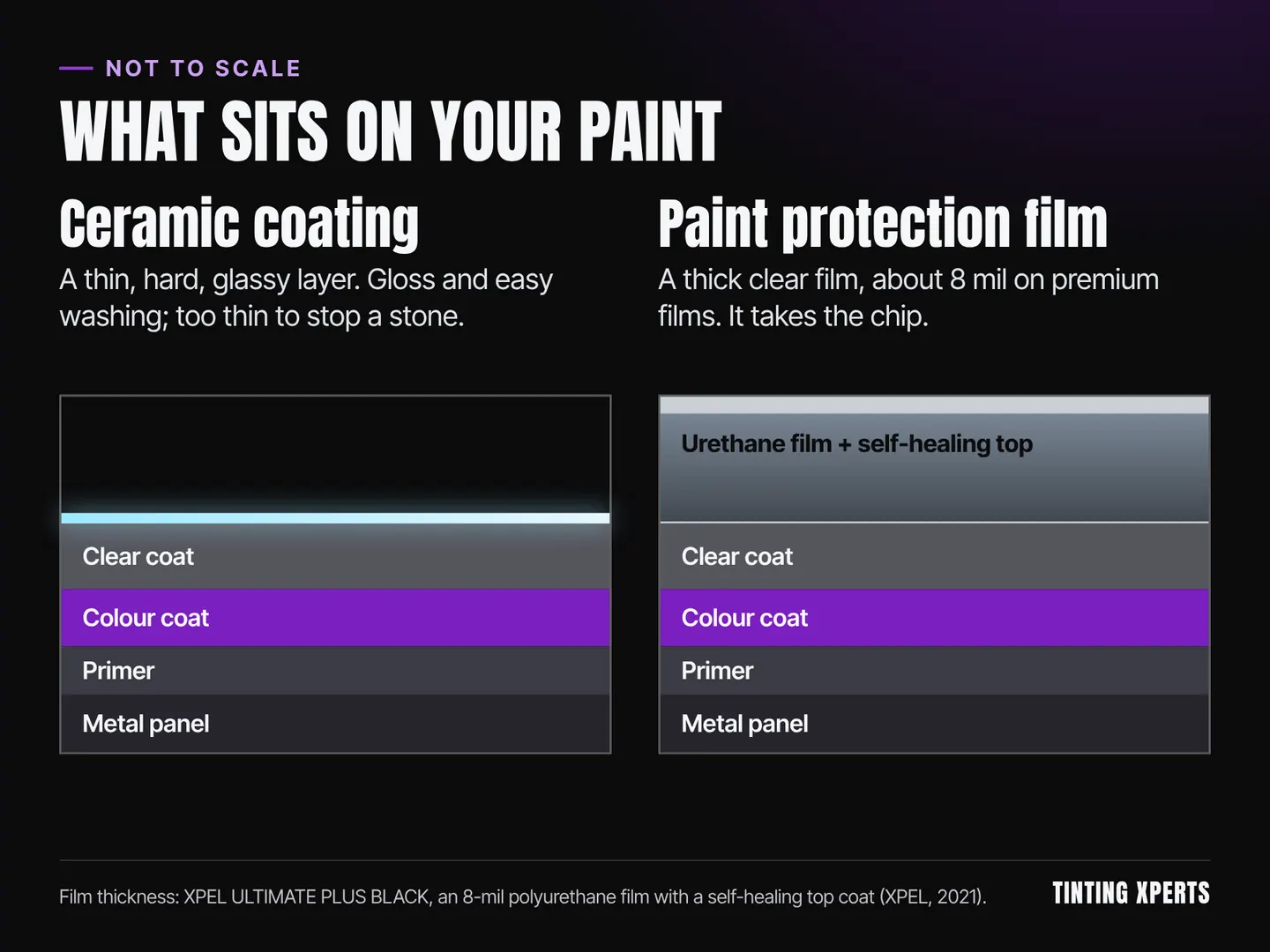
Thickness is the point. XPEL says its ULTIMATE PLUS film is 8 mil thick, which is roughly two-tenths of a millimetre.[4] That's enough body to spread the energy of a flicked stone before it reaches the clear coat.
Self-healing: what it fixes and what it doesn't
Most premium films have an elastic top coat that closes up light scratches when it warms. XPEL says its film can self-heal minor scratches and swirls, but deeper cuts through the film may need repair or replacement.[4] SunTek says its Ultra film heals with heat from the sun or the engine.[5]
In practice, self-healing deals with the fine marks from washing, fingernails round door handles and brushing past in a car park. It won't undo a gouge from a key or a deep rock strike.
Gloss, matte and the edges
Film comes in gloss and in satin or matte versions. 3M lists both gloss and matte versions of its Scotchgard Pro Series film in Australia, so you can protect a factory matte finish without making it shiny.[6] On a well-fitted job you have to look closely to see film. XPEL notes that the edge may be slightly visible depending on your paint colour, and that good installers blend the edges to keep it discreet.[4]
What a ceramic coating is
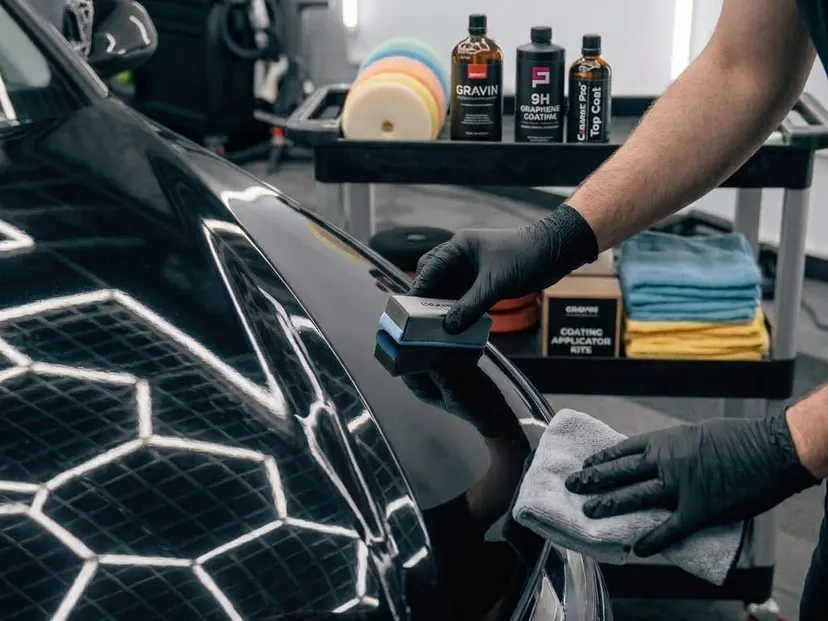
A ceramic coating is a liquid wiped onto clean, polished paint. It cures into a hard, slick layer bonded to the clear coat. XPEL says ceramic coating is primarily made from a liquid polymer containing silicon dioxide (SiO2), which forms a glass-like layer.[4]
The layer is very thin. Gtechniq says its coatings are about 1 micron thick, compared with roughly 150 microns for film.[1] That's why a coating can't stop a stone chip. Gtechniq says plainly that coatings can't offer meaningful protection against stone chipping, and that a 1 micron layer of hard ceramic has limits against scratching too.[1]
What hydrophobic really buys you
Coated paint is hydrophobic, so water beads and rolls off and takes loose dirt with it. XPEL says a coating shields against UV rays, bird droppings and road grime, and makes the surface dirt-resistant.[4] Gtechniq says its Crystal Serum Ultra resists strong wash chemicals and bird droppings.[3]
The everyday payoff is time. Grime lets go with a rinse and a light wash, so you scrub less. Less scrubbing means fewer wash scratches, which is how a coating keeps paint looking better for longer.
Protection head to head
Here's how each one handles the damage Sydney cars actually see. The ratings are a plain reading of what the manufacturers cited above claim, not lab results.
| Threat | Paint protection film | Ceramic coating |
|---|---|---|
| Stone chips from trucks and roadworks | Strong: the film absorbs the hit | Weak: too thin to absorb an impact |
| Swirls from washing | Strong: light marks heal with heat | Moderate: slicker surface, fewer marks |
| Bird and bat droppings | Strong: the film takes the etching | Moderate: buys time to wipe them off |
| Tree sap and bug splatter | Strong: easy to remove from the film | Strong: slides off coated paint |
| Fading from UV | Strong: paint sits under the film | Moderate: a sacrificial surface layer |
| Key scratches and deep gouges | Partial: the film may take a shallow one | None: they go straight through |
| Dirt build-up and washing time | Moderate: depends on the top coat | Strong: water beads and rinses clean |
Australia's sun makes the UV row matter more than in most places. Cancer Council Australia says peak summer UV Index values here are regularly above 12, and anything above 11 is classed as extreme.[7] Both products help, but only film puts a physical layer between the sun and your clear coat.
How long PPF and ceramic coatings last
10 years
XPEL's limited warranty on ULTIMATE PLUS film against yellowing, cracking, blistering and delaminating[2]
Film makers back their premium films for a long time. XPEL Australia warrants ULTIMATE PLUS and STEALTH film for ten years from installation against yellowing, cracking, blistering and delaminating.[2] 3M's Australian warranty card gives its Scotchgard Pro Series 200 and Series 150 films ten years, and Series 100 seven years.[6] SunTek backs its Ultra film for ten years against cracking, bubbling and yellowing.[5]
Real life varies with sun, mileage and care. XPEL says PPF typically lasts between 5 to 10 years, depending on the film and the conditions it faces.[4] SunTek says its films are designed to last at least 5 and up to 12 years, depending on the product.[8]
Coatings range much more widely, because "ceramic coating" covers everything from spray sealants to multi-layer professional systems. Gtechniq gives its professional-only Crystal Serum Ultra a nine-year guarantee, provided the car is looked after and washed with suitable products.[1] Its lighter EXO coating is rated for up to 18 months.[1] Our guide on how long ceramic coating lasts goes into the detail.
What the warranties don't cover
Read the exclusions before you compare years. They change what the number means.
Impact damage. XPEL's warranty excludes damage from the physical impact of rocks or road debris, and so does 3M's.[2][6] The film is designed to be sacrificial: it takes the hit so your paint doesn't.
Wash damage. XPEL excludes damage from automatic car washes and improper washing.[2]
Removal from repaired paint. 3M's card excludes paint that lifts when the film is removed, and the warranty isn't transferable to a new owner.[6]
Professional installation. XPEL's warranty only applies to film professionally installed the way the company recommends.[2]
Maintenance: living with each one
Neither product means you never wash the car. Both last longer with gentle, regular washing, and both are damaged by harsh brushes. XPEL recommends touchless washes or hand washing over brush car washes for filmed cars.[4] Gtechniq recommends a pH-neutral shampoo and a wash mitt for coated cars.[1]
Rinse first
Hose or pressure-rinse the whole car from the top down to lift loose grit before anything touches the paint. Keep a pressure washer nozzle well back from film edges.
Wash with two buckets
Use one bucket of pH-neutral shampoo and one of clean rinse water. XPEL recommends this two-bucket method with a soft microfibre wash mitt.[4]
Dry with a soft towel
Blot or drag a clean microfibre drying towel across each panel. Coated paint sheds most of the water for you.
Deal with droppings and sap quickly
Soften them with a quick detailer spray, wait a moment, then lift them off. Don't scrape.
Top up the protection
Use a maintenance spray made for your coating or film. It refreshes the water beading and makes the next wash easier.
Can you put ceramic coating over PPF?
Yes, and it's the most popular way to combine them. The film handles impacts. The coating on top adds gloss and beading, and keeps the film's surface cleaner. XPEL's own answer is direct:
Yes, you can coat paint protection film (PPF) with ceramic coating to enhance its protective properties.
Two cautions. First, order matters. Gtechniq warns that film and vinyl won't stick to paint that has already been coated, so the film goes on first and the coating goes over it.[1] Second, check the film's warranty rules. XPEL's warranty excludes damage from non-XPEL branded ceramic coatings, so ask your installer which coating keeps your film warranty intact.[2]
The usual sequence on a new or near-new car is: decontaminate and correct the paint, fit the film, then coat the whole car including the filmed panels. Our guide what is paint correction explains why that first step matters before any protection goes on.
Which should you choose?
For a brand-new car
This is the best time for film. The paint is as good as it will ever be, so there's nothing to correct and no chips to seal in. Film on the front, mirrors and door edges, and a coating over the whole car, is the combination most owners pick. If you can only do one, decide whether chips or washing bother you more.
For a daily driver on Sydney motorways
Commuting on the M5, the M7 or the M4 means sitting behind trucks, utes and trailers, often past roadworks with loose aggregate. That's stone-chip country. Front-facing panels take nearly all of it: the bumper, the leading edge of the bonnet, the headlights and the mirrors. Film on those panels is the protection that changes the outcome. A coating on its own won't stop a single chip.
For a track car or weekend toy
Track days throw rubber, gravel and debris at the front of the car at speed. Film is the only one of the two that helps. Many track owners add film to the rocker panels and the area behind the wheels as well. A coating is optional here; it mainly makes cleaning off rubber and brake dust easier afterwards.
For an older car, or one you'll sell soon
If the paint already has chips and swirls, film will seal them in. A paint correction followed by a coating usually gives the bigger visual lift. If you're selling within a year or so, a correction and coating makes the car present well without the cost of film.
Our service
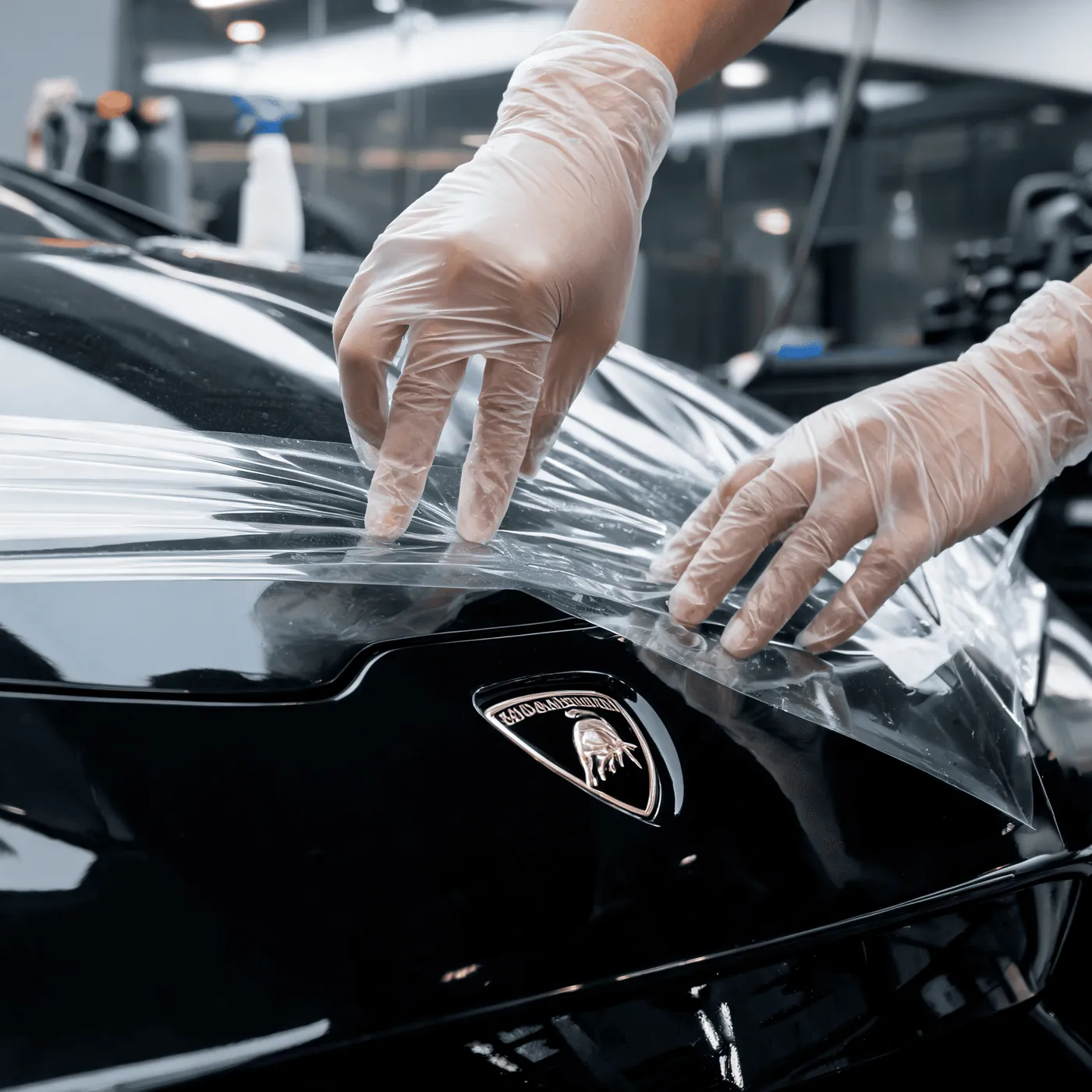
Paint protection film is a clear, self-healing urethane layer fitted over your paint. It takes the stone chips, grit and scuffs that would mark the panels. We correct the paint, then fit gloss, matte or colour film, from partial front to full body, at Revesby and Condell Park.
Our service
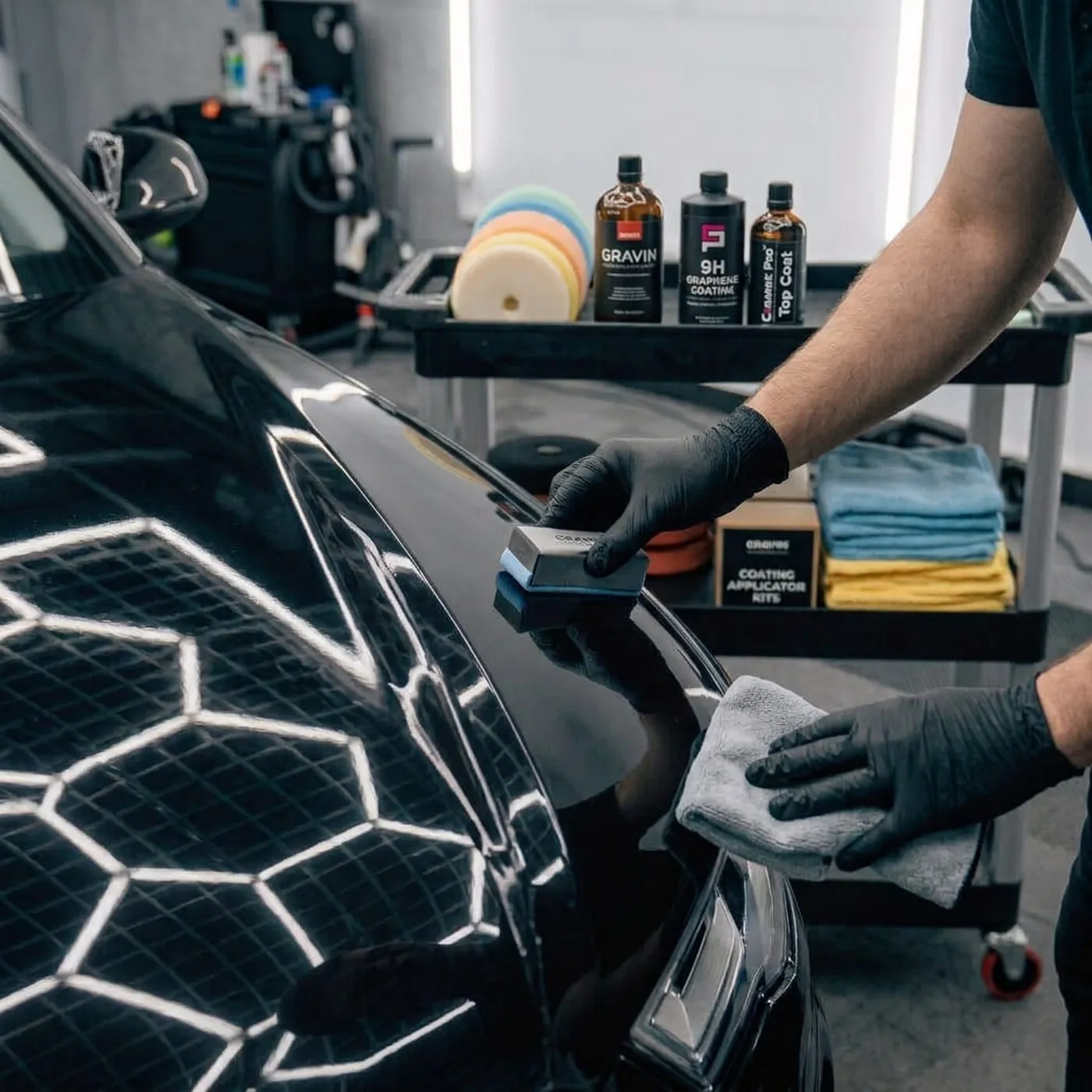
A ceramic coating is a liquid layer that bonds to your clear coat and cures hard, slick and glossy. Water beads off, grime lets go and washing gets quicker. We decontaminate and correct the paint first, then coat it by hand in a clean indoor bay at Revesby or Condell Park.
What decides the cost of each
We don't publish prices because every car is different. These are the things that set the quote:
Coverage. A few high-impact panels, a full front, a track pack or the whole car.
The size and shape of the car. Deep vents, sharp creases and complex bumpers take longer to film.
The film or coating you choose. Gloss or matte film, and a single-layer or multi-layer coating.
Paint condition. Paint that needs correcting first adds a stage before anything goes on.
Trim removal. Taking off badges and lights lets film wrap further round edges, but takes more time.
Send us the make, model and year, and what you want covered, through our quote request page. We'll come back with a written quote.
PPF and ceramic coating questions
Is PPF better than ceramic coating?
PPF is better at stopping physical damage like stone chips and scratches, because it's far thicker. A ceramic coating is better at adding gloss and making the car easy to clean. XPEL says many owners combine the two for complete protection.[4]
Does ceramic coating stop stone chips?
No. A ceramic coating is only around a micron thick, so it can't absorb a stone's impact. Gtechniq, which makes coatings, says they offer no meaningful protection against stone chipping.[1] Only film does that.
Can you put ceramic coating on top of PPF?
Yes. XPEL says coating PPF adds protection, makes it easier to clean and enhances its gloss.[4] Fit the film first, then coat it, and check the film maker's warranty rules on which coating you can use.
How long does PPF last compared with ceramic coating?
Premium films carry warranties of up to ten years, and XPEL says PPF typically lasts between 5 to 10 years.[4] Coatings vary by product, from about 18 months for a light coating to a nine-year guarantee for a professional one.[1]
Does PPF turn yellow?
Modern urethane films are made to resist yellowing, and the major brands warrant against it. XPEL, 3M and SunTek all list yellowing among the defects their film warranties cover.[2][6][5]
Will removing PPF damage my paint?
Not when it's done correctly on factory paint. XPEL says removing film properly won't harm the paint.[4] Resprayed or repaired panels are a different story, and 3M's warranty excludes paint that lifts during removal.[6]
Is ceramic coating worth it if I already have PPF?
It's worth it if you want stronger water beading and easier washing on the filmed panels, and gloss on the rest of the car. It also protects the unfilmed panels from UV and stains. It won't add chip protection.
You can see film and coated finishes in person at our Revesby workshop or our Condell Park workshop. Bring the car and we'll show you which panels take the most damage on your daily drive.
Sources
- [1]Gtechniq Australia. Gtechniq Australia FAQs, 2026. ↑
- [2]XPEL Australia. Warranty Information, 2026. ↑
- [3]Gtechniq Australia. Crystal Serum Ultra, 2026. ↑
- [4]XPEL. Frequently Asked Questions (FAQs), 2026. ↑
- [5]SunTek. Paint Protection Film Ultra, 2026. ↑
- [6]3M Australia. 3M Paint Protection Film Warranty Information (Australia and New Zealand), 2024. ↑
- [7]Cancer Council Australia. UV Radiation Prevention Policy: UV radiation, 2020-06. ↑
- [8]SunTek. Select the PPF Product and Performance You Need, 2026. ↑
About the author
Founder, Tinting Xperts
Mohammad Habboushi founded Tinting Xperts in 2016 with one bay, one squeegee and a rule the team still works to: if it isn't right, it doesn't leave. The business has grown to two workshops, at Revesby and Condell Park, and a team of more than 30 fitters, and Mohammad still fits cars on the floor most days.


