
Guide · Paint Protection
Is paint protection film worth it? An honest guide for Sydney drivers
What clear film really stops, what it doesn't, how long it lasts and which cars and drivers get the most out of it.
Written and reviewed by Mohammad Habboushi, Founder of Tinting Xperts
· 13 min read

Key takeaways
- Paint protection film is worth it when stone chips are your main risk: new or near-new cars, dark paint and regular motorway driving.
- Film absorbs chips and heals light swirls with heat, but it won't stop a deep gouge, a dent or a car park scrape that cuts through it.
- Premium films carry manufacturer warranties of up to ten years against yellowing, cracking and peeling, but none cover impact damage.
- A full front is the usual sweet spot; full-car film suits owners who want every panel kept factory-perfect.
- It's harder to justify on a car you'll sell soon, on paint already full of chips, or where the fit would be rushed.
Is paint protection film worth it? For a new or near-new car that sees regular motorway driving, usually yes. Clear film soaks up the stone chips that ruin a bonnet and bumper, and premium films are warranted for years. It's harder to justify on a car you'll sell soon or on paint that's already chipped.
That's the short version. The honest answer depends on your car, your driving and how long you'll keep it. This guide explains what film really stops, what it can't, how long it lasts and what the warranties leave out. Then it works through the cases where film pays off and where it doesn't. When you're ready, our paint protection film service page shows how we fit it.
Is paint protection film worth it? The short answer
Film is a physical layer between your paint and the road. Its value comes from one thing above all: stopping chips that would otherwise need touching up or respraying. So the more chips your car is likely to collect, and the more you care about original paint, the more film is worth.
It's usually worth it when:
The car is new or the paint is still in great condition. There's nothing to seal in, and you keep the factory finish.
You drive the motorways often. Following trucks, utes and trailers flicks grit at the front of the car every trip.
The paint is dark, matte or hard to match. Chips and swirls show up clearly on dark colours, and matte finishes can't simply be polished.
You plan to keep the car for years. Premium films are made to last most of a typical ownership.
You'd rather not use touch-up paint or a respray. Film keeps the factory paint you paid for.
It's usually harder to justify when:
You'll sell or hand the car back within a year or two. You may not get the benefit for long.
The paint is already chipped and swirled. Film seals existing damage in unless it's fixed first.
Your worry is gloss and easy washing, not chips. A ceramic coating does that job on its own.
The only option is a rushed or poorly fitted job. Lifting edges and trapped dust undo the point of film.
What paint protection film actually protects against
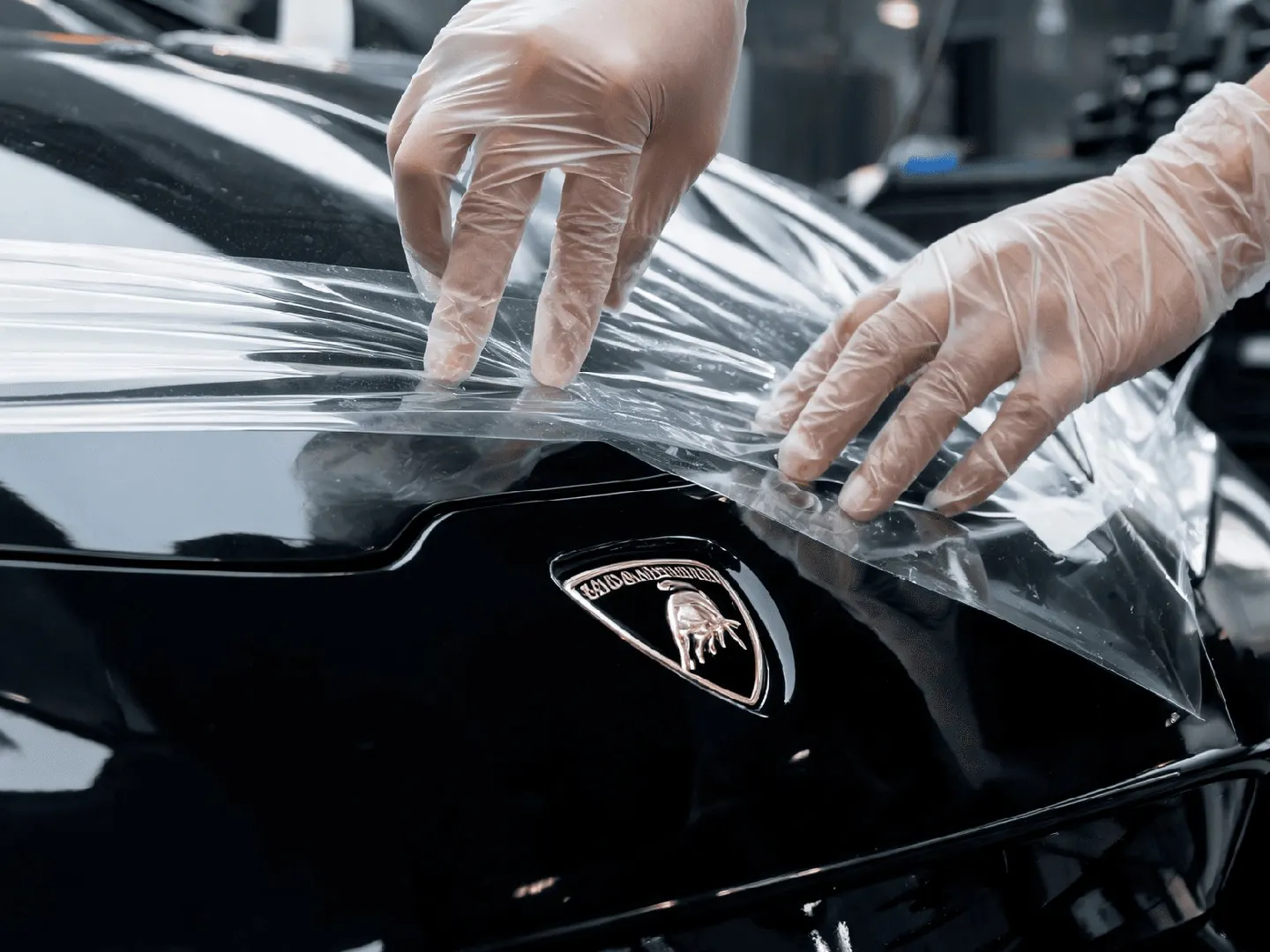
Paint protection film, or PPF, is a clear urethane film laid over painted panels. XPEL describes it as a transparent, durable polyurethane film that protects paint from scratches, chips, stains and environmental damage.[1] It's thick for a film: XPEL's ULTIMATE PLUS is 8 mil, roughly two-tenths of a millimetre.[1] That body is what absorbs a flicked stone before it reaches the clear coat.
Stone chips and road debris
This is the job film is built for. XPEL says the film absorbs the impact of rocks and debris, so the paint underneath stays intact.[1] SunTek says each of its films is designed to help protect against rock chips.[2]
Chips land almost entirely on panels that face forward. That's the front bumper, the leading edge of the bonnet, the headlights, the mirror caps and the front of the guards. Behind the wheels and along the sills, grit thrown up by your own tyres does the damage.
Swirls, light scratches and self-healing
Premium films have an elastic top coat that closes up fine marks when it warms. XPEL says its film self-heals minor scratches and swirls, but deeper scratches through the film may need repair or replacement.[1] SunTek says its Ultra film heals with heat from the engine or the sun.[3]
In everyday terms, self-healing deals with wash marks, fingernail scuffs round door handles and brushes from bags or clothing. It won't undo a key scratch or a deep stone strike. Here's XPEL showing how its current film behaves:

Bird droppings, sap, bugs and sun
Droppings, sap and bug splatter etch whatever surface they sit on, and the film takes that etching instead of your clear coat. SunTek's Ultra has a stain-resistant top coat designed to shield against water, insects, road debris and other stains.[3]
Sun matters more in Australia than most places. Cancer Council Australia says Australia has some of the highest levels of UV radiation in the world.[4] XPEL says quality film keeps paint safeguarded against UV damage as well as chips.[1] Paint under film is shaded from the worst of it.
What film won't stop
Be clear-eyed about the limits. Film is a sacrificial layer, not armour.
| Damage | Does film help? | What to expect |
|---|---|---|
| Stone chips from motorway driving | Yes | The film takes the hit; the paint underneath stays intact |
| Wash swirls and fine scratches | Yes | Light marks heal with heat from the sun or warm water |
| Bird droppings, sap and bugs | Yes | The film's top coat takes the etching instead of the clear coat |
| Fading and oxidation | Yes | Paint under the film is shielded from direct sun |
| Deep gouges and key scratches | Partly | A cut through the film may need that panel re-filmed |
| Dents and minor door dings | Partly | Film may soften a light touch but won't stop a dent |
| Large rocks at speed | Partly | A big strike can still mark or tear the film |
XPEL says film can help reduce the impact of minor door dings, but may not completely prevent damage from more severe impacts.[1] The same is true of a large rock: it can mark or tear the film, which is then replaced on that panel.
Film now, or fix chips later?
The real comparison isn't film against nothing. It's film against what you'll do about chips as they appear. There are three common ways to deal with them, and each one has a catch.
Touch-up paint. Cheap and quick, but a touch-up is rarely invisible up close, and it doesn't restore the factory finish.
A respray of the panel. It can look excellent, but the panel is no longer original paint, and colour matching on metallic and pearl finishes takes skill.
Living with them. Chips on the front are common, but on a newer or prestige car they're the first thing a buyer or valuer notices.
Film avoids all three by keeping the original paint intact. That's why it makes the most sense early, while the paint is still perfect. If your car already has chips and swirls, our guide to what paint correction involves explains how the paint is brought back first.
How long PPF lasts, and what the warranty really covers
10 years
XPEL Australia's limited warranty on ULTIMATE PLUS film, from installation, against yellowing, cracking, blistering and delaminating[5]
Premium films are backed for a long time. XPEL Australia warrants its ULTIMATE PLUS and STEALTH films for ten years against yellowing, cracking, blistering and delaminating.[5] SunTek backs professionally installed Ultra for ten years against cracking, bubbling and yellowing.[3] 3M's Australian warranty card lists up to ten years against yellowing, bubbling and cracking, depending on the film series.[6]
Real-world life depends on sun, mileage and care. XPEL says PPF typically lasts between 5 to 10 years, depending on film quality, installation and conditions.[1] SunTek says its professionally installed films are designed to last at least 5 and up to 12 years, depending on the product.[2]
Not every film is the same grade
Makers sell films at different levels, and the warranty tells you which is which. XPEL's own Australian terms give its PROTEX Lite film five years, against ten for ULTIMATE PLUS.[5] Ask your installer which film they're quoting, and ask to see the warranty card for it.
What the warranties leave out
Read the exclusions before you compare years. They change what the promise means.
Impact damage. XPEL and 3M both exclude damage from the physical impact of rocks or road debris.[5][6] The film is meant to take the hit; the warranty covers the film itself failing.
Wash damage. XPEL excludes damage from improper washing, automatic car washes and abrasive wash tools.[5]
Paint lifting on removal. 3M's card excludes paint pull during the film removal process.[6]
Professional fitting. XPEL's warranty applies only to film professionally installed the way the company recommends.[5]
Coatings on top. XPEL excludes damage from non-XPEL branded ceramic coatings, so check before you coat filmed panels.[5]
Does paint protection film add resale value?
The film makers say it does. XPEL puts it plainly:
Yes, paint protection film (PPF) is worth the cost as it provides superior protection against scratches, chips, and more, helping to maintain your vehicle's resale value and appearance over time.
Keep in mind that's a film maker talking. Nobody can promise a set return on film when you sell. What film does is protect the things buyers and valuers look at first: chips on the bonnet, swirls on dark paint and signs of respraying. A clean, original front end is easier to sell than a peppered one.
Warranty transfer helps too. XPEL Australia's ULTIMATE PLUS warranty can pass to the next owner for the rest of its term, if they can prove the original installation date.[5] 3M's card says its warranty is not transferable.[6] Keep the paperwork with the car's service records.
Full car, full front or partial: how much film is worth it?
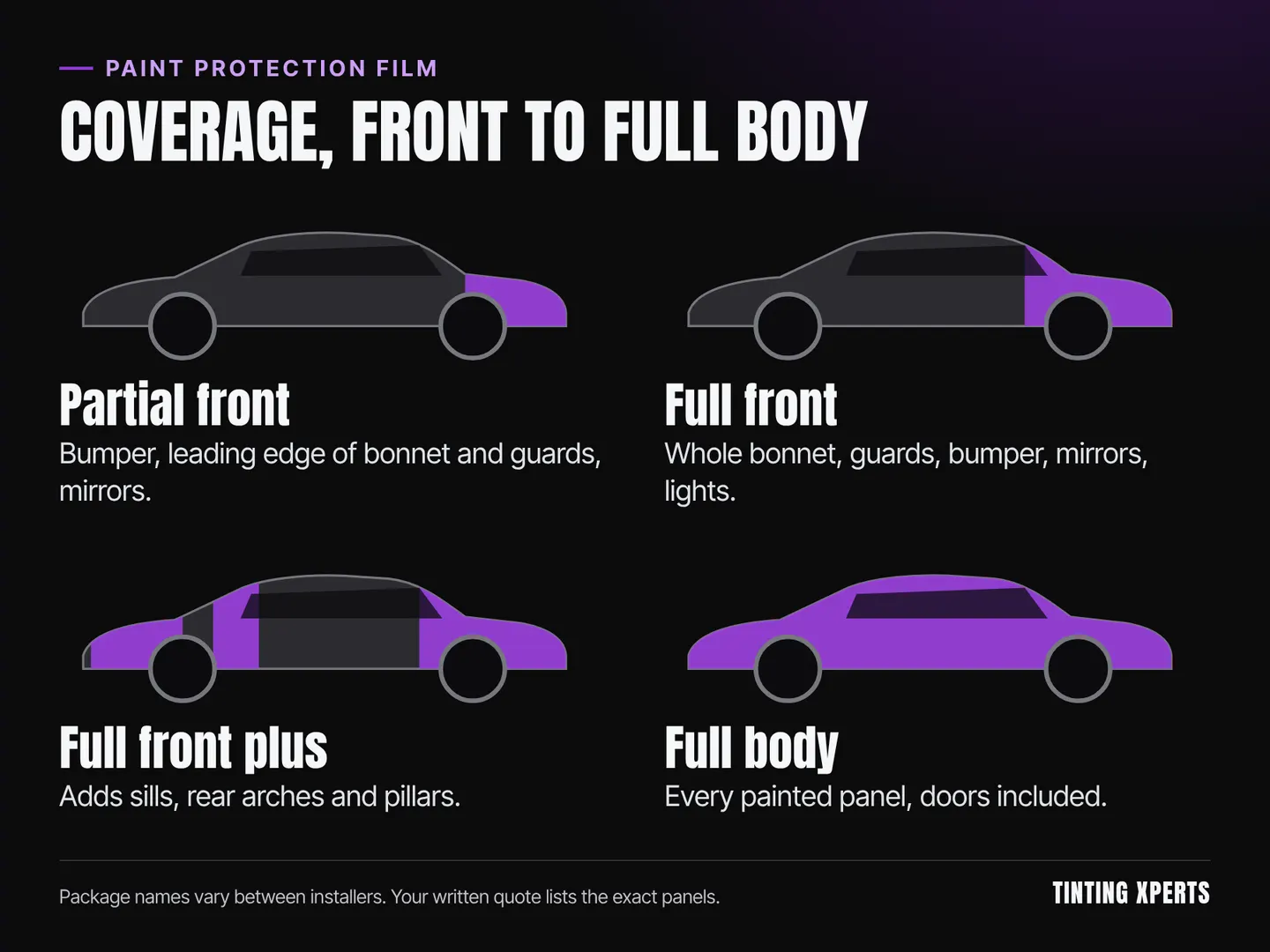
Coverage is the biggest decision after whether to film at all. Most chips land on the front, so most owners start there and add panels as budget and use demand.
| Coverage | Panels usually included | Best for |
|---|---|---|
| Partial front | Front bumper, part of the bonnet and guards, mirror caps | Owners who want the most-hit areas covered on a tighter budget |
| Full front | Front bumper, whole bonnet, both front guards, mirrors and headlights | Most new cars that do regular motorway driving |
| Track pack | Full front plus sills, rear guards behind the wheels and the A-pillars | Performance cars, track days and gravel roads |
| Full car | Every painted panel, sometimes with door jambs | Prestige, matte or collectable cars kept for the long term |
A partial front leaves a line across the bonnet and guards. XPEL says that edge may be slightly noticeable depending on the colour and finish of your car.[1] A full front avoids the line on the bonnet because the whole panel is covered, which is why it's the most popular choice.
Full-car film makes most sense when every panel matters. Matte paint is a good example: it can't be polished like gloss, so a scratch is hard to fix. XPEL's STEALTH film has a satin finish, and SunTek offers a matte version of its film too, so a matte car keeps its look under film.[1][2]
When paint protection film is worth it, car by car
A brand-new car
This is the best time for film. The paint is as good as it'll ever be, so nothing needs correcting and no chips get sealed in. Book the film for the first weeks of ownership, before the first motorway trips leave their mark.
A daily commuter on Sydney motorways
Commuting on the M5, M4 or M7 means hours behind trucks and through roadworks. That's where most chips come from. A full front is the protection that changes the outcome. A ceramic coating alone won't stop a single chip, as our guide to PPF vs ceramic coating explains.
A dark, matte or hard-to-match colour
Black and other dark paints show every chip and swirl. Some metallic and pearl colours are tricky to match when a panel is resprayed. Matte finishes can't be polished at all. Each of these makes film worth more, because the alternatives are harder.
A car you'll sell or hand back soon
If you'll sell within a year or two, film still protects the front, but you won't enjoy it long. A paint correction and a coating often present the car better for the money. If the car is leased, check your lease return conditions on chips before you decide.
An older car with some chips already
Film on chipped paint locks the damage in. Fix the paint first: touch up the chips, then correct the swirls. Then decide whether film or a coating is the better next step. Gtechniq points out that a coating can't offer meaningful protection against stone chipping, so film remains the only chip answer.[7]
The downsides of PPF, honestly
Film has real trade-offs. Weigh them before you book.
It's a significant spend. You're paying for a premium material and hours of careful, panel-by-panel fitting.
The fit matters as much as the film. XPEL recommends professional installation to reduce the risk of bubbles and misalignment.[1]
Edges can be visible up close. Especially on partial kits and on some colours.
Resprayed panels are a risk. Paint that wasn't applied at the factory may lift when film comes off, and 3M excludes paint pull from its warranty.[6]
It changes how you wash. XPEL says frequent automatic washes with harsh brushes can damage film over time.[1]
It isn't invincible. A deep cut or a large rock can still mean re-filming a panel.
None of these are reasons to avoid film. They're reasons to choose the installer carefully and to know what you're buying.
What a good PPF installation looks like
The difference between film that disappears and film that peels is the prep and the fit. Here's what to expect from a careful job, and what to ask about when you compare installers.
Inspect the paint
The car is checked in good light for chips, swirls and any panels that have been resprayed. Anything that would be sealed under the film is pointed out before work starts.
Wash and decontaminate
The paint is washed, clayed and wiped clean so nothing is trapped under the film. Any swirls are polished out first if needed.
Lay and position the film
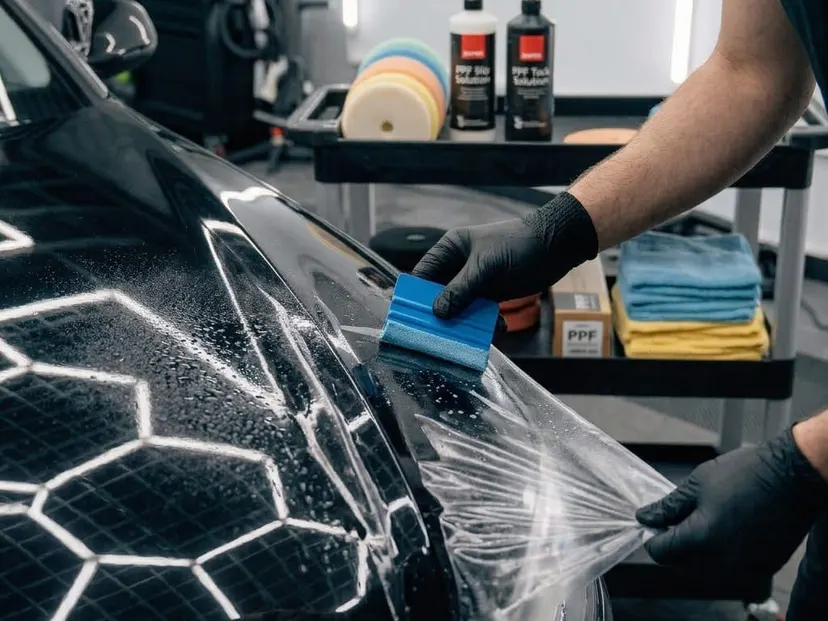
Each piece is laid wet with a slip solution, slid into place and squeegeed down to push out the water. Edges are wrapped or trimmed neatly.
Check the edges and finish
The installer checks every edge, corner and sensor area under light. Lifting edges are dealt with before the car leaves.
Let it settle
XPEL says small bubbles from fitting usually go away within a few days to a few weeks as the adhesive cures.[1] For its COLOR film, it says to wait 72 hours before washing.[1]
Looking after film so it lasts
Film needs less care than bare paint, but it does need the right care. The film makers' own advice is simple.
Hand wash with two buckets. XPEL recommends a two-bucket hand wash with a soft microfibre mitt, then a rinse and a microfibre dry.[1]
Skip brush car washes. XPEL recommends touchless washes or hand washing over automatic washes with harsh brushes.[1]
Keep the pressure washer off the edges. SunTek says to avoid spraying film edges with a high-pressure nozzle to prevent lifting.[3]
Use gentle protection. SunTek suggests a non-abrasive wax once or twice a year.[3] Many owners use a ceramic coating instead; see our guide on how long ceramic coating lasts.
Let heat do the healing. XPEL says warm water or a heat gun activates self-healing for surface marks.[1] SunTek says the sun or engine heat does the same.[3]
Our service
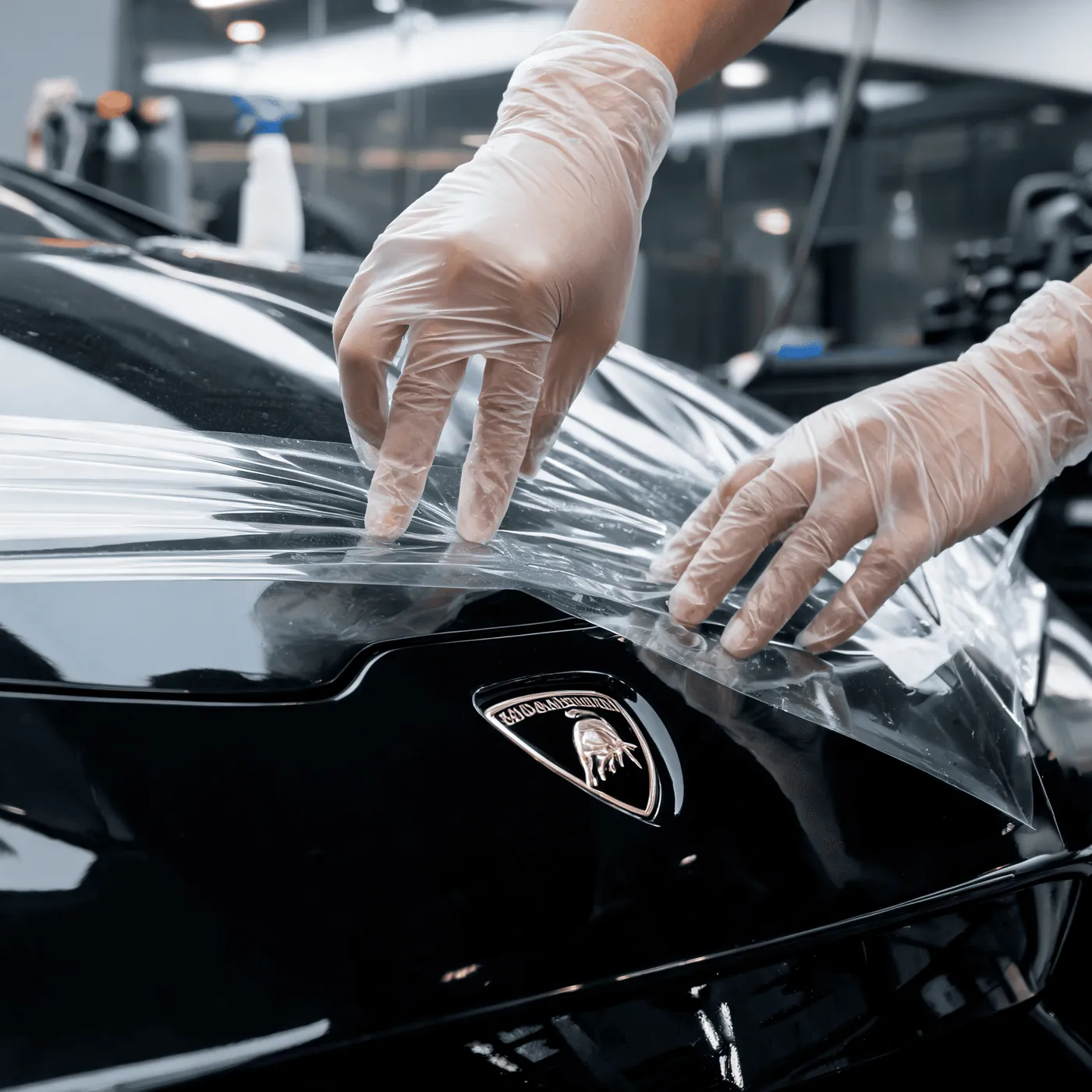
Paint protection film is a clear, self-healing urethane layer fitted over your paint. It takes the stone chips, grit and scuffs that would mark the panels. We correct the paint, then fit gloss, matte or colour film, from partial front to full body, at Revesby and Condell Park.
What decides the cost of PPF
We don't publish prices, because every car and every job is different. These are the things that set the quote:
Coverage. A partial front, a full front, a track pack or the whole car.
The car's size and shape. Deep vents, sharp creases, aero parts and complex bumpers take longer to film.
The film. Gloss or matte, and the grade and warranty you choose.
Paint condition. Paint that needs chips fixed or swirls corrected adds a stage before film goes on.
Trim removal. Removing badges, lights or handles lets film wrap further, but adds time.
Send us the make, model and year, and which panels you want covered, through our quote request page. We'll come back with a written quote.
Paint protection film questions
Is PPF worth it on a new car?
A new car is the best time to fit film, because the paint has no chips or swirls to seal in. A full front covers the panels that take most stone chips. Fitting it in the first weeks protects the factory finish before motorway driving marks it.
Is it worth just doing the front of the car?
For most drivers, yes. Chips land mostly on the bumper, bonnet, headlights and mirrors, so a full front covers the bulk of the risk. XPEL notes that the edge of a partial front kit may be slightly noticeable on some colours.[1]
Does PPF damage paint when it's removed?
Not when it's removed correctly from factory paint. XPEL says removing film properly won't harm the paint.[1] Resprayed panels are riskier, and 3M's warranty excludes paint that lifts during removal.[6]
How long does paint protection film last in Australia?
XPEL says PPF typically lasts between 5 to 10 years, depending on the film, the fit and the conditions.[1] Premium films carry ten-year warranties against yellowing and cracking. Strong sun, high mileage and harsh washing shorten real-world life.
Can you see paint protection film on a car?
On a well-fitted job you have to look closely. Gloss film keeps the paint's shine, and matte film keeps a matte finish. Edges on partial kits can show slightly on some colours, which is why many owners choose full panels.
Does paint protection film stop all scratches?
No. It heals light swirls and fine scratches with heat, but XPEL says deeper scratches through the film may need repair or replacement.[1] It also won't stop dents or a hard car park scrape.
Is PPF better than a ceramic coating?
They do different jobs. Film stops stone chips; a coating adds gloss and makes washing easier, but Gtechniq says coatings offer no meaningful chip protection.[7] Many owners fit film on the front and coat the whole car.
Want to see film on a car before you decide? Visit our Revesby workshop or our Condell Park workshop. Bring your car and we'll show you where it's already collecting chips, and which panels are worth covering. If you'd like gloss and easy washing too, ask about adding a ceramic coating over the film.
Sources
- [1]XPEL. Frequently Asked Questions (FAQs), 2026. ↑
- [2]SunTek. Select the PPF Product and Performance You Need, 2026. ↑
- [3]SunTek. Paint Protection Film Ultra, 2026. ↑
- [4]Cancer Council Australia. UV Index, 2026. ↑
- [5]XPEL Australia. Warranty Information, 2026. ↑
- [6]3M Australia. 3M Paint Protection Film Warranty Information (Australia and New Zealand), 2024. ↑
- [7]Gtechniq Australia. Gtechniq Australia FAQs, 2026. ↑
About the author
Founder, Tinting Xperts
Mohammad Habboushi founded Tinting Xperts in 2016 with one bay, one squeegee and a rule the team still works to: if it isn't right, it doesn't leave. The business has grown to two workshops, at Revesby and Condell Park, and a team of more than 30 fitters, and Mohammad still fits cars on the floor most days.


