
Guide · Detailing & Paint Correction
How to Remove Swirl Marks: Paint Correction Explained
What swirl marks are, why they appear, what polishing can and can't fix, and how paint correction removes them for good.
Written and reviewed by Mohammad Habboushi, Founder of Tinting Xperts
· 7 min read

Key takeaways
- Swirl marks are fine scratches in the clear coat, mostly from washing and drying with grit trapped in the mitt or towel.
- To remove swirl marks for good, the clear coat is machine-polished level with the bottom of the scratches; glazes and waxes only fill them for a while.
- Paint correction is done in stages: a single polish for light swirls, a compound then polish for deeper marring.
- Scratches through the clear coat into the colour can't be polished out; they need touch-up or paint.
- The two-bucket wash, clean towels and a coating after correction stop swirls coming back.
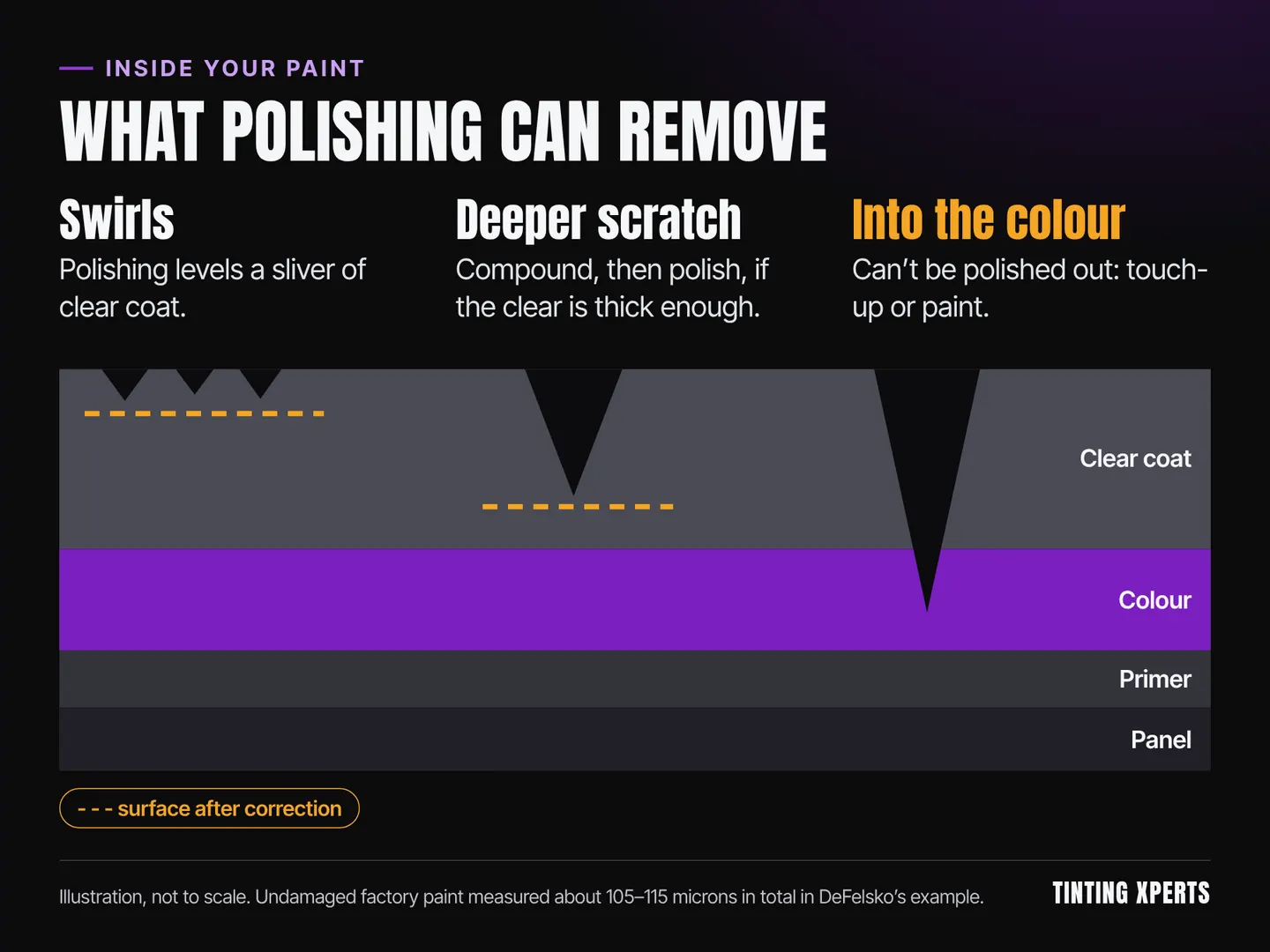
To remove swirl marks properly, the clear coat is machine-polished until its surface sits level with the bottom of the scratches, so there's nothing left to catch the light. That's paint correction. Glazes, waxes and "scratch removers" only fill the swirls, so they come back after a few washes.
Swirls are the fine, circular scratches you see in direct sun or under a torch, especially on dark paint. Nearly every car that's been washed by hand or through a car wash has some. This guide explains where they come from, what can and can't be fixed, and how to keep them from returning.
What swirl marks are, and why they appear
A car's paint has several layers: primer, the colour coat, and a clear coat on top that gives the gloss. Swirl marks are fine scratches in that clear coat. Each one is shallow, but together they scatter light, which is why the paint looks dull and webbed in the sun.
Most swirls come from washing and drying. Grit picked up by the wash mitt gets dragged across the paint, panel after panel. Chemical Guys explains it simply: a mitt rinsed in a single soapy bucket keeps carrying the dirt it just removed back to the car.[1]
Washing with one bucket, or a dirty or dropped mitt.
Automatic car washes with brushes.
Drying with a rough or dirty towel, or wiping a dusty car dry.
Polishing by hand or machine with a contaminated pad.
Brushing snow, dust or leaves off the paint with a cloth.
Can you remove swirl marks at home?
You can hide them at home, and with the right tools and practice you can remove light ones. Hand polishes and glazes contain fillers and oils that sit in the scratches, so the paint looks better for a few weeks. Once those wash out, the swirls are back.
Removing swirls means taking a very thin layer of clear coat off with a machine polisher, an abrasive polish and the right pad. It's a skill: too little and the swirls remain; too much heat or pressure and you can burn through the clear coat, which can only be fixed with paint.
How paint correction removes swirl marks
Paint correction is the professional process of levelling the clear coat to remove swirls and light scratches. It always starts with measurement and inspection, because no two cars have the same paint.
Wash and decontaminate
The car is washed, then treated to remove bonded iron particles, tar and sap. A clay or decontamination step leaves the paint smooth, so the polisher isn't grinding grit into it.
Measure the paint
A paint thickness gauge shows how much paint each panel has. It also reveals resprays: big differences between neighbouring panels strongly suggest repainting.[2]
Inspect under lights
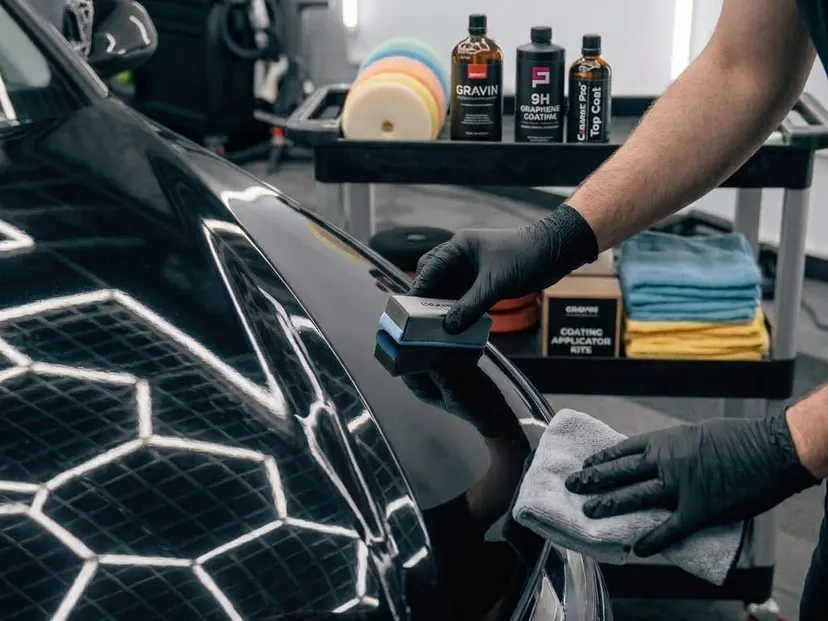
Swirls, scratches and holograms show up under strong inspection lights. Tape protects trim, rubber and edges.
Test a section
A small area is polished with the gentlest combination that works, then checked, before the whole panel is done.
Compound, then polish
Deeper defects get a cutting compound first. A finishing polish then refines the surface to a high gloss.
Wipe down and protect
Polish oils are removed so you see the true finish, then the paint is protected with a coating or sealant.
Paint correction stages, explained
You'll hear correction described in "stages". It describes how many polishing steps the paint gets, which depends on how deep the defects are:
| Stage | What it involves | Best for |
|---|---|---|
| Single-stage (enhancement) | One machine polish that cuts lightly and finishes | Light swirls on newer paint; before a coating |
| Two-stage | A cutting compound, then a finishing polish | Moderate swirls, wash marring, light scratches |
| Multi-stage | Several cutting and refining steps, tested panel by panel | Heavy defects; show cars; dark paint |
More stages aren't automatically better. Every cut removes some clear coat, so the goal is the biggest improvement for the least paint removed. A good detailer will tell you when a defect isn't worth chasing.
Holograms and buffer trails
Not every swirl comes from washing. Holograms, also called buffer trails, are hazy, shifting patterns left by a rotary polisher used badly, often after a quick detail or a dealer's pre-delivery polish. They look like a ghostly film that moves as you walk past the car.
They're fixed the same way as swirls, with a careful machine polish that refines the surface. The difference is that a hologrammed car has already had clear coat removed once, so measuring the paint matters even more.
Swirl marks on a brand-new car
Many new cars arrive with swirls already. Cars are washed at ports and dealerships, sometimes with the same mitt for dozens of cars, and some are machine-polished before delivery. On dark paint, the marks show the first time the car is in full sun.
If you're planning to coat or film a new car, a light correction first is usually worth it. It's the one chance to lock in a flawless finish before the protection goes on.
What paint correction can't fix
If you can catch a fingernail in a scratch, it's likely deeper than the clear coat can safely give up. Correction can't fix these:
Scratches into the colour coat or primer. You'll see a different colour, or white or grey, in the bottom of the scratch.
Stone chips, which are missing paint, not scratches.
Failing clear coat that's peeling, cracking or chalky.
Paint that's too thin from earlier polishing or a poor respray.
These need touch-up, a panel repaint, or, for chips, paint protection film on the front from now on. Our guide to whether paint protection film is worth it covers that option.
Can a car wash cause swirl marks?
Yes, and brush car washes are one of the most common causes. The brushes clean dozens of cars a day and hold grit from all of them, which is dragged across your paint at speed. Hand car washes can do the same if they use one bucket and the same mitt for every car.
Touchless washes are gentler, because nothing rubs the paint, but they rely on stronger chemicals to loosen dirt. For a car you care about, a careful hand wash at home, or a detailer who uses the two-bucket method, is the safest option.
How to stop swirl marks coming back
Wash with two buckets
Use one bucket of shampoo and one of clean rinse water, ideally each with a grit guard. Rinse the mitt in the clean bucket after every panel, before it goes back into the shampoo.[1] Start from the roof and work down, leaving the dirtiest lower panels until last.
Dry gently
Use a clean, plush microfibre drying towel, or a blower, and pat or glide rather than scrub. Wash microfibres separately, without fabric softener, and throw away any that have been dropped.
Protect the finish
A ceramic coating makes the surface slicker, so dirt lets go with less rubbing, and that alone means fewer new swirls. Our guide to how long ceramic coating lasts has a washing routine for coated cars, and our comparison of graphene and ceramic coatings helps you choose.
Our service
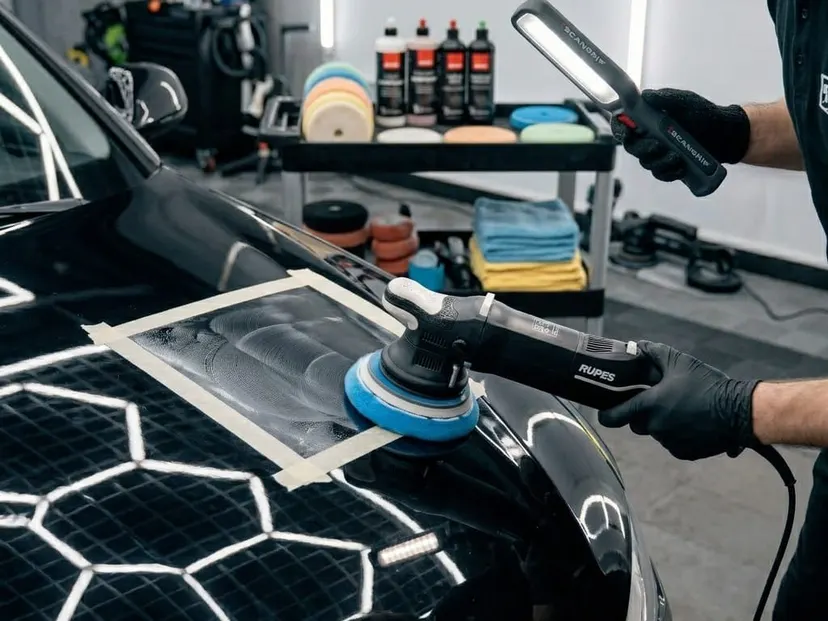
Paint correction is careful machine polishing that levels swirl marks, haze, holograms and light scratches out of your car's clear coat, so the paint looks deep and glossy again. We check paint depth, test a section, and correct panel by panel in indoor bays at Revesby and Condell Park, with a written quote first.
Paint correction before a coating or film
Correction is almost always the first step before a ceramic coating or paint protection film. A coating locks in whatever finish is underneath, and film seals in any swirls or dirt for its whole life. At our workshops, the paint is corrected before any coating goes on.
If you're thinking about protecting the paint, plan the correction and the protection together. It saves a second polish later, and the protection keeps the corrected finish looking that way.
Our service
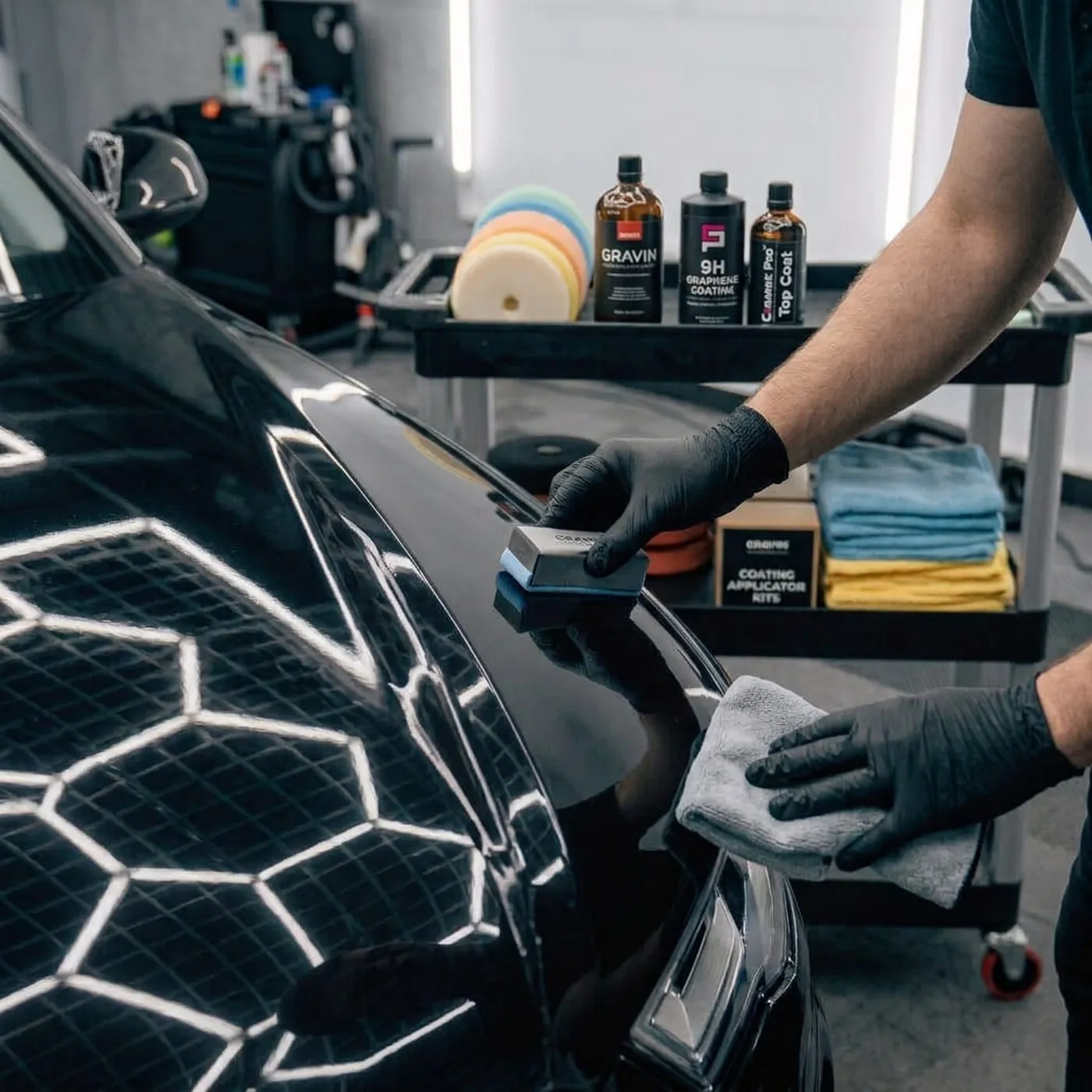
A ceramic coating is a liquid layer that bonds to your clear coat and cures hard, slick and glossy. Water beads off, grime lets go and washing gets quicker. We decontaminate and correct the paint first, then coat it by hand in a clean indoor bay at Revesby or Condell Park.
Frequently asked questions
Can swirl marks be removed permanently?
Yes, by machine polishing the clear coat level with the bottom of the swirls. They only come back if the car is washed or dried in a way that creates new ones.
Do swirl remover products work?
Most hide swirls with fillers and oils, which wash out. True removal takes an abrasive polish and a machine polisher.
Is paint correction safe for my paint?
Done properly, yes. A professional measures the paint first and removes as little clear coat as possible. Thin or previously polished paint is approached more gently, or not at all.
How long does paint correction take?
From most of a day for a single-stage enhancement to several days for multi-stage correction on a large or dark car. We confirm the time when we see the paint.
Will a ceramic coating hide swirl marks?
No, it locks them in. A coating is clear, so any swirls underneath stay visible, often more so under the extra gloss. That's why the paint is corrected before coating.
What causes swirl marks?
Mostly washing and drying: grit trapped in a mitt or towel scratches the clear coat. A single-bucket wash keeps carrying that grit back to the car.[1]
Sources
- [1]Chemical Guys. Use two buckets, say goodbye to swirls. ↑
- [2]DeFelsko. Automotive paint inspection: paint meters. ↑
About the author
Founder, Tinting Xperts
Mohammad Habboushi founded Tinting Xperts in 2016 with one bay, one squeegee and a rule the team still works to: if it isn't right, it doesn't leave. The business has grown to two workshops, at Revesby and Condell Park, and a team of more than 30 fitters, and Mohammad still fits cars on the floor most days.

