
Paint Protection & Care
Paint Correction in Sydney: Swirls, Haze and Light Scratches Removed
Paint correction is careful machine polishing that levels swirl marks, haze, holograms and light scratches out of your car's clear coat, so the paint looks deep and glossy again. We check paint depth, test a section, and correct panel by panel in indoor bays at Revesby and Condell Park, with a written quote first.

What it is
What paint correction gets you
Paint correction in Sydney means machine polishing your car's clear coat to remove swirl marks, wash haze, holograms and light scratches. Instead of hiding marks under wax or glaze, polishing levels the clear coat until the marks are gone. The paint reflects light cleanly again, and dark colours look deep instead of grey.
We correct paint at our Revesby and Condell Park workshops in south-west Sydney. Each car is washed and decontaminated first, its paint depth is checked with a gauge, and a test section decides how hard the machine needs to work. The goal is always the biggest improvement for the least clear coat removed.
This page covers what correction fixes and what it can't, the difference between one, two and three stages, how the job runs, how to protect the result and what drives the quote. For the basics, read our plain-English guide on what paint correction is.
- Full wash, iron and tar removal and a clay treatment before any polishing
- Paint depth checked with a gauge, especially on edges and resprayed panels
- Inspection under workshop lights to map swirls, haze and scratches
- A test section to find the gentlest polish and pad that works
- Trim, badges and edges taped off before the machine touches the paint
- Polish oils wiped away so you see the true finish, not a filled one
What paint correction fixes
Most of the defects that make paint look tired sit in the top layer, the clear coat. They're shallow, but they scatter light, which is why a car can look dull even when it's clean. Correction removes them by levelling the clear coat around them.
Swirl marks. Fine circular scratches from washing and drying, most obvious around the sun or a torch on dark paint.
Wash haze and marring. A general dullness made of countless tiny scratches, often from brush car washes and dirty towels.
Holograms and buffer trails. Shimmering, shifting trails left by a rotary polisher used badly, usually from an earlier "cut and polish".
Light scratches. Marks from fingernails around door handles, bag zips, branches and careless drying, as long as they're still in the clear coat.
Light oxidation. The chalky, faded look on older paint and on cars without a clear coat, often seen on reds and blues.
Water spot etching and bird dropping marks, where they haven't eaten deep into the clear coat.
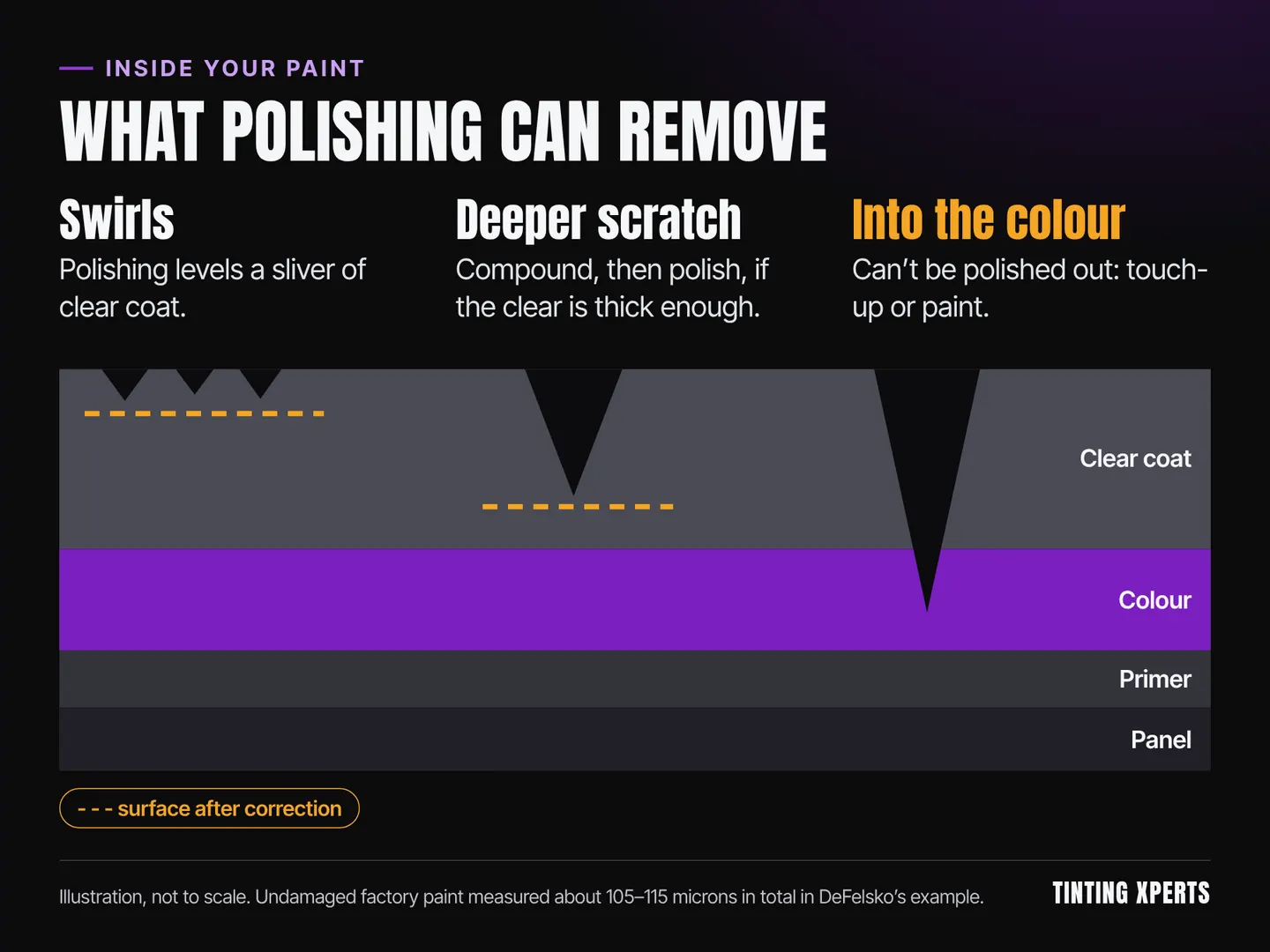
Swirls are the most common reason people book. If you'd like to understand where they come from first, our guide on how to remove swirl marks covers the causes and the do-it-yourself limits.
What polishing can't fix
Correction takes a very thin layer off the clear coat. It can't add paint back, so some damage needs a different repair. We'll tell you which is which before we start, rather than after.
| Fault | Why polishing won't fix it | What usually helps |
|---|---|---|
| Scratch through to the colour or primer | The scratch is deeper than the clear coat, so levelling it would cut through | Touch-up or a panel repair, then polish to blend |
| Stone chips | Paint is missing, not just marked | Chip touch-up, then paint protection film on the front |
| Peeling or failing clear coat | The clear coat is breaking down and there's nothing sound to polish | A respray of the affected panels |
| Deep etching from droppings or water | The mark runs too deep to level safely | Sometimes reduced by polishing, sometimes a repaint |
| Dents and dings | The panel's shape has changed, not its surface | Paintless dent repair before correction |
One, two or three stages: choosing the right level of correction
"Stages" is the number of polishing steps each panel goes through. Every step uses a polish and pad of a particular cut, from aggressive to fine. More stages remove deeper defects, but each one takes a little clear coat with it.
One-stage polish, sometimes called a gloss enhancement
A single polish that removes light swirls and haze and leaves a glossy finish in one step. It suits newer cars, cars that have been washed with care, and paint that's about to be coated. It gives a big visual lift for the least paint removed.
Two-stage correction
A cutting compound first to remove heavier swirls and light scratches, then a finishing polish to clear the fine haze the compound leaves and bring back full gloss. This is the level most daily drivers in Sydney need.
Three-stage, or multi-stage, correction
A heavy cut, a refining polish and a final finishing polish, sometimes with extra wet sanding on isolated deep marks. It's for badly marked paint, show cars and soft dark paint where every flaw shows. Each panel is tested, and paint depth is checked as we go.
| Criterion | One stage | Two stage | Three stage |
|---|---|---|---|
| Removes | Light swirls and haze | Most swirls, haze and light scratches | Heavy swirls, holograms and deeper scratches within the clear coat |
| Clear coat removed | The least | More | The most |
| Time in the workshop | Usually a day | Often a day or two | Often several days |
| Good for | Newer or well-kept cars, and before a coating | Most daily drivers | Neglected, dark or show-standard paint |
More stages aren't automatically better. Clear coat doesn't grow back, so we recommend the level that gets your paint where you want it with the most clear coat left for the future.
How we correct paint, step by step
Good correction is slow, methodical work under bright light. This is how a job runs in our workshop, whichever stage you choose.
Wash, decontaminate and clay
The car is foam-washed and hand washed, then bonded iron, tar and sap are removed and the paint is clayed. Any grit left on the surface would be ground into the paint by the polisher.
Measure paint depth and inspect
A paint-depth gauge reads each panel, so we spot resprays, thin edges and areas polished before. Then the paint is inspected under lights to map every swirl and scratch.
Tape off trim and edges
Rubbers, plastic trim, badges and sharp panel edges are taped. Edges carry the least paint, and trim can stain or burn if a pad catches it.
Test a section
We start with the gentlest polish and pad on a small area and step up only if it isn't enough. The test spot sets the plan for the whole car.
Correct panel by panel
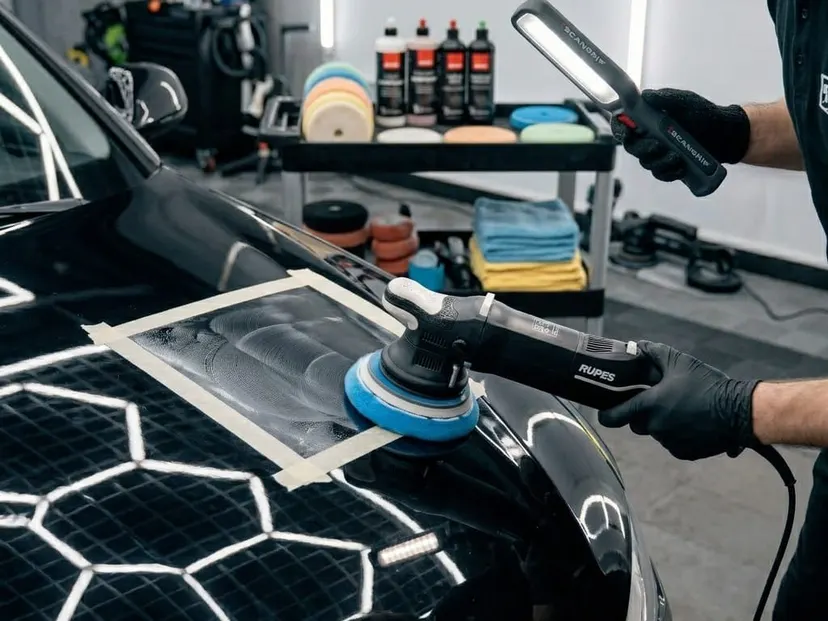
Each panel is polished in small sections with a dual-action machine, then wiped with a panel prep spray. That strips the polish oils, so what you see is the real finish and not filled-in swirls.
Final inspection and protection
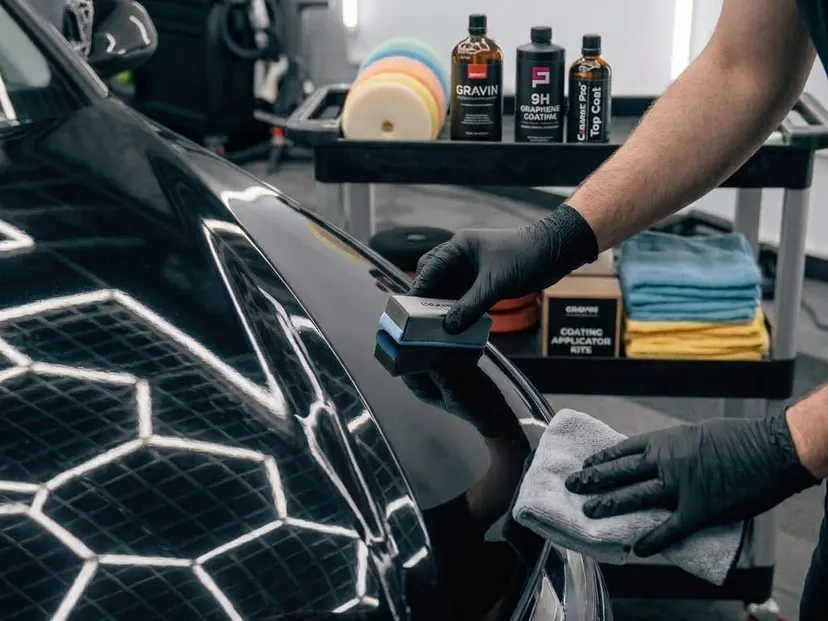
The car is checked under different lights from different angles. Then it goes straight on to its coating or film, or gets a sealant if you're protecting it later.
Signs your paint needs correcting
Correction is easy to put off because the car looks fine from a few metres away in the shade. Walk around it on a sunny day, or hold a phone torch close to a dark panel at night, and look for these.
Rings of fine scratches that circle the reflection of the sun or the torch.
Black, navy or dark grey paint that looks milky or grey instead of deep.
Straight lines across the bonnet and doors from drying with a towel or chamois.
A shimmer that moves as you walk past, the sign of holograms from an earlier polish.
Faded, chalky patches on the roof or bonnet of an older car.
You're about to coat the car or fit film and want a flawless base under it.
Protecting corrected paint: ceramic coating or PPF
Freshly corrected paint looks its best on the day it's finished. How long it stays that way depends on what goes on top and how it's washed. Unprotected paint picks up new wash marks within months.
A ceramic coating bonds to the corrected clear coat, adds gloss and makes the car far easier to wash, which means fewer new swirls. Correction and coating are usually booked together, because a coating locks in whatever is underneath. Paint protection film goes further on the panels that take stone chips, like the bonnet, bumper and mirrors, because a chip is the one thing correction can never fix.
Many owners do both: film on the front, a coating over the rest. Our guide to PPF compared with ceramic coating explains how the two work together.
Our service
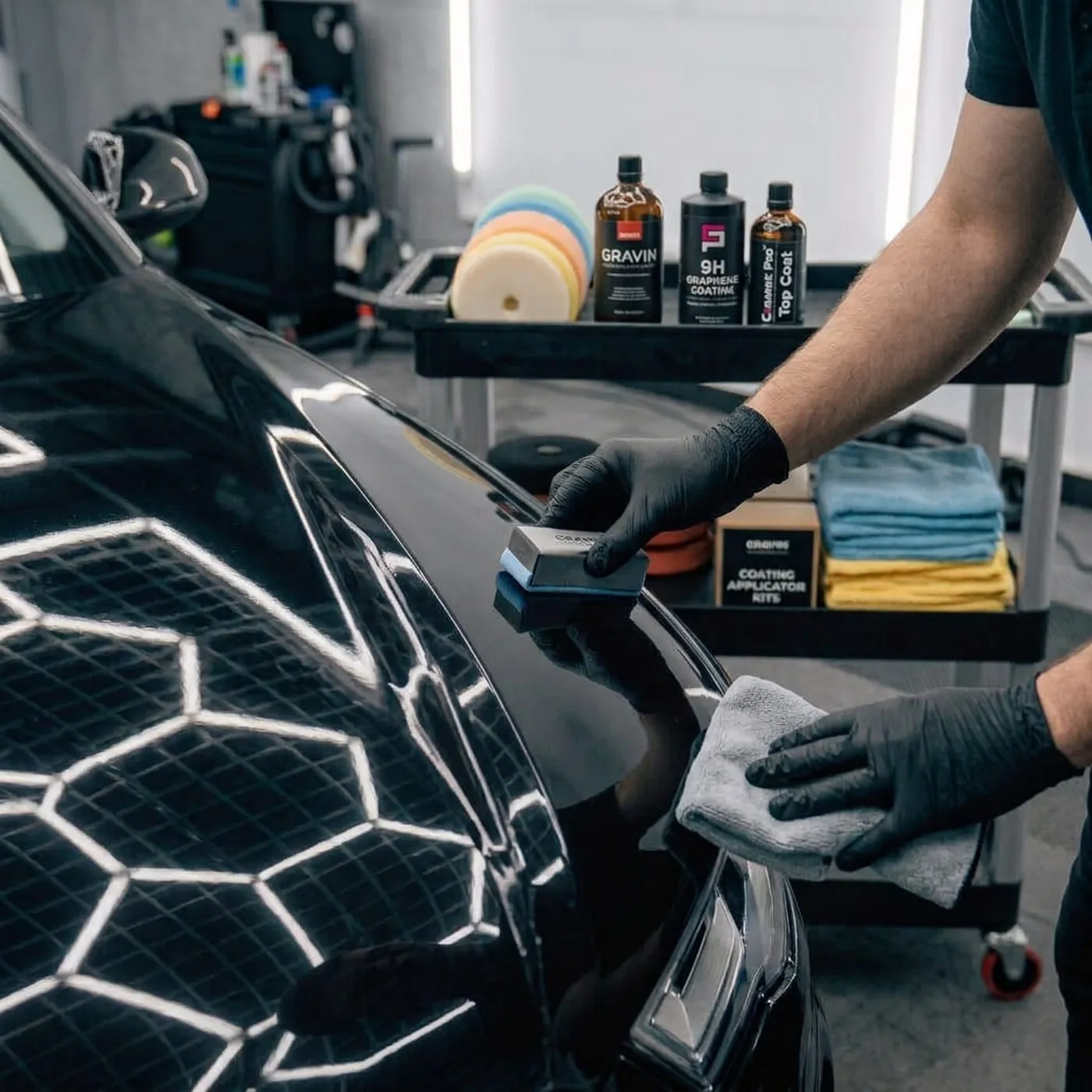
A ceramic coating is a liquid layer that bonds to your clear coat and cures hard, slick and glossy. Water beads off, grime lets go and washing gets quicker. We decontaminate and correct the paint first, then coat it by hand in a clean indoor bay at Revesby or Condell Park.
Paint correction for new cars, older cars and cars for sale
New cars
New cars often arrive with marks from transport, storage and dealer washing. A light one-stage polish before a coating or film starts the car off with flawless paint, and the correction needed is usually small.
Older cars and garage finds
Years of washing and sun leave older paint hazy and sometimes oxidised. These cars often see the most dramatic change, but they're also the ones most likely to have thin or resprayed panels. That's why we measure paint depth before we polish.
Cars about to be sold
Glossy paint photographs well and suggests a car has been looked after. A one-stage polish after a full car detailing service is often enough to lift a car's presentation for sale.
After a wrap comes off
Paint that has been under a wrap is usually well preserved, but the panels around it may have aged differently. A light polish evens out the gloss across the car. See our car wrapping service if you're planning a wrap.
What drives the cost of paint correction
We quote after we've seen the paint, because its condition decides the hours more than anything else. These are the main factors.
How marked the paint is. Light haze needs one stage; heavy swirls and scratches need more.
The level of correction you want. A big improvement and a near-flawless finish are different jobs.
How big the car is, and its shape. More panels, vents and body lines mean more time with the machine.
The colour and hardness of the paint. Dark colours show every flaw, and some factory paints are much harder or softer to polish.
Paint depth and repairs. Thin or resprayed panels need gentler, slower work.
What goes on afterwards. A coating or film is quoted in the same visit, with no second prep.
Send us the make, model and year and a few photos of the paint in sunlight, and we'll arrange an inspection and a written quote. Get in touch with the team or visit our Revesby workshop.
Why trust us with your paint
Polishing is the one paint service that can't be undone, so it should go to people who measure before they cut. We use paint-depth gauges and inspection lighting on every job, test before we commit, and stop at the level the paint can safely take.
Since 2016 our team has prepared paint for coatings, film and wraps every working day, in clean indoor bays at Revesby and Condell Park. Correction is done in-house by the same fitters who protect the paint afterwards, so nothing gets lost between jobs. You get straight advice, a written quote and no extras on the day.
In their words
What some of our customers say
“Took my bike in for paint correction, PPF, and ceramic coating—wanted protection from stone chips and easier cleaning. The result is a deep, wet gloss that looks incredible.”
Nick Lyris · Paint Correction, PPF & Ceramic Coating · on Google
See some of our work: photos of a few cars we’ve finished
Areas we serve
Paint Correction near you
Customers come to whichever of our two workshops is closer. Pick your suburb for the nearest one and local work.
- Paint Correction in Revesby2212
- Paint Correction in Bankstown2200
- Paint Correction in Padstow2211
- Paint Correction in Panania2213
- Paint Correction in Milperra2214
- Paint Correction in East Hills2213
- Paint Correction in Georges Hall2198
- Paint Correction in Condell Park2200
- Paint Correction in Chester Hill2162
- Paint Correction in Bass Hill2197
- Paint Correction in Greenacre2190
- Paint Correction in Liverpool2170
Questions
Paint Correction: common questions
How long does paint correction take?
A one-stage polish is usually done in a day. Two-stage work often takes a day or two, and three-stage correction on a large or dark car can take several days. We confirm the timing in your written quote.
Is paint correction bad for my paint?
Done properly, no. Every stage removes a very thin layer of clear coat, which is why we measure paint depth first and use the gentlest method that works. Repeated, aggressive polishing over the years is what thins paint, not one careful correction.
Will the swirl marks come back?
Not on their own. New swirls come from washing and drying, so they return only if the car is washed roughly. A ceramic coating and a careful hand wash keep the paint clear for much longer.
What's the difference between a cut and polish and paint correction?
A cut and polish is often a quick single pass, sometimes with fillers that hide swirls until the next few washes. Paint correction is measured, staged and inspected with the oils wiped off. That way the marks are actually gone, not filled.
Can paint correction remove a key scratch?
Only if it stays in the clear coat, which most key scratches don't. If your fingernail catches in it, it probably needs a touch-up or panel repair. Polishing can still make it much less obvious.
Do I need paint correction before a ceramic coating?
In most cases, yes. A coating seals in whatever is under it, swirls included, and makes them look glossier. Even new cars usually benefit from a light polish first.
Can you correct matte or satin paint?
No. Polishing adds gloss, so it would ruin a matte or satin finish. Those paints need specialist cleaning and protection instead, and we'll advise you on what's safe.
How many times can a car be paint corrected?
It depends on how much clear coat is left, which varies from car to car and panel to panel. That's why we measure the paint before every job. Careful washing and a coating mean you shouldn't need heavy correction again for a long time.
Can you polish just one panel?
Yes. A single scratched door or a bonnet hazed by droppings can be corrected on its own. We'll make sure it matches the gloss of the panels around it.
Guides
Read before you book
Plain-English guides on paint correction, from the people who fit it.
Guide · Detailing & Paint Correction
What is paint correction? How it removes swirls and scratches, and when it's worth it
Paint correction levels your clear coat by machine to take swirls, haze and light scratches out for good, and it's the step that decides how a coating or film will look.
· 11 min read
Guide · Ceramic & Graphene Coatings
How long does ceramic coating last? Real lifespans, and how to make yours go the distance
What the coating makers actually promise, what wears a coating out on a Sydney car, and the simple routine that keeps it working for years.
· 12 min read
Guide · Detailing & Paint Correction
How to Remove Swirl Marks: Paint Correction Explained
What swirl marks are, why they appear, what polishing can and can't fix, and how paint correction removes them for good.
· 7 min read

Visit us
Two workshops, one team
Tinting Xperts Revesby
Unit 28/172 Milperra Road, Revesby NSW 2212
Mon – Sat · 9:00am – 5:00pm
Tinting Xperts Condell Park
141 Eldridge Road, Condell Park NSW 2200
Mon – Sat · 9:00am – 5:00pm
Reviewed by Mohammad Habboushi, Founder.