
Guide · Home & Commercial Film
Office window film: glare, heat, privacy and safety for your workplace
How film on existing office glass cuts screen glare and afternoon heat, adds privacy to meeting rooms, holds broken glass together, and goes on without closing the office.
Written and reviewed by Mohammad Habboushi, Founder of Tinting Xperts
· 10 min read

Key takeaways
- Office window film is a retrofit: it changes how existing glass handles glare, heat, privacy and breakage without replacing it.
- Glare is about visible light, so the film's shade decides how much screen glare it removes.
- Frosted film gives privacy day and night; reflective one-way film loses its privacy once it's brighter inside than out.
- Safety film holds broken glass together, but it isn't certified safety glazing or bullet resistant unless tested as a system.
- The film must suit the glass, and most installs can be planned around trading hours.
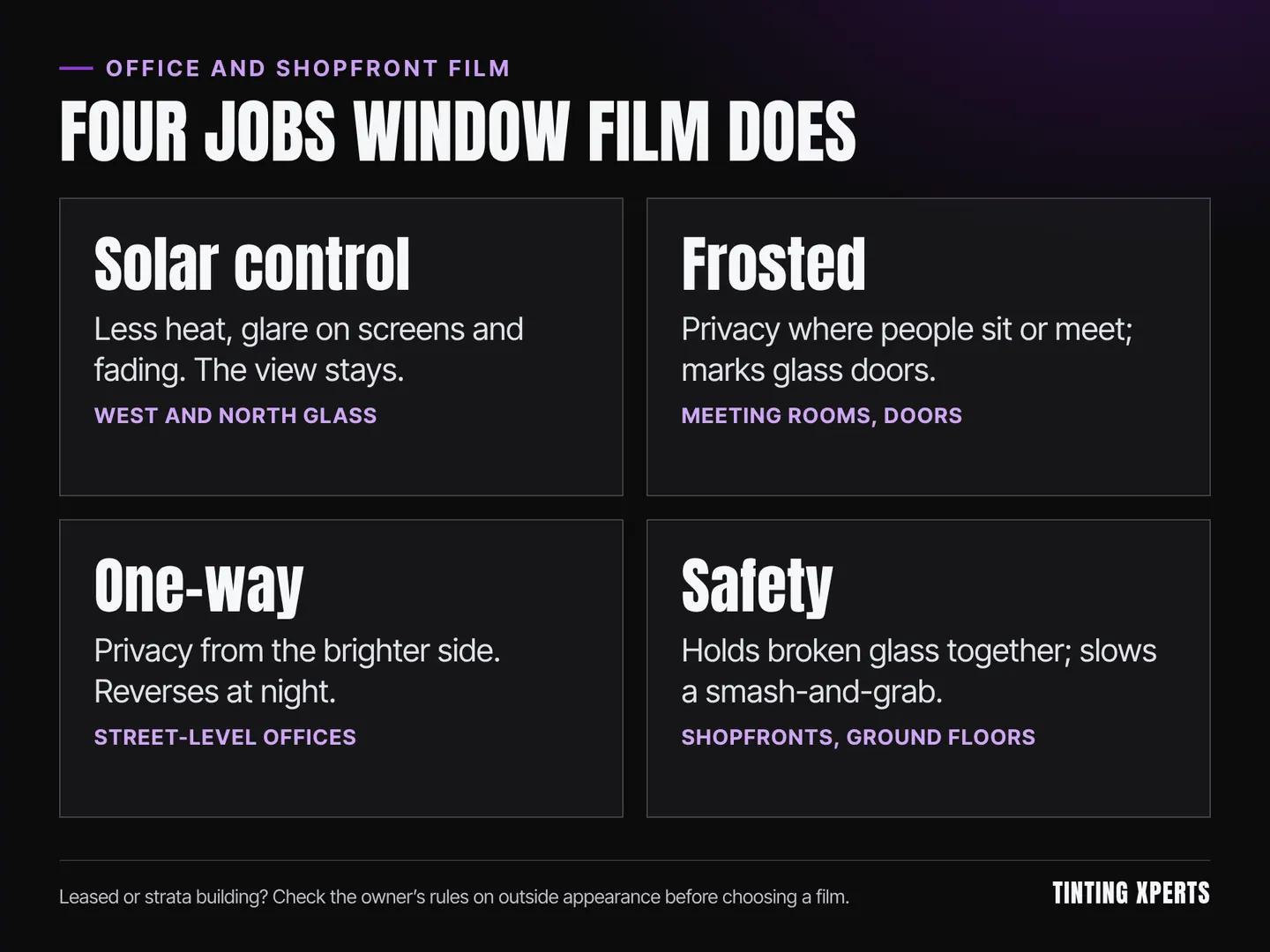
Office window film is a thin layer on existing glass that cuts screen glare, reduces sun heat, adds privacy to meeting rooms and holds broken glass together. The windows stay where they are. The right film depends on the job each pane has to do: solar control, frosted, decorative or safety.
Most offices need more than one. A west-facing open-plan floor wants glare and heat control, a glass boardroom wants privacy, and a ground-floor shopfront may want safety film and graphics. This guide covers each type, what it can and can't do, and how to install it without closing the office.
What office window film can do
The International Window Film Association groups the benefits of film into UV protection, energy savings, safety and security, heat control, privacy and glare, and appearance.[1] In an office, those become six practical film types.
Solar control film reduces the sun's heat and glare through the glass.[2]
Frosted and privacy film blurs the view into meeting rooms, offices and bathrooms.
Decorative film adds patterns, bands or branding to glass walls and doors.[1]
Safety and security film holds broken glass in the frame and slows smash-and-grab attempts.[3]
Anti-graffiti film is a sacrificial layer that's replaced after someone scratches or tags it.[3]
Low-emissivity film reflects room heat back inside for spaces that feel cold near the glass.[4]
| Film type | Main job | Private at night? | Typical spots |
|---|---|---|---|
| Solar control | Heat and glare | No | Sun-facing open-plan floors and reception |
| Reflective (one-way) | Heat, glare and daytime privacy | No, once inside is brighter | Street-facing offices |
| Frosted or patterned | Privacy and light | Yes | Meeting rooms, partitions, bathrooms |
| Decorative or branded | Look and visibility of glass | Depends on the design | Glass walls, entry doors, shopfronts |
| Safety and security | Holding broken glass | No, usually clear | Ground-floor glass, doors, low panes |
Some jobs overlap. Safety film is mostly clear, but versions with solar control are available, so one film can hold glass together and cut heat.[3]
Office window film for screen glare
Glare is a workplace health issue, not just an annoyance. SafeWork NSW lists eye discomfort, squinting, eye strain and impaired vision among the effects of glare and reflections.[5]
The national model code of practice on work environments, as adopted in the ACT, names glare and reflections among the factors to consider when planning lighting.[6] Its listed controls include curtains, blinds and external louvres to reduce reflections, shadows and glare.[6] Film does the same job while leaving the view and daylight in.
What decides glare is visible light. The association says glare control is almost exclusively a function of visible light.[4] So for a glare problem, look at the film's visible light transmission first. Our guide to window tint percentages explains how that number works.
Low sun is the worst case. The association notes that in offices and schools, where computer screens are vital, glare can be a real issue as it reflects off the screens.[7] In Sydney that means east-facing glass in the morning and west-facing glass in the afternoon.
Heat, hot spots and the air conditioning
Solar film reduces the sun's heat by reflecting or absorbing part of it before it reaches the room. The association says this means less load on air conditioning, which can lead to energy savings, especially in buildings with large glass facades.[2]
The bigger day-to-day win is evening out hot and cold spots. The association's training guide describes buildings where the heating runs on the east side while the cooling fights the west.[4] It says film can modulate those effects, making the whole system work more efficiently.[4]
20–26 °C
Optimum comfort range for sedentary work in the national model code of practice; direct sunlight control is one listed way to keep it[6]
Desks beside sun-facing glass are where that range breaks down. The code notes that thermal comfort is affected by sun penetration as well as air temperature.[6] Film on that glass helps the people sitting closest to it, without turning the thermostat down for everyone else.
Does office window film save energy?
It can, but the saving depends on the building. The association says comfort and cost savings are mostly driven by the film's solar heat gain coefficient, or SHGC.[4] It recommends asking the film manufacturer for an energy analysis on large buildings.[4]
Darker isn't automatically better for heat. Solar Gard, quoting the association, says visibly clear window film can be just as effective as a dark one.[8] That matters in offices, where you usually want to keep daylight.
UV for staff by the windows
Commercial glass already does better than house glass on UV. A University of Wollongong article says most office glass allows less than 25% of UVA through.[9] Cancer Council Australia adds that UV through building windows poses little risk unless people spend extended periods close to windows in direct sun.[10] Staff with desks pressed against sunny glass are that case.
Privacy film: frosted, decorative and one-way
Privacy is the most common reason offices call about film. Glass walls look open on the fit-out plan, then nobody wants to take a confidential call in a fishbowl.
Frosted film for meeting rooms and partitions
Frosted film blurs the view instead of relying on a brightness difference, so it keeps working at night. It lets light through, which keeps internal rooms from feeling like cupboards. A common approach is a frosted band across the eye-level zone, with clear glass above and below.
Decorative films take this further, with patterns, gradients, cut lettering or your logo. The association notes that decorative film can add style to office and retail spaces.[1] Our commercial window tinting service covers shopfront graphics and signage on glass as well as heat, glare and privacy films.
One-way film and the night-time problem
Reflective film acts like a one-way mirror only while it's brighter outside. The association says that privacy virtually disappears once there is more light inside than outside, such as at night.[4] An office that works late, with the lights on, is on show from the street.
Making glass walls visible
Clear glass doors and full-height panels can be mistaken for an opening. In its housing provisions, for example, the National Construction Code requires such glass to be marked so it's readily visible.[11] The code also says marking the glass is not a substitute for safety glazing.[11]
A frosted or decorative band is a common way to mark glass. The exact requirements depend on the building and the code volume that applies, so confirm the design with your building manager or certifier before it's cut.
Safety and security film for offices and shopfronts
Safety film is a clear, thicker film with an aggressive adhesive. When the glass breaks, the film stretches and keeps the pieces in the frame instead of letting them fly.[3] The association's guide says safety films range from 4 mils (about 100 microns) to 15 mils thick.[3]
How it's fitted matters as much as the film. A standard daylight installation stops just short of the frame. The association says attaching the film to the frame, mechanically or with sealant, gives better protection than a daylight install.[3] Tempered glass in particular may need an attached system to stay in the frame.[3]
Smash and grab: a daylight install resists forced entry in most cases unless the attack is more than smash and grab.[3]
Not bullet resistant: the association makes no claim that any film and existing glass combination is bullet resistant.[3]
Graffiti: thick sacrificial films can be removed and replaced after the glass is tagged.[3]
Test claims: if a seller says a film has passed an impact test, ask for the written approval for that exact product.[3]
Be clear about what you're buying. Film on existing glass slows an intruder and reduces flying glass. It does not turn ordinary glass into certified safety glazing. Code-level claims usually need the whole glazing system tested, not just the film.[3]
Will the film suit your building's glass?
Not every film suits every pane. Film changes how glass absorbs the sun's heat, and uneven heating can crack some glass. The association says all glass types except tempered glass can suffer thermal breakage if the wrong film is installed.[4]
Double-glazed units need special care, but the association says they can be filmed very effectively if the selection rules are followed.[4] Manufacturers publish which films suit which glass, based on absorption, glass type and thickness, glazing, orientation and shading.[4]
Find out the glass type. Your building manager or the original glazing drawings may list it.
Avoid car tint. The association says highly absorbing automotive-type films should be avoided on architectural glass.[4]
Take care with very large panes. The association urges extreme caution, as squeegee pressure can break oversized glass.[4]
Use exterior film where needed. Louvres and patterned glass often need a film made for the outside face.[4]
Get approval. Film changes how the building looks from outside, so check your lease and ask the landlord or building manager first.
Installing office window film without downtime
Film goes on from inside, a pane at a time, so the office rarely needs to close. The work does need clear access to the glass and a clean, dust-free area. Plan it like any small fit-out job.
Walk the floor and list the problems
Note each window, which way it faces, and the complaint: glare on screens, a hot corner, a meeting room people avoid, or a ground-floor pane that worries you. Note the glass type if you know it.
Try samples on the real glass
Look at samples from inside and outside, at the time of day the problem is worst.[4] For frosted and decorative designs, mark the band height on the glass before anything is cut.

Book around your trading hours
Tell us your opening hours, building access rules and any rooms that can't be disturbed. Clear sills and desks in front of the glass so the installers can work cleanly.
Install, then let the film cure
Each pane is cleaned, the film is cut to size and squeegeed on. The association says curing typically takes from a few days to a couple of weeks.[12] Some films look slightly hazy while the moisture dries, and that can take several days to clear.[4]
After curing, clean filmed glass with a mild, non-abrasive cleaner and soft cloths. The association warns that harsh chemicals and abrasive materials can damage the film.[12] Brief your cleaning contractor before their next visit.
What decides the cost of office window film
We don't publish prices, because no two buildings are the same. These are the things that drive a commercial quote:
Glass area and pane count: many small panes take longer than a few large ones of the same area.
Film type: solar, frosted, decorative, printed or safety film all differ.
Access: high windows, atriums and skylights may need lifts or other access equipment.[4]
Attachment systems: anchoring safety film to the frame is more labour-intensive than a daylight install.[3]
Old film: failed or outdated film has to come off before new film goes on.
Timing: work outside normal hours, or in stages, changes how the job is scheduled.
Tell us about the building, the glass and the problems, and we'll reply with a written quote.
Commercial window tinting with Tinting Xperts
Our commercial window tinting covers heat, glare and privacy films for offices and shopfronts, plus graphics and signage on glass. It's arranged through our team at the Revesby workshop and the Condell Park workshop. For your house, our guide to home window tinting benefits covers heat, fading and privacy film for living spaces.
Our service
Commercial window tinting puts film on the glass your business already has: solar film to take heat and glare off desks, frosted film for meeting rooms, safety and anti-graffiti film for shopfronts, and graphics for your brand. We plan the install around your trading hours and quote in writing first.
Office window film questions
What is the best window film for office glare?
Glare depends on visible light, so choose a film by how much light it lets through, then check its heat performance. A neutral film with low reflectivity keeps the office bright while cutting glare on screens. Test a sample on the worst window at the worst time of day.
Does frosted window film work at night?
Yes. Frosted film blurs the view rather than relying on the outside being brighter, so it stays private when the lights are on. It still lets light through, so silhouettes may show close to the glass.
Can people see into an office with one-way film at night?
Yes, once the office is brighter than outside. One-way film reflects only from the brighter side, so at night the effect reverses. Use blinds after dark or frosted film for rooms that need privacy all the time.
Does office window film reduce heat?
Solar control film reduces the sun's heat through the glass and evens out hot spots near sunny windows. The size of any energy saving depends on the building, the glass and the film. For large buildings, ask the film manufacturer for an energy analysis.
Is safety film the same as safety glass?
No. Safety film holds broken glass together and slows a smash-and-grab, but it doesn't make ordinary glass certified safety glazing. Code-level claims need test results for the whole glass, film and frame system.
Can window film go on double-glazed office windows?
Usually, if the film is one the manufacturer approves for that glass. Double-glazed units can crack from heat stress when the wrong film is used. The installer should check the glass type, orientation and shading first.
Can office window film be removed later?
Yes. Applied film can be taken off by an installer when a lease ends or the fit-out changes, and new film can go on. Removal from acrylic or polycarbonate is the exception, because those plastics scratch easily.
Planning a fit-out or fixing a hot, glary floor? Send us the details of your building and we'll come back with film options and a written quote.
Sources
- [1]International Window Film Association. Benefits of Window Film, 2026. ↑
- [2]International Window Film Association. Staying Cool: How Window Film can help in Summer, 2025-07. ↑
- [3]International Window Film Association. Safety & Security Education Guide, 2023. ↑
- [4]International Window Film Association. Flat Glass-Solar Control Education Guide, 2023-01. ↑
- [5]SafeWork NSW. Lighting, 2026. ↑
- [6]ACT Government (based on the Safe Work Australia model code). Managing the Work Environment and Facilities Code of Practice, 2025-11. ↑
- [7]International Window Film Association. Don't Let The Winter Sun Catch You Off Guard, 2026. ↑
- [8]Solar Gard. Myth Buster: Does Window Film Need To Be Dark To Work?, 2026. ↑
- [9]University of Wollongong. Can you get sunburnt or UV skin damage through car or home windows?, 2025-02. ↑
- [10]Cancer Council Australia. Fact sheet: Tinted windows, 2017-11. ↑
- [11]Australian Building Codes Board. Part 3.6 Glazing (NCC 2019 Volume Two), 2019. ↑
- [12]International Window Film Association. After You Buy, 2026. ↑
About the author
Founder, Tinting Xperts
Mohammad Habboushi founded Tinting Xperts in 2016 with one bay, one squeegee and a rule the team still works to: if it isn't right, it doesn't leave. The business has grown to two workshops, at Revesby and Condell Park, and a team of more than 30 fitters, and Mohammad still fits cars on the floor most days.


