
Guide · Home & Commercial Film
Home window tinting benefits: what film really does for your house
What window film does for heat, glare, fading, privacy and broken glass in an Australian home, where it falls short, and how to choose it room by room.
Written and reviewed by Mohammad Habboushi, Founder of Tinting Xperts
· 12 min read

Key takeaways
- Window film cuts solar heat, glare and UV through the glass you already have, without replacing windows.
- Film slows fading but can't stop it, because visible light and heat fade things too, not just UV.
- Reflective film gives privacy by day only; at night, with the lights on, people can see in.
- The film has to suit the glass: dark, heat-absorbing car tint is the wrong product for most house windows.
- In NSW, shatter-resistant film is a minor change a landlord can't unreasonably refuse, but you still need written consent.
The main home window tinting benefits are cooler rooms on hot afternoons, less glare on screens, slower fading of floors and furniture, daytime privacy and safer glass if it breaks. You get them without replacing a single window. Film can't stop fading completely, and reflective film gives no privacy at night.
Windows matter because they are where a house gains and loses the most heat for their size. The City of Greater Bendigo's home energy program says up to 40% of the energy used to heat or cool a home is lost through windows.[1] Film is one of the few ways to change how existing glass behaves without a builder.
This guide covers each benefit honestly: what the film does, what it doesn't, and which windows gain the most. It's written for Sydney houses, units and townhouses, and for the questions people actually ask before they book.
The main home window tinting benefits at a glance
Window film is a thin polyester layer, usually bonded to the inside of the glass. Different films are built for different jobs, so one product rarely does everything. Here is what a well-chosen film can do in a home.
Less heat: solar film reflects or absorbs part of the sun's energy before it warms the room.[2]
Less glare: a film that trims visible light makes TVs and laptop screens easier to see.[3]
Slower fading: film blocks most UV, one of the main causes of faded floors, rugs and fabrics.[4]
Daytime privacy: reflective and frosted films stop people seeing straight in from the street.
Safer glass: safety film holds broken glass together instead of letting it fall as shards.[5]
Skin protection: film cuts the UVA that ordinary window glass lets through.[6]
None of these needs new frames or glass. The International Window Film Association says film can usually be installed in a day or less.[3] That makes it a practical fix for a room you already live in.
Does window tint keep heat out of a house?
Yes, a solar control film reduces the sun's heat coming through the glass. The International Window Film Association explains that film reflects or absorbs a significant portion of the sun's rays, which means less load on air conditioning.[2] How much depends on the film, the glass and how much direct sun the window gets.
Darkness is not the measure. Solar Gard, quoting the same association, says visibly clear window film can be just as effective as a dark one.[7] It puts the best films at blocking up to 84 percent of the sun's heat.[7] Treat that as the top of the range, not what every film achieves.
The percentage on a film's label usually describes visible light, not heat. Our guide to window tint percentages explains how shade and heat rejection differ. The same principle applies to house glass: choose the film's heat performance first, then a shade you're happy to live with.
Up to 40%
of the energy used to heat or cool a home is lost through its windows[1]
Which windows benefit most?
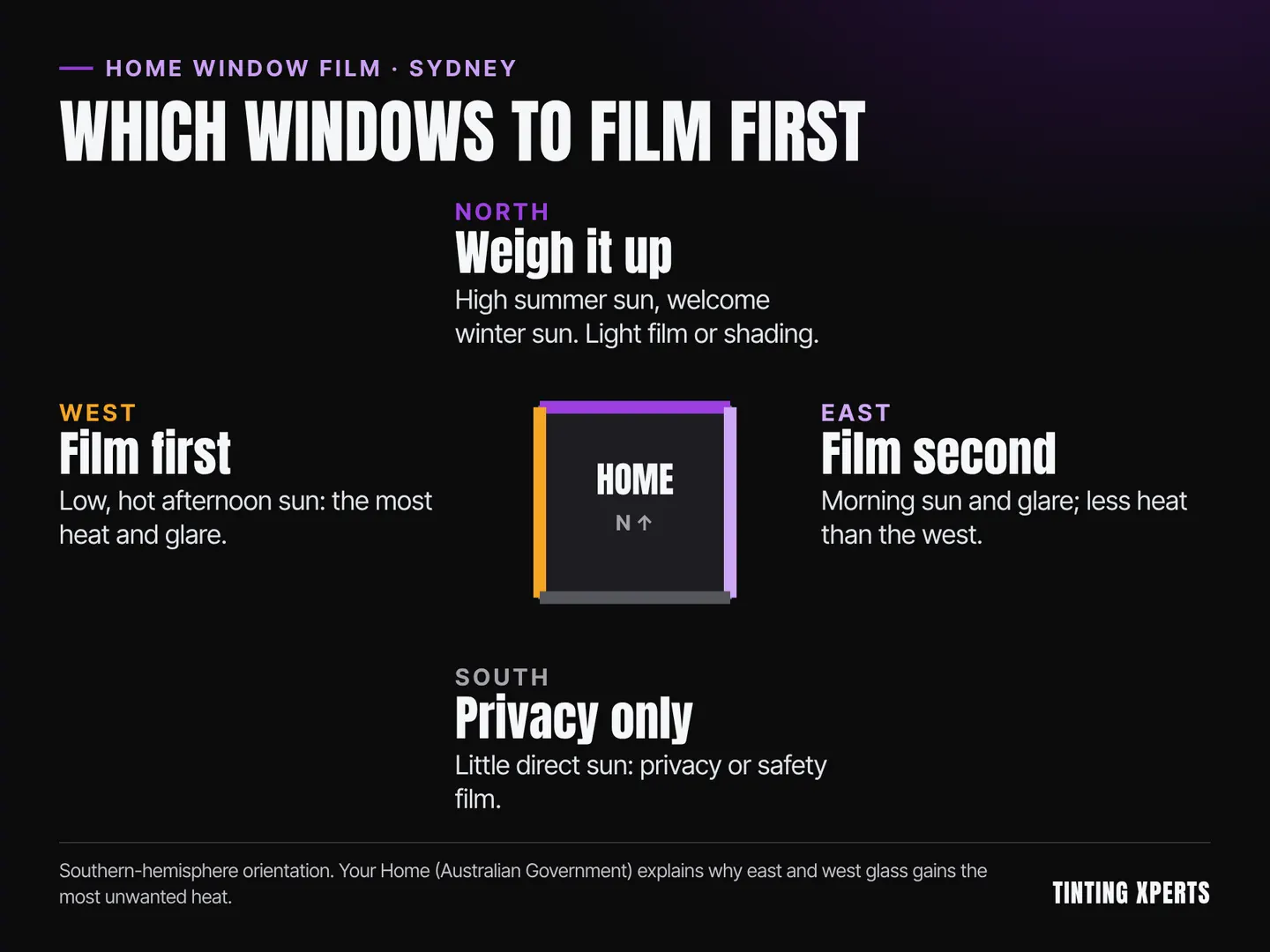
Start with glass that gets direct afternoon sun. Bendigo's guide tells householders to shade north-facing and west-facing windows to block unwanted sun.[1] West-facing living rooms and bedrooms are the usual complaint: they cop the low, hot sun late in the day, when blinds are the only defence.
If you can add an awning, eaves or external blinds, do that first on the worst windows. Bendigo puts the heat-gain reduction from external shading at 50% to 55%.[1] Film earns its place where outside shading isn't possible, isn't allowed, or would block a view you bought the house for.
Is the saving on power bills guaranteed?
No, and an honest installer won't promise one. The association's own training guide says it is difficult to assign a cost savings benefit to film in homes.[8] Homes have a much smaller window-to-wall ratio than office towers, so film improves a smaller share of the building.[8] The reliable payoff is comfort: rooms you can use on a hot afternoon.
What about winter?
A film that blocks summer sun also blocks some winter sun. Sustainability Victoria notes that reflective coatings and tinted glass reduce radiant heat and light entry throughout the year.[9] If your north-facing living room relies on winter sun, keep film light there or leave that glass alone.
For homes that feel cold next to the glass, ask about low-emissivity (low-E) film. It reflects radiant heat back into the room, and Sustainability Victoria says low-E films can be applied to existing single-glazed windows to improve their thermal performance.[9]
UV protection and fading
Ordinary house glass blocks most UVB but lets a lot of UVA through. A University of Wollongong medical scientist writes that most residential glass lets between 45 and 75% of UVA pass through.[6] The same article says window tinting blocks around 95% of UVA radiation.[6]
The type of glass matters. Cancer Council Australia says laminated building glass blocks UVA completely, while tempered and smooth annealed building glass can let around 70% through.[10] Solar Gard notes that most Australian homes have plain annealed glass,[11] which sits at the leaky end.
While tinting of windows in buildings can further reduce UV radiation transmission, the need for this should be weighed against the actual health risks to occupants.
That is a fair warning. Cancer Council says UV through untinted building windows poses little health risk unless you spend extended periods close to windows that receive direct sun.[10] So UV film matters most at a sunny desk, a sunroom or a favourite reading chair, not in every room.
Does window film stop fading?
It slows fading; nothing stops it. The University of Wollongong article notes that we see UV damage through home windows in faded materials, furniture and plastics.[6] But UV is only part of the cause, as Avery Dennison's breakdown shows.
| Cause of fading | Share of fading (industry estimate) | What film can do |
|---|---|---|
| Ultraviolet light | Up to 40%[4] | Most films block almost all of it, even clear ones |
| Visible light | Roughly 25%[4] | A darker film helps, but costs you daylight |
| Solar heat (infrared) | Roughly 25%[4] | A heat-rejecting film reduces it |
| Humidity, dyes and indoor lighting | The remainder[4] | Nothing on the glass helps |
Avery Dennison says plainly that no window film can completely stop fading.[4] The association's guide agrees, and warns dealers not to oversell film as preventing fading.[8] Expect film to buy your timber floors and fabrics more time, and keep rotating rugs and drawing curtains in peak sun.
Glare: TVs, screens and the home office
Glare is too much light for your eyes to adapt to. The association notes that glare control is almost exclusively a function of visible light.[8] So the shade of the film, not its heat rejection, decides how much glare it removes.
In homes this is a balancing act, because most people don't want darker rooms. The association suggests a film with medium light transmission, a neutral shade and low reflectivity, so the room doesn't feel very different.[8] It also points out that a home office facing the sun can make video calls hard work.[3]
Glare film suits rooms where you watch or work at a screen through the day. If a window only glares for an hour in the morning, a blind may still be the cheaper answer.
Privacy by day, and why it disappears at night
Reflective film works like a one-way mirror, but only while it's brighter outside than inside. The association says its privacy virtually disappears once there is more light in the home than outside, such as at night.[8] At night with the lights on, people on the street can see in.
Frosted and patterned films work differently. They blur the view instead of relying on a brightness difference, so they suit bathrooms, front-door sidelights and windows facing a neighbour. The trade-off is that you lose the clear view out as well.
Many homes mix the two: reflective or tinted film on street-facing living areas, frosted film on bathrooms and entries. You choose film window by window, not for the whole house.
Safety film: holding broken glass together
Solar Gard notes that the most common glass in Australian homes is simply annealed (float) glass, which forms dangerous shards when broken.[11] That matters around children, low windows and glass doors.
Safety film is a thicker, clear film with an aggressive adhesive. When the glass breaks, the film stretches and holds the pieces in the frame instead of letting them fall.[5] The association's guide puts safety films at 4 mils (about 100 microns) up to 15 mils thick.[5] Thicker films generally absorb more impact.
Be realistic about security. The same guide says a standard safety-film installation resists most smash-and-grab attempts, but not a determined attack.[5] It also says the association makes no claim that any film and glass combination is bullet resistant.[5]
Will window film damage my windows?
Not when the film suits the glass. Problems come from the wrong film. Film-covered glass in the sun runs hotter, and uneven heating can crack some glass. The association says all glass types except tempered glass can suffer thermal breakage if the wrong film is installed.[8]
Double-glazed units need special care, but the association says they can be filmed very effectively if the right selection rules are followed.[8] Manufacturers publish which films suit which glass. They weigh the film's absorption, the glass type and thickness, single or double glazing, orientation and shading.[8]
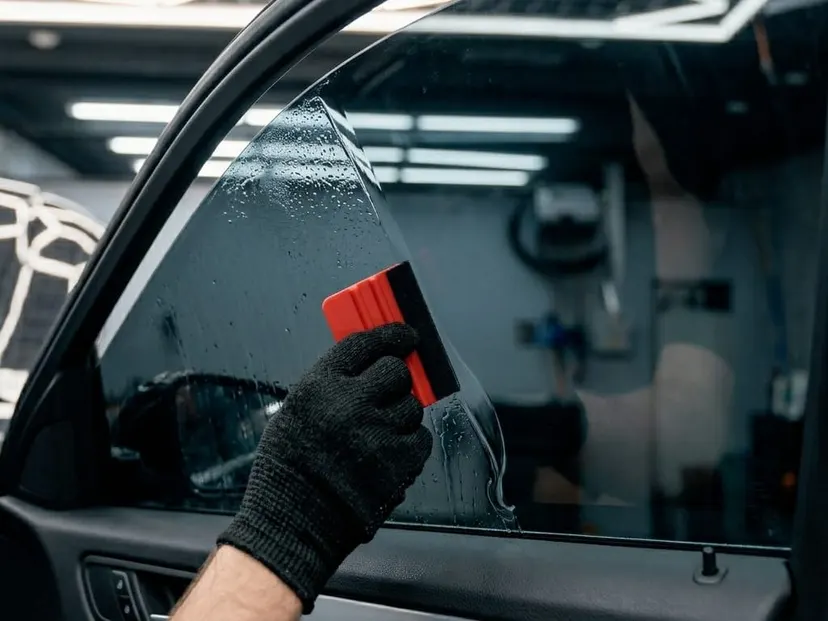
Car tint is the wrong product for a house. The association says highly absorbing automotive-type films should be avoided on architectural glass.[8]
Wired glass: solar film shouldn't go on the inside of exterior-facing wired glass, because the wire overheats.[8]
Patterned or textured glass: the adhesive can't bond to the textured side, so an exterior film is used instead.[8]
Acrylic or polycarbonate: only film designed for plastic glazing, because these sheets can out-gas and bubble.[8]
Very dark films: high-absorbing dark films aren't recommended for many glass types in direct sun.[8]
If your windows are under a manufacturer's warranty, check its terms before film goes on. Ask the installer which film they recommend for your glass type, and why.
Choosing film for each room
The best results come from treating each window as its own problem. Work through the house in this order before asking for a quote.
List the problem in each room
Note the room, which way the window faces and what bothers you: afternoon heat, glare on the TV, faded floorboards, a neighbour's view, or a low pane near the kids. The problem decides the film.
Identify the glass
Single or double glazed? Clear, tinted, laminated, wired or patterned? If you're not sure, the installer can check. The glass type decides which films are safe to use.
Look at samples on your own glass
A swatch in the hand looks different from film on a sunny window. View samples at the time of day the problem is worst, from inside and outside, before you choose a shade.
Fit, then let it cure
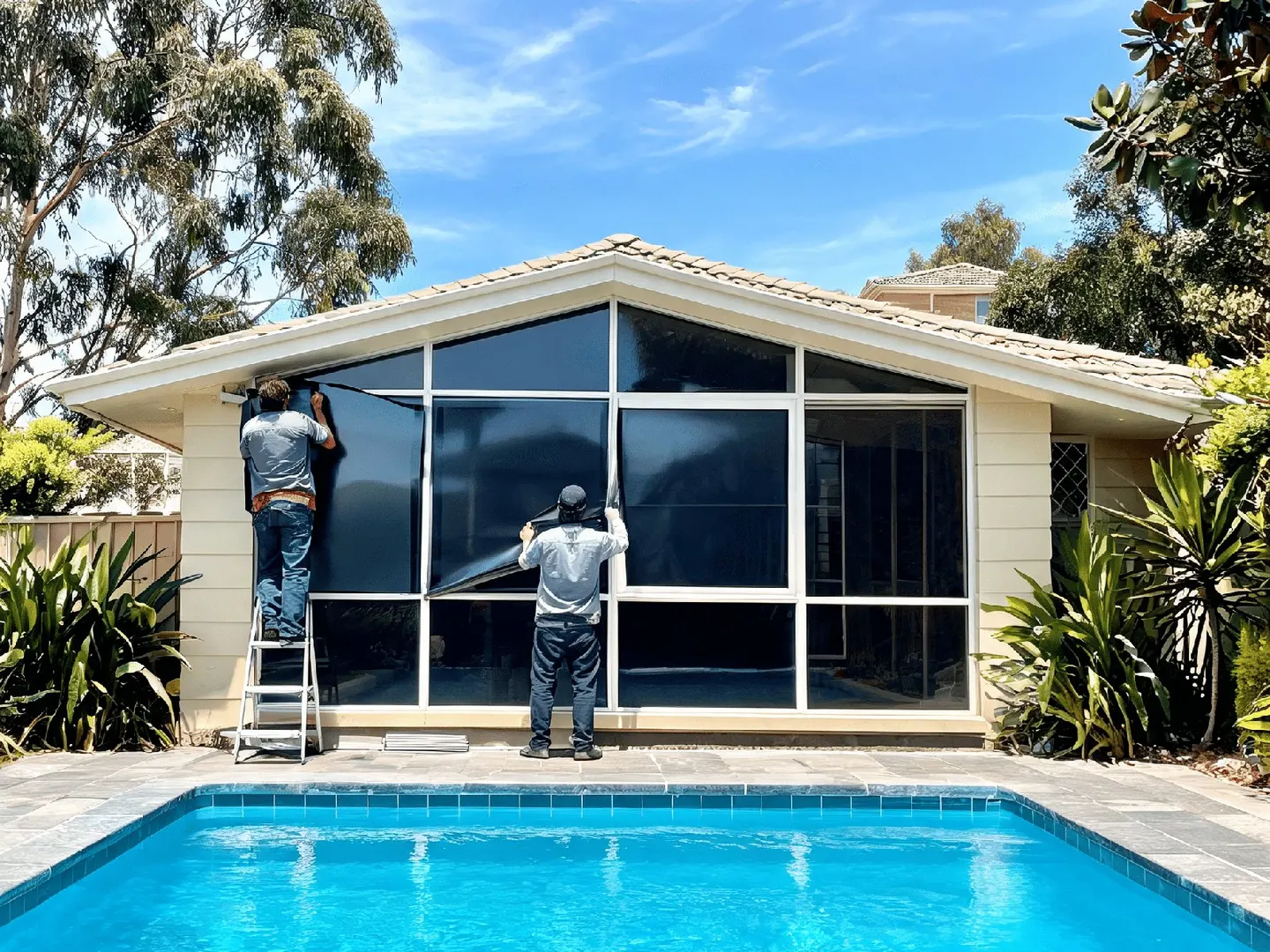
Film is cut to each pane and squeegeed onto clean glass. The association says curing typically takes from a few days to a couple of weeks, depending on the film and the weather.[12] Some films look slightly hazy while moisture dries out, which can take several days to clear.[8]
Once cured, clean filmed glass with a mild, non-abrasive cleaner and a soft cloth. The association warns against harsh chemicals and abrasive materials that could damage the film.[12]
Renting or in a strata building? Check first
In NSW, applying shatter-resistant film to windows or glass doors is on the list of minor changes a landlord cannot unreasonably refuse.[13] You still need the landlord's written permission, and you pay for it unless they agree to.[13] The rule doesn't apply to heritage properties or homes on the loose-fill asbestos register.[13]
Solar and privacy films aren't named on that list, so treat them as a request you need approved. Get any consent in writing before booking.
Is home window tinting worth it?
It is worth it when a specific window causes a specific problem. Film is a strong answer for these situations:
West-facing living areas that are too hot to use on summer afternoons and can't take an awning.
Timber floors, rugs or artwork fading in front of sunny glass.
Screens washed out by glare in a lounge, study or home office.
Street-facing rooms where you'd like the blinds open by day.
Low or large panes of plain glass near children or busy walkways.
It is less worth it where external shading would do the job better, or where you value every bit of winter sun. And it won't fix a draughty frame or a poorly insulated ceiling.
Cost depends on the glass area, the number and size of panes, the film type, access to high windows and whether old film must come off first. We don't publish prices because two houses are never the same. Tell us about the rooms and we'll reply with a written quote.
Residential window tinting with Tinting Xperts
Our residential window tinting covers heat, fade and privacy films for home windows. It's arranged through our team at the Revesby workshop and the Condell Park workshop. Running a business too? Our guide to office window film covers glare, frosted film and safety film for workplaces, and our commercial window tinting page explains the service.
Our service
Residential window tinting puts a thin film on the inside of your existing glass to cut sun heat, glare and fading, and to add privacy or safety where you need it. We choose the film window by window, check it suits your glass, and quote in writing first.
Home window tinting questions
Does window tint keep a house cool?
A solar control film reduces the sun's heat coming through the glass, so sunny rooms stay noticeably more comfortable. It works best on windows that get direct afternoon sun. Where you can fit external shading, that usually blocks more heat, so many homes use both.
Does window film stop furniture fading?
It slows fading but can't stop it. Film blocks most UV, yet visible light and solar heat also fade materials, as does humidity. Expect floors and fabrics to last longer, not forever.
Can people see into a tinted house at night?
With reflective film, yes, once your lights are on and it's darker outside. The mirror effect only works while it's brighter outside than inside. For privacy after dark, use frosted film or close the curtains.
Can you put window film on double-glazed windows?
Often yes, but the film must be one the manufacturer approves for that glass. Double-glazed units can crack from heat stress if the wrong film is used. Your installer should check the glass type and orientation before recommending a film.
Will window film make my rooms dark?
Not unless you choose a dark film. Many heat-rejecting films are light or almost clear, because heat rejection depends on how the film is made, not how dark it looks. Choose the shade for glare and privacy, and the film type for heat.
Can I tint my windows if I'm renting in NSW?
You need the landlord's written permission for any film. Shatter-resistant film is a listed minor change, so the landlord can't unreasonably refuse it, but solar and privacy films aren't listed. Unless the landlord agrees to pay, the cost is yours.
Is car window tint the same as home window film?
No. Car tint is designed for vehicle glass and is often dark and heat-absorbing, which can stress house glass in the sun. Home windows need architectural film chosen for the glass type and the way the window faces.
Want to know which film suits your rooms? Tell us about your windows and we'll come back with options and a written quote.
Sources
- [1]City of Greater Bendigo. Home Energy Empowerment Program: Windows, 2026-08. ↑
- [2]International Window Film Association. Staying Cool: How Window Film can help in Summer, 2025-07. ↑
- [3]International Window Film Association. Window Film and Your Home, 2026. ↑
- [4]Avery Dennison. Can UV Reduction Window Film Fully Protect Building Interiors?, 2026-07. ↑
- [5]International Window Film Association. Safety & Security Education Guide, 2023. ↑
- [6]University of Wollongong. Can you get sunburnt or UV skin damage through car or home windows?, 2025-02. ↑
- [7]Solar Gard. Myth Buster: Does Window Film Need To Be Dark To Work?, 2026. ↑
- [8]International Window Film Association. Flat Glass-Solar Control Education Guide, 2023-01. ↑
- [9]Sustainability Victoria. Window Film Secondary Glazing Retrofit Trial, 2017-01. ↑
- [10]Cancer Council Australia. Fact sheet: Tinted windows, 2017-11. ↑
- [11]Solar Gard. Providing Peace of Mind for Parents – Making Windows Safe, 2026. ↑
- [12]International Window Film Association. After You Buy, 2026. ↑
- [13]NSW Government. Making changes to a rental property, 2026. ↑
- [14]NSW Government. Strata renovation rules, 2026-06. ↑
About the author
Founder, Tinting Xperts
Mohammad Habboushi founded Tinting Xperts in 2016 with one bay, one squeegee and a rule the team still works to: if it isn't right, it doesn't leave. The business has grown to two workshops, at Revesby and Condell Park, and a team of more than 30 fitters, and Mohammad still fits cars on the floor most days.


