
Window Tinting
Residential Window Tinting in Sydney
Residential window tinting puts a thin film on the inside of your existing glass to cut sun heat, glare and fading, and to add privacy or safety where you need it. We choose the film window by window, check it suits your glass, and quote in writing first.

What it is
What residential window tinting gets you
Residential window tinting in Sydney means fitting a film to the inside of your home's existing glass. The right film keeps a west-facing lounge usable on a summer afternoon, takes the glare off the TV, slows the fading of floors and rugs, and gives you privacy or safer glass where you need it.
It isn't one product. A house usually needs two or three different films: a clear-looking heat film for the living areas, frosted film for the bathroom and front-door sidelights, and perhaps safety film on a low pane near where the kids play. Choosing the film window by window is what separates a good job from a dark, gloomy one.
Our team arranges home jobs from our workshops in Revesby and Condell Park, and the fitting happens at your place. We look at the rooms, check the glass, show you samples on your own windows and put the quote in writing before anything is cut.
- A room-by-room plan: which windows to film and which to leave
- Glass type and glazing checked against the film maker's guidance
- Samples viewed on your own windows before you choose
- Frames, sills and floors protected while we work
- Every pane cleaned, fitted, trimmed and inspected
- Care instructions for the first weeks and beyond
What residential window tinting fixes in a Sydney home
People rarely call us asking for tint. They call about a problem: the bedroom that never cools down, the timber floor going pale in a stripe by the door, the neighbour's second storey that looks straight into the kitchen. Film is a fix for each of those, as long as it's the right film on the right glass.
Solar heat: a heat-rejecting film turns down the warmth you feel standing in the sun by the glass.
Glare: screens, glossy benchtops and white walls stop bouncing the low sun into your eyes.
Fading: film filters most of the ultraviolet that bleaches timber, carpet, fabric and artwork.
Privacy: reflective film for daytime, frosted or patterned film for any time of day.
Safer glass: safety film keeps broken glass stuck together instead of falling as shards.
Our guide to home window tinting benefits weighs each of these honestly, including what film can't do. This page is about how we choose and fit it in your house.
Heat and glare, room by room
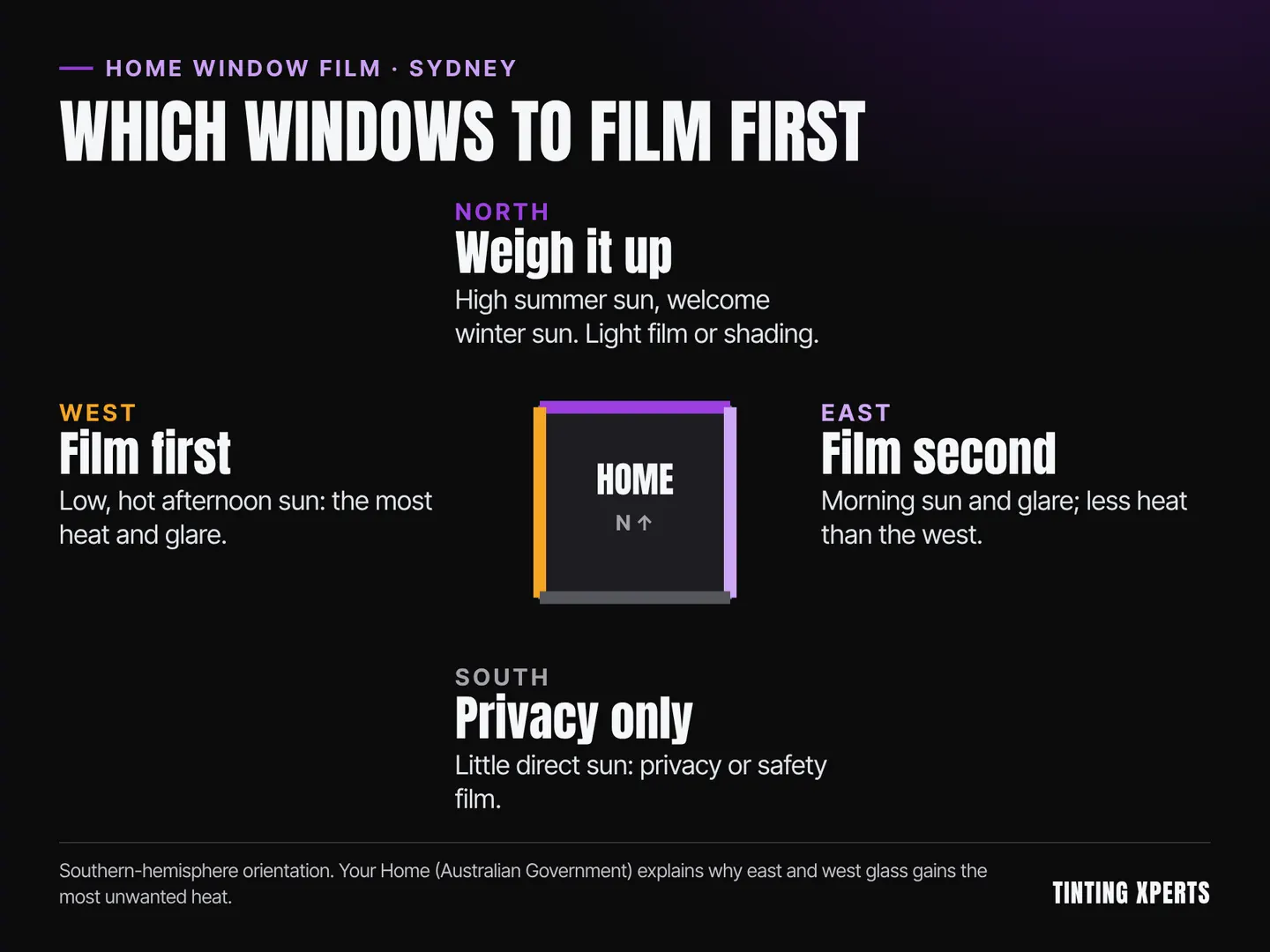
In Sydney, the direction a window faces decides most of what it needs. Two identical panes on opposite sides of the house can want completely different films, or one may want none at all. Start with the windows that cause the problem, not with the whole house.
West-facing windows
These take the low, hot afternoon sun, and they're the usual reason people book. Bedrooms on the west side stay warm long after sunset because the walls and furniture have soaked up heat all afternoon. A strong solar control film here makes the most noticeable difference in the house.
East-facing windows
East glass gets morning sun that is lower and brighter than it feels. It glares across breakfast benches and home-office screens. A film aimed at glare, rather than maximum heat rejection, often suits these rooms best.
North-facing windows
North is a judgement call. The summer sun is high and partly blocked by eaves, while the winter sun comes in low and warms the room for free. A light, clear-looking film keeps most of that winter warmth; a dark film throws it away. Some north windows are better left alone.
South-facing windows
South glass rarely gets direct sun in summer, so heat film earns little here. When we film a south window it's usually for privacy from a neighbour or for safety on an old, low pane.
Faded floors, furniture and artwork
Fading is slow, so people notice it late: a rug that's lighter on one half, a timber floor with a pale band in front of the sliding door, a print that has lost its reds. Ordinary house glass lets a good share of ultraviolet through, and ultraviolet is a big part of the cause.
Almost any quality window film filters most of that UV, including films that look nearly clear. That's useful when the glass faces a view you don't want to dim. Visible light and heat also play a part in fading, so a film slows it down rather than stopping it. Rotating rugs and closing the curtains in peak sun still helps.
Privacy by day and after dark
Privacy is where we see the most disappointment from films chosen online, because the two main privacy films behave very differently once the sun goes down.
Reflective film works like a one-way mirror only while it's brighter outside than in. During the day you see out and the street sees a reflection. At night, with the lamps on, the effect reverses and the room is on show again.
Frosted and patterned film blurs the glass instead. It works around the clock, still lets daylight in, and suits bathrooms, ensuites, toilets, front-door sidelights and any pane that faces a close neighbour. The cost is the view: you can't see out clearly either.
A frosted band at eye height, with clear glass above, is a popular middle ground. You keep the sky and the light, and the people walking past see nothing of the room.
Frosted, decorative and safety film
Frosted and decorative film
Frosted film gives the look of sandblasted or acid-etched glass for a fraction of the disruption, and it can come off later if you change your mind. Decorative films add lines, gradients or patterns. Both are cut to each pane, so a band can sit at a precise height across a run of windows and line up from one to the next.
Safety and security film
Older homes often have plain glass in places a newer build would use safety glass: low windows, glass doors, panels beside a staircase. Safety film is a thicker, clear film that holds the pieces together if the pane breaks, which matters most where children run and play.
It also slows someone trying to break in, because a filmed pane doesn't simply fall out when it's hit. Treat that as a delay, not a guarantee; it doesn't make a window burglar-proof. Many safety films can be combined with solar control, so one film handles heat and breakage on the same glass.
Home window film types compared
Most homes end up with a mix. Here's how the main types compare, so you can see which job each one does before we visit.
| Film type | Main job | How it looks | Private at night? | Typical rooms |
|---|---|---|---|---|
| Spectrally selective (clear-look heat film) | Heat and UV with little change in daylight | Close to clear | No | Living areas with a view, north glass |
| Neutral solar control | Heat and glare | Lightly to moderately tinted | No | West and east bedrooms, home offices |
| Reflective (one-way) | Heat, glare and daytime privacy | Mirror-like from outside by day | No, it reverses | Street-facing rooms with blinds for night |
| Frosted or patterned | Privacy at any hour, light kept | Translucent, like etched glass | Yes | Bathrooms, sidelights, glass doors |
| Safety and security | Holding broken glass together | Clear, or with a solar tint | No | Low panes, glass doors, older homes |
Shade numbers on film samples describe how much visible light gets through, not how much heat is rejected. Our guide to window tint percentages explains how those numbers work; on a house, we choose the film's heat and glare performance first and the shade second.
Before the film goes on: glass, double glazing and approvals
A good installer asks questions before quoting. These are the ones we work through, and the reasons they matter.
What glass do you have?
Film changes how much heat the glass absorbs. On some glass, the wrong film can make the pane run hot enough to crack, especially large panes, tinted glass and glass partly shaded by an eave. We identify the glass and pick a film its maker approves for it. Wired glass and textured glass need particular care, and some need a film made for the outside face.
Can you tint double-glazed windows?
Often, yes, but not with every film. A double-glazed unit traps heat between its panes, so a film that absorbs a lot of heat can stress the seal or the inner glass. We choose a film rated for insulated glazing and check the window maker's warranty terms first. Sometimes the honest answer is that the unit already does the job and film adds little.
Strata, rentals and the look from the street
Bring any colour or reflectivity rules from your strata to the quote. A neutral, low-reflective film is usually the easiest kind to get approved.
Your install day
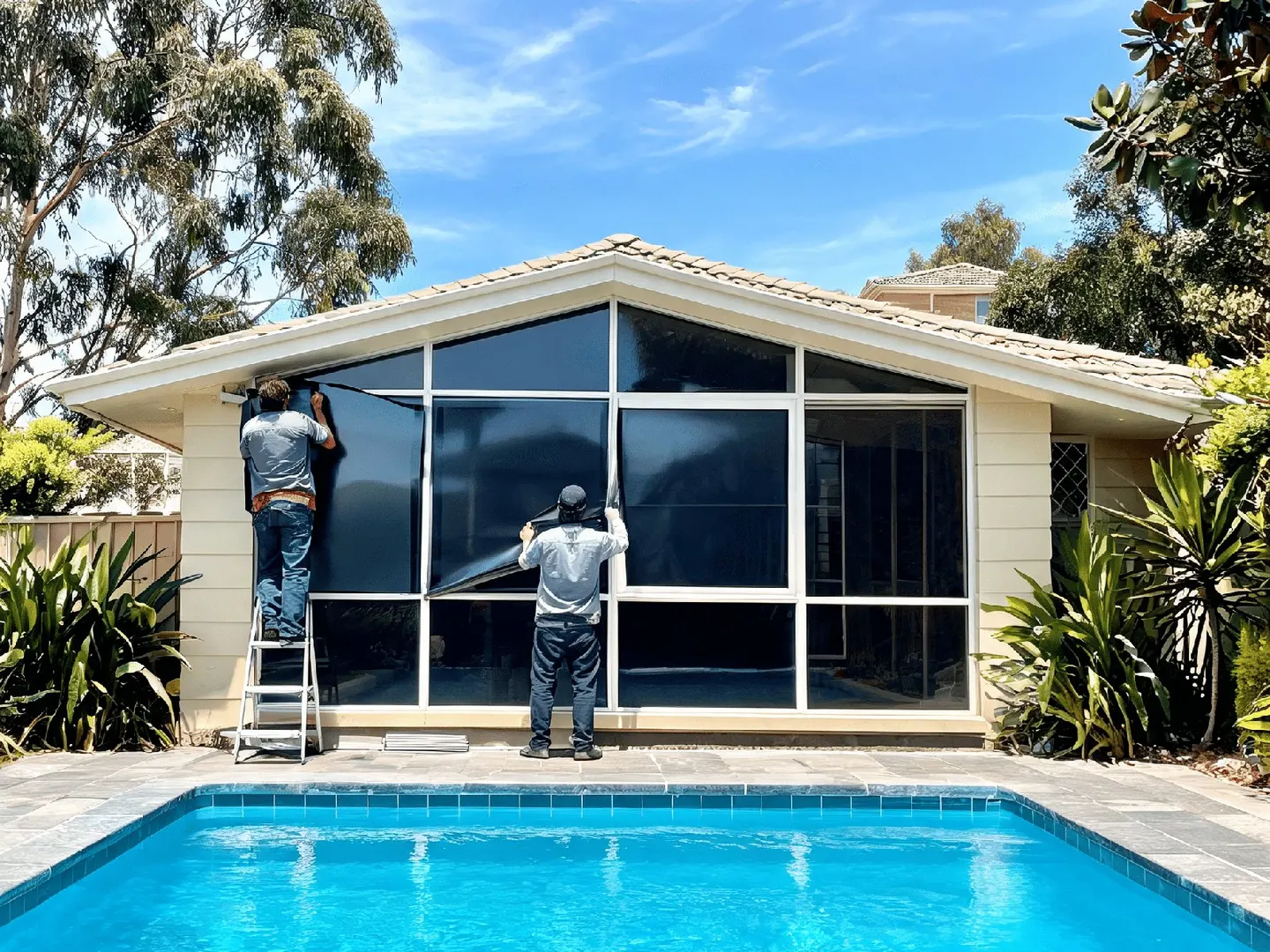
Home film is fitted on site, from inside the house. Here's what happens from the moment we arrive.
Walk-through and final check
We confirm each window, the film going on it and where any frosted band will sit. If something has changed since the quote, such as a new blind bracket, we sort it out before cutting anything.
Protect and clean
Furniture is moved back from the glass, and floors, sills and frames are covered. Every pane is washed and scraped so no dust or paint flecks end up trapped under the film.
Cut, fit and squeegee
Film is cut to each pane, laid onto wet glass, positioned and squeegeed firmly to push the water out. Edges are trimmed with a fine, even gap to the frame.
Inspect and hand over
We check every pane in daylight, put the room back as we found it and talk you through the drying period and cleaning.
Fresh film can look slightly hazy or show small water pockets while the moisture behind it dries. That clears on its own, more slowly in cool weather and on shaded windows. The process is the same one our guide on how long window tint takes to cure explains for cars; at home, there are no windows to keep up, just glass to leave alone.
Caring for home window film
Indoor film is protected from rain and wind, so it lasts for many years with very little care. Most damage comes from cleaning it the wrong way.
Leave it alone while it dries. Don't clean the filmed side until the haze has gone.
Use a soft cloth or a rubber squeegee, with water and a drop of mild detergent.
Skip ammonia and abrasives. No scourers, razor blades or powdered cleaners on the film.
Watch hooks and tape. Suction cups, stickers and tape on the film can lift or mark it.
Tell your window cleaner which panes are filmed before their next visit.
What decides the cost of tinting your home
We don't publish prices, because two homes are never the same job. These are the things that move a home quote up or down:
How much glass: the total area, and how many panes it's split into. Many small panes take longer than a few large ones.
The film: clear-look heat film, neutral solar film, frosted, decorative and safety film are all different products.
Access: high windows, stairwell glass, skylights and second-storey panes take more time and equipment.
Very large panes: big sliding doors and floor-to-ceiling glass need two installers and careful handling.
Old film: failed or bubbled film has to be stripped and the glue cleaned off first.
Frosted designs: bands, cut-outs and patterns add cutting time.
Send us photos of the windows, which way they face and what bothers you about each room. We'll reply with a written quote, and visit to measure where the job needs it.
Why Sydney homeowners book Tinting Xperts
Tinting Xperts was founded in 2016 and has grown to more than 30 fitters across two workshops. Our fitters cut, clean and squeegee film every working day, and that care shows on a big pane of house glass as much as on a car door. Every quote is in writing before work starts.
Talk to us at the Revesby workshop or the Condell Park workshop, or send us your windows and rooms for a quote. Running a business as well? Our commercial window tinting covers offices and shopfronts, and the guide to office window film explains the options for workplaces.

Our service
Commercial window tinting puts film on the glass your business already has: solar film to take heat and glare off desks, frosted film for meeting rooms, safety and anti-graffiti film for shopfronts, and graphics for your brand. We plan the install around your trading hours and quote in writing first.
While you're thinking about heat, the car parked in the driveway gets the same afternoon sun. Our car window tinting keeps the cabin cooler, with film cut to your make and model.
See some of our work: photos of a few cars we’ve finished
Areas we serve
Residential Window Tinting near you
Customers come to whichever of our two workshops is closer. Pick your suburb for the nearest one and local work.
Questions
Residential Window Tinting: common questions
Will window tint make my house dark?
Not if the film is chosen well. Clear-look heat films reject a lot of solar heat while changing the daylight very little. Darker films are only needed where glare or daytime privacy is the main problem.
Can I see out of tinted house windows at night?
With a light or clear-look film, the view out at night is much the same as before. Reflective film makes the glass act like a mirror from the brighter side, so at night you may see your own reflection more than the garden.
Does home window film work in winter too?
A heat-rejecting film also blocks some of the welcome winter sun. That's why we often suggest a lighter film, or none, on north-facing glass. Rooms that mainly overheat in summer usually benefit year-round.
Can window film go on the outside of the glass?
Some glass, such as textured panes and some louvres, can only take a film made for the outside face. Exterior films are built for the weather but generally don't last as long as interior film. They're used only where an interior film won't work.
Is window film a good alternative to double glazing?
They do different jobs. Double glazing mainly slows heat moving through the window in both seasons, while film mainly cuts incoming sun, glare and UV. Film is far less disruptive and suits homes where replacing windows isn't practical.
Can old window film be removed and replaced?
Yes. We peel the old film, remove the leftover adhesive and clean the glass before new film goes on. Removal is quoted separately because badly aged film can take a while to come off.
Do you tint windows in apartments and townhouses?
Yes, as long as you have the approvals you need. Get written consent from the owners corporation or landlord first, especially for film that changes how the glass looks from outside.
Does window film stop condensation on my windows?
No. Condensation comes from moist indoor air meeting cold glass, and a solar film doesn't change that much. Better ventilation or a different glazing system addresses condensation.
How do I get a quote for my home?
Send us photos of the windows, which way they face and what bothers you about each room. We'll come back with a written quote, and arrange a visit to measure where it's needed.
Guides
Read before you book
Plain-English guides on residential window tinting, from the people who fit it.
Guide · Home & Commercial Film
Home window tinting benefits: what film really does for your house
What window film does for heat, glare, fading, privacy and broken glass in an Australian home, where it falls short, and how to choose it room by room.
· 12 min read

Guide · Home & Commercial Film
Office window film: glare, heat, privacy and safety for your workplace
How film on existing office glass cuts screen glare and afternoon heat, adds privacy to meeting rooms, holds broken glass together, and goes on without closing the office.
· 10 min read

Visit us
Two workshops, one team
Tinting Xperts Revesby
Unit 28/172 Milperra Road, Revesby NSW 2212
Mon – Sat · 9:00am – 5:00pm
Tinting Xperts Condell Park
141 Eldridge Road, Condell Park NSW 2200
Mon – Sat · 9:00am – 5:00pm
Reviewed by Mohammad Habboushi, Founder.